Eurosatory 2026: What has become of the Main Ground Combat System?
An artistic rendering of the MGCS concept. (Image: KNDS)
The Main Ground Combat System has had a troubled life. With repeated delays and competition on the horizon, the programme may be approaching the end of the road.


With the recent confirmation that the Future Combat Air System (FCAS) has been cancelled, attention is now turning to the other flagship programme of Franco-German cooperation: the Main Ground Combat System (MGCS). Previous editions of Eurosatory have provided new updates on the programme, and Eurosatory 2026 may shed some light on a venture that appears to be trapped in perpetual limbo.
Launched in 2018 as an effort to develop a next-generation main battle tank (MBT) and a family of supporting vehicles, MGCS was intended to deepen defence industrial cooperation between France and Germany, while also providing the countries with a replacement for their existing vehicle fleets.
Envisaged as a system of systems, MGCS was to encompass a new MBT with enhanced firepower over the existing Leclerc and Leopard 2. This new MBT would be accompanied by supporting vehicles that could perform various specialist tasks, with an armoured personnel carrier (APC), infantry fighting vehicle (IFV) and counter-uncrewed aerial system (CUAS) platform all proposed.
Related Articles
Rolls-Royce to lead powertrain development for MGCS in important step for the programme
Europe’s future tank hits targets as MARTE programme gains momentum
FCAS future fighter jet collapse: where does Europe’s next-generation air power go next?
These vehicles would share a common chassis and digital architecture, allowing them to operate as an integrated network. Additional elements, such as crewed-uncrewed teaming (CUC-T), were also evaluated for inclusion.
Originally slated to enter service in 2035, with full operational capability by 2040, the programme has been repeatedly delayed, with deliveries now unlikely to take place until 2045 at the earliest, if at all.
Since the outset, the programme has been beset with repeated delays. Reportedly, this was due to considerable disagreement between the two partner nations, something which industry insiders have confirmed to Shephard. These disagreements resulted in the programme’s timeline repeatedly slipping and deadlines being missed.
For instance, a technology demonstrator was originally planned to have been completed by 2025. However, the agreement to actually produce one was only signed in January 2025, with no sign that it will be forthcoming in the near future.
MGCS also seems to have been overly ambitious, with the more complex technical aspects having caused delays. While CUC-T is being increasingly discussed today, in 2018 the technology was more conceptual than practical, hampering efforts to include it in the programme.
Competitors and quiet quitting
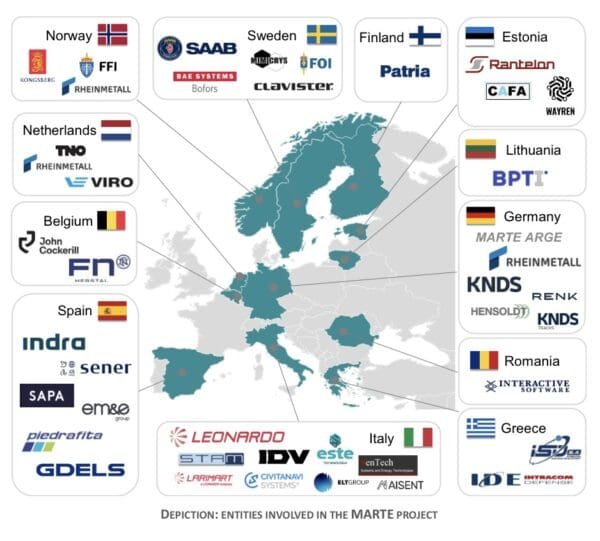
These delays and disagreements have left the programme’s future in doubt. This is reinforced by the fact that in July 2025 KNDS and Rheinmetall announced the creation of the Main ARmoured Tank of Europe (MARTE). MARTE brings together 12 European countries, led by Germany, to develop a next-generation MBT. Notably, the programme does not include France. It also appears to have learned from MGCS and is focused solely on a new MBT.
This was followed by an announcement in December 2025 that Projekt System & Management GmbH (PSM), the joint venture between Rheinmetall and KNDS established to produce the Puma IFV, would expand its focus to include the development of a new MBT. Despite claiming that this is an interim solution until MGCS can commence deliveries, this does appear to resemble preparations for the end of the MGCS programme.
Furthermore, earlier this year French Armed Forces Minister Catherine Vautrin stated that France may need to seek an interim MBT solution to bridge the gap between the Leclerc XLR and MGCS. Given the programme’s uncertainty, however, an interim solution may ultimately become a permanent solution.
Officially, the future of MGCS remains under review. In October 2025, French President Emmanuel Macron confirmed that he and his German counterpart, Friedrich Mertz, had instructed their respective Defence Ministers to review the status of MGCS and decide on whether to progress by the end of the year. However, the results of this review have not been disclosed, and MGCS has continued to stutter on.
Given that Germany is now actively evaluating alternatives, and France has admitted it may need to find something else, it is quite possible that MGCS will not officially be cancelled; it could simply continue rolling forward slowly until it is eventually overtaken by competing platforms and quietly forgotten.
Related Programmes in Defence Insight
Main ARmoured Tank of Europe (MARTE) [Germany]
Related Equipment in Defence Insight



More from Eurosatory 2026
-
![Eurosatory 2026 roundup: uncrewed, counter-uncrewed and new vehicles define direction]()
Eurosatory 2026 roundup: uncrewed, counter-uncrewed and new vehicles define direction
Uncrewed and counter-uncrewed systems were a major feature of this edition of Eurosatory 2026 along with programme updates and first sight of new main battle tanks.
-
![Eurosatory 2026: Iran’s attacks on UAE have “accelerated” Edge’s plans, says company]()
Eurosatory 2026: Iran’s attacks on UAE have “accelerated” Edge’s plans, says company
The UAE’s Edge has undergone massive changes since it was formed in 2019, from acquisitions to partnerships, and has now set up a European division in Paris.
-
![Eurosatory 2026: As MGCS stalls, has Europe’s new MBT been unveiled?]()
Eurosatory 2026: As MGCS stalls, has Europe’s new MBT been unveiled?
Eurosatory 2026 saw a number of main battle tanks on display, including two new platforms which could be the future of European tanks.
-
![Eurosatory 2026: MARSS and parent company EOS expand air defence capability]()
Eurosatory 2026: MARSS and parent company EOS expand air defence capability
MARSS became part of EOS Defence earlier this year, bringing together the former’s C2 NiDAR and Nation Shield air defence products with the latter’s suite of effectors and sensors.
-
![Eurosatory 2026: Wartime iteration gives Ukraine an edge as future UAV exporter]()
Eurosatory 2026: Wartime iteration gives Ukraine an edge as future UAV exporter
As industrial-scale drone production proves its battlefield worth in Ukraine, what happens to that production capacity and knowhow once the guns fall silent – and is Ukraine about to become one of the world’s most credible UAV export partners?
-
![Eurosatory 2026: Pearson Engineering to send AI mine detecting systems into Ukraine]()
Eurosatory 2026: Pearson Engineering to send AI mine detecting systems into Ukraine
Pearson Engineering’s Threat-Sense system is designed to use imaging from drones to geolocate scattered mines and support uncrewed systems in defeating the threats.