“Timelines are measured in seconds”: tackling the UAS threat with dispersed defences
Small uncrewed aerial systems (UAS) have transformed the battlespace, posing a complex threat across all domains. Militaries now need counter-UAS (CUAS) capabilities that defeat the danger while meeting demands around readiness, manoeuvrability and adaptability, according to Mike Spina, Director, Global Sales and Business Development for Targeting and Sensor Systems (TSS) at L3Harris Technologies.


This In Conversation interview is brought to you by Shephard in partnership with L3Harris Technologies.
As seen in the wars in Ukraine, the Middle East and beyond, Group 1-3 UAS – including one-way attack systems – can be deployed with minimal operator training and launched with very little signature. This means the CUAS challenge has been compressed in both cost and timeline, Spina noted.
“Engagement timelines are short, often measured in seconds once detected,” he said.
In this landscape, manoeuvre forces or forward sites need persistent local defence with minimal setup time, Spina said, moving beyond traditional approaches. “Reliance on higher-tier air defence or centralised assets leaves gaps, particularly against low-altitude threats,” he explained.
Gaps in defences
Many forces today have radars and interceptors that are effective against larger or higher-altitude threats. However, there is a common gap in these networks: engagement against low-altitude UAS with a hard-to-detect radar cross-section (RCS). This is particularly challenging in cluttered environments, especially when forces are dispersed.
The sheer volume of low-cost, attritable drones also creates a mismatch in sustainable engagement capacity, Spina added, with units encountering multiple small UAS over time. They need systems that can “maintain readiness, reload quickly and operate without a large logistics footprint,” he said.
To meet these needs around flexibility and readiness, CUAS equipment must be highly mobile and simple to deploy. “The requirement is for systems that can move with the force and be repositioned without engineering work or specialised integration,” Spina said.
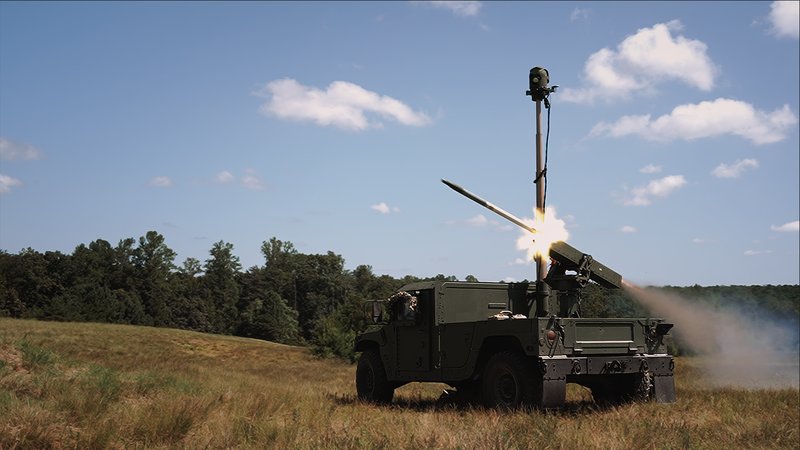
L3Harris developed the Vehicle-Agnostic Modular Palletised ISR Rocket Equipment (VAMPIRE) system with these needs in mind. A self-contained, multi-mission, low-cost, precision-guided weapons platform, VAMPIRE is designed to deploy on almost any vehicle or static mount across domains and is capable of firing a variety of effectors, such as the AGR-20A Advanced Precision Kill Weapon System (APKWS).
VAMPIRE aims to meet military needs with minimal integration demands, mounting onto existing tactical vehicles using a flatbed or palletised interface. It brings together a launcher, sighting system and fire control in a single package.
“From a unit perspective, it behaves like an organic weapon system rather than supporting equipment,” added Spina. “This allows commanders to position coverage based on terrain, threat avenues and mission phase, instead of where fixed systems happen to be located.”
Self-contained capability
With VAMPIRE, L3Harris has focused on developing a deployable capability that can operate at the unit level, explained Spina. “It provides a stabilised precision fires capability with its own targeting system, so the unit does not depend on external cueing to act,” he added.
Despite this self-contained nature, the system can operate within a broader C2 architecture, Spina stressed. This “allows end users the flexibility to employ the CUAS system in a manner that best fits current operational demand,” he noted.
Crucially, the integration requirement is minimal; power and mounting are the primary considerations. In most cases, the system can be installed and made operational in a short period of time, assuming a suitable vehicle or mounting point is available.
“There is no requirement for deep vehicle integration or modification of core systems. In the field, the system can be mounted and set up by two operators within an approximate two-hour window, which highlights its agility,” Spina emphasised.
Continuity of operations
This approach offers a range of advantages. Spina used the example of a logistics node or forward arming and refuelling point within range of a small UAS attack. Without an organic CUAS capability, such sites depend on early warning and external support, which can introduce delays and expose vulnerabilities.
“Even a small UAS can disrupt operations if it reaches the site,” he warned.
But with VAMPIRE deployed locally, the unit can detect, track and engage within its own perimeter, he said. The engagement happens inside the threat’s terminal phase, “which is where timing matters most. The result is continuity of operations under repeated low-level attack.”
This is just one of many potential applications, noted Spina. There could be similar benefits for border security and patrol missions, he added; with VAMPIRE, “a UAS threat can be detected and engaged before it crosses an international line.”
Conserving resources
In a battlespace increasingly defined by large volumes of small, low-cost drones, it is now essential to ensure the effector matches the threat, both in terms of capability and cost-per-shot. The calculation is driven by target size, speed and the engagement window, said Spina, noting that for small UAS, “miss distance and reaction time are more limiting factors than raw intercept range.”
VAMPIRE can use laser-guided 70mm rockets, which provide a controlled engagement geometry and a high first-shot probability against manoeuvring targets, he added. The guidance method allows for correction during flight, an important capability when engaging small, agile systems.
This functionality also provides vital advantages from a resources perspective, meaning highly valuable systems are not expended against numerous low-cost threats.
“From a cost perspective, this sits in a sustainable bracket for repeated engagements, particularly against one-way UAS,” Spina explained. “It allows units to engage without exhausting higher-cost interceptors intended for more complex threats.”
Effective detection
While engagement is a crucial priority, it is also vital to effectively detect threats, a capability that relies on the right combination of sensors. Detection is the limiting factor in most engagements, explained Spina, with small UAS presenting challenges in both the radar and visual domains.
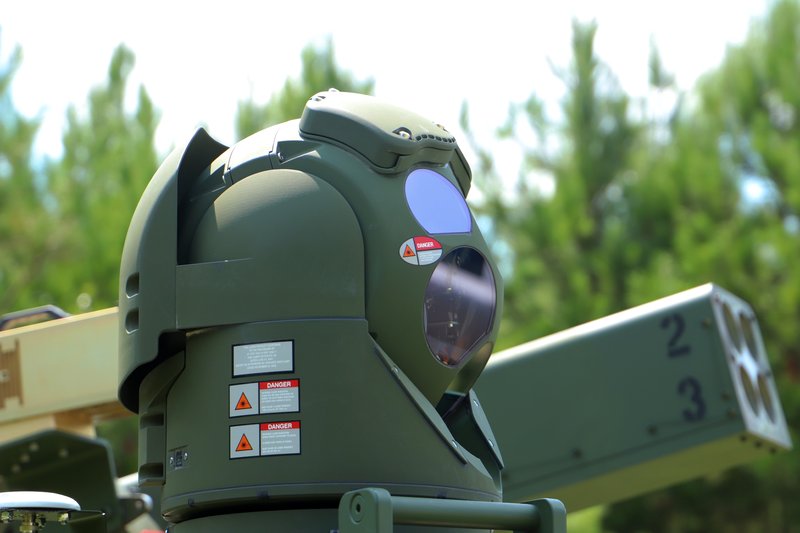
To meet the challenge, VAMPIRE incorporates a WESCAM MX-series® electro-optical/infrared (EO/IR) targeting system with laser designation, he said, which supports identification and engagement once the target is acquired. This is typically an MX-10D RSTA or MX-15D RSTA, systems designed specifically to counter uncrewed systems.
However, adaptability is important here, too: VAMPIRE is not tied to any single sensor solution, Spina stressed.
“It can accept cues from other sensors – such as radar – and then complete the engagement cycle. That keeps it usable across different force structures and sensor mixes,” he said.
Supporting the end user
CUAS must also adapt to the needs of its users, including operators who may not be experienced in the area. In an increasingly congested battlespace, “operator workload is a key factor,” said Spina. The system must support rapid target acquisition and engagement under time pressure, often by personnel without an air defence background.
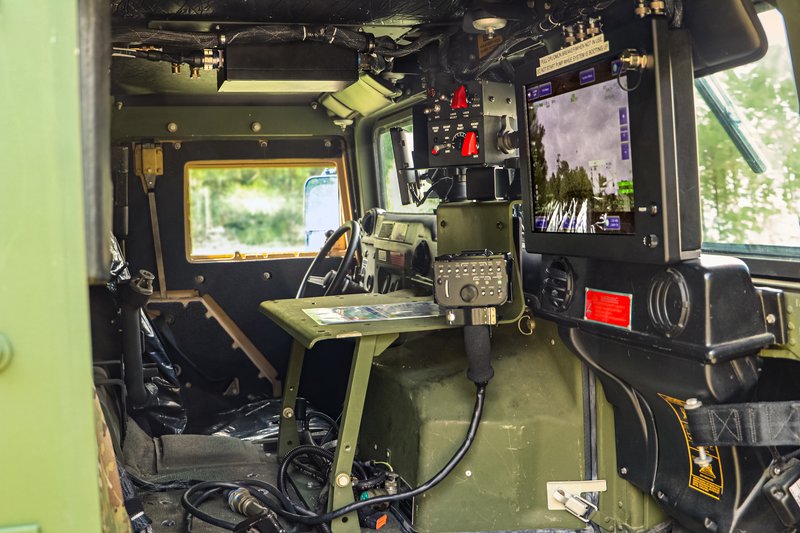
To minimise workload, VAMPIRE uses stabilised optics, automated tracking and a simplified control interface via L3Harris’ Widow mission management software, reducing the number of steps in the engagement sequence. “Training focuses on recognition, engagement authority and system handling rather than complex system management,” he added.
For industry, the requirement is to deliver systems that can be learned quickly and allow operators to retain proficiency, without demanding extensive sustainment training. The aim with VAMPIRE is that “the more operators use the system, the more intuitive it becomes, magnified by new AI tracking, identification and targeting tools that will continue to improve and alleviate operational burden.”
Adapting to future threats
As the danger from small UAS evolves at a rapid pace, adaptability in both software and interfaces is crucial, said Spina. CUAS systems must have the ability to accept new inputs and support different engagement methods without redesign.
With VAMPIRE, the system’s modularity helps ensure this adaptability, said Spina. This aspect has been demonstrated through the integration of different kinetic effectors, including APKWS and Thales’ FZ275 laser-guided rocket.
“New EW effectors or drone-on-drone interceptors will give operators increased options to engage depending on the threat,” he added.
Future CUAS success will depend on interoperability and integration, Spina argued. Interoperability allows VAMPIRE to connect with the broader air defence ecosystem deployed by joint forces, while incorporating sensors, C2 systems and effectors through open architectures.
Integration is what turns these individual technologies into a responsive weapon system, added Spina. By designing VAMPIRE with a modular open systems approach (MOSA), “we reduce the time and complexity required to introduce new capabilities. This ensures that operators can rapidly adopt emerging technologies without redesigning the platform.”
The threat from small UAS is only set to expand in the coming years. The direction of travel points towards higher-density attacks and greater autonomy at platform level, warned Spina, an evolution that will place further pressure on detection, tracking and engagement timelines.
“For systems like VAMPIRE, the focus is on increasing engagement efficiency per operator, improving integration with sensor networks for faster cueing, and maintaining compatibility with new effectors as they become available,” he concluded.




More from Industry Spotlights
-
![Orchestrating operational readiness across every defence domain]()
Orchestrating operational readiness across every defence domain
Are all systems ready for the next mission? Have upgrades been applied? Are all assets aligned to deploy together, on time and fully prepared? In modern defence operations, readiness is no longer measured platform by platform. It is measured by how well people, assets, data and decisions move together — across land, sea and air.
-
![Extending mission readiness: where XR adds real value in pilot, crew and maintenance training]()
Extending mission readiness: where XR adds real value in pilot, crew and maintenance training
Extended reality (XR) is becoming increasingly relevant in military aviation training, adding a flexible layer to an integrated ecosystem spanning the pilot, crew, and maintenance domains.
-
![Dominating the spectrum: ASELSAN’s EW capabilities take center stage at MSPO 2026]()
Dominating the spectrum: ASELSAN’s EW capabilities take center stage at MSPO 2026
ASELSAN is showcasing its advanced electronic warfare (EW) capabilities at MSPO 2026, highlighting technologies designed to detect, analyse, disrupt and deceive threats across increasingly contested electromagnetic environments.
-
![“Creating a decision advantage”: how C-UAS is evolving to reduce the operator burden]()
“Creating a decision advantage”: how C-UAS is evolving to reduce the operator burden
In Conversation… Speaking to Shephard’s Gerrard Cowan, Dr Brian Shand, Director – Advanced Concepts & Technology at L3Harris, explains how, as operators face growing numbers of low-cost drones, C-UAS providers must focus on reducing operator workload, transforming fragmented sensor data into effective decision-making.
-
![Shield the warfighter, win the fight (video)]()
Shield the warfighter, win the fight (video)
BAE Systems’ Intrepid Shield™ approach delivers full-spectrum electromagnetic protection to detect, exploit, and counter advanced threats.
-
![How joint ventures are expanding Rheinmetall's munitions portfolio (video)]()
How joint ventures are expanding Rheinmetall's munitions portfolio (video)
Roman Köhne, CEO of Rheinmetall's Weapon and Ammunition Division, discusses the company's announcements at Eurosatory 2026, including developments in defence technology, precision systems, industrial partnerships and future capability programmes.