Eurosatory 2026: European cooperation drives TRACKX programme towards production
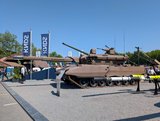
At Eurosatory, the TRACKX vehicle was displayed with Patria’s 120mm NEMO mortar turret, demonstrating one potential operational configuration. (Photo: author)
Finland and Sweden have advanced the Common Arctic Mobility programme, highlighting how multinational funding and industrial cooperation are becoming increasingly important to European defence capability development.


European efforts to strengthen defence-industrial cooperation received a boost at Eurosatory 2026 with the signing of an implementation agreement for the Common Arctic Mobility (CAM) programme.
The agreement, signed at the event in Paris by Lt Gen Jari Mikkonen, chief of staff for armament and logistics of the Finnish Defence Forces, and Brig Gen Jonas Lotsne, director of the land systems department at the Swedish Defence Materiel Administration (FMV), enables further technology cooperation on the pre-series development of the TRACKX all-terrain vehicle (ATV).
Developed by Patria as part of the earlier FAMOUS (European Future Highly Mobile Augmented Armoured Systems) initiative but subsequently renamed TRACKX, the programme is backed by the European Defence Fund (EDF) and has involved around 20 countries and more than 50 defence companies in a major European collaborative land systems project.
Related Articles
DSEI 2025: Patria’s FAMOUS becomes TRACKX with production ready before end of 2027
The programme reflects a broader shift across Europe towards collaborative capability development as governments seek to accelerate procurement, strengthen sovereign industrial capacity and reduce dependence on non-European supply chains.
TRACKX evolved from the FAMOUS concept demonstrator first unveiled at Eurosatory and has since progressed through a series of technology test-bed vehicles. These have undergone trials in a range of operating environments, including snow, sand, forests, swamps and paved surfaces, leading to the development of additional prototype vehicles incorporating lessons learned from earlier testing.
The project received further momentum in April when the EDF approved funding for the third phase of development.
According to programme information released at Eurosatory, the initiative has received €79 million in EDF funding as part of a wider €115 million programme. Participating countries and industry partners have contributed a further €20 million.
With its wide composite rubber tracks the TRACKX has a very high level of mobility, especially in marginal terrain and its design is such that it can be used for a wide range of battlefield missions, including as an armoured personnel carrier (APC), and can accommodate a wide range of weapons such as remote weapon stations (RWS), and turrets armed with machine guns (MG) and cannon.
At Eurosatory, the vehicle was displayed with Patria’s 120mm NEMO mortar turret, demonstrating one potential operational configuration.
Adapting for the modern battlefield
The programme is also evolving to address growing interest in uncrewed and optionally crewed land systems. At Eurosatory, Patria and German drive train specialist RENK unveiled a next-generation heavy uncrewed ground vehicle (UGV) concept based on the TRACKX platform.
The demonstrator combines the TRACKX vehicle with RENK’s HSWL 076 transmission and drive-by-wire architecture, highlighting how technologies developed under collaborative European programmes could support future autonomous and remotely operated capabilities.
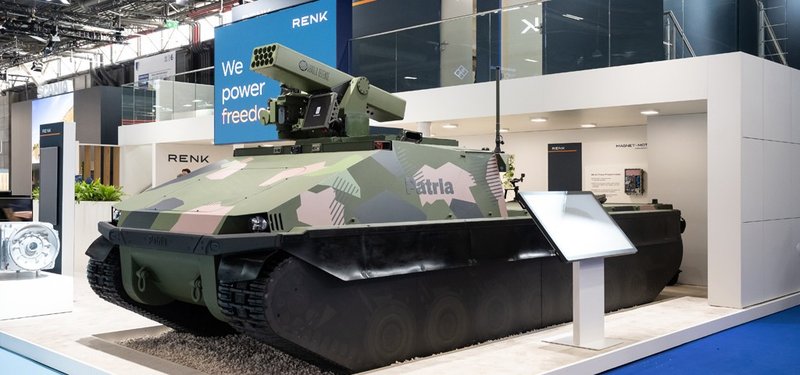
The companies said recent conflicts, particularly the war in Ukraine, have reinforced the importance of reducing crew exposure while maintaining mobility, protection and mission effectiveness.
The programme is also intended to address future mobility requirements in northern and Arctic environments, where tracked vehicles retain significant advantages over wheeled platforms because of their lower ground pressure and improved performance in difficult terrain.
While many European armies continue to modernise their fleets of 6x6 and 8x8 armoured vehicles, TRACKX highlights continuing demand for specialised tracked platforms capable of operating in extreme conditions.
According to Patria, serial production is scheduled to begin in 2027, with additional countries able to join the programme as development progresses.
As European governments continue to increase defence spending and place greater emphasis on industrial resilience, programmes such as CAM are becoming an increasingly important example of how multinational funding, shared research and collaborative procurement can accelerate capability development while supporting broader European efforts to strengthen defence capability and industrial resilience.
The addition of uncrewed and autonomous concepts to the TRACKX programme also illustrates how European industry is seeking to balance immediate capability requirements with longer-term investments in future battlefield technologies.
Related Programmes in Defence Insight
Tracked APC/IFV Replacement [Finland]
Related Equipment in Defence Insight


More from Eurosatory 2026
-
![Eurosatory 2026 roundup: uncrewed, counter-uncrewed and new vehicles define direction]()
Eurosatory 2026 roundup: uncrewed, counter-uncrewed and new vehicles define direction
Uncrewed and counter-uncrewed systems were a major feature of this edition of Eurosatory 2026 along with programme updates and first sight of new main battle tanks.
-
![Eurosatory 2026: Iran’s attacks on UAE have “accelerated” Edge’s plans, says company]()
Eurosatory 2026: Iran’s attacks on UAE have “accelerated” Edge’s plans, says company
The UAE’s Edge has undergone massive changes since it was formed in 2019, from acquisitions to partnerships, and has now set up a European division in Paris.
-
![Eurosatory 2026: As MGCS stalls, has Europe’s new MBT been unveiled?]()
Eurosatory 2026: As MGCS stalls, has Europe’s new MBT been unveiled?
Eurosatory 2026 saw a number of main battle tanks on display, including two new platforms which could be the future of European tanks.
-
![Eurosatory 2026: MARSS and parent company EOS expand air defence capability]()
Eurosatory 2026: MARSS and parent company EOS expand air defence capability
MARSS became part of EOS Defence earlier this year, bringing together the former’s C2 NiDAR and Nation Shield air defence products with the latter’s suite of effectors and sensors.
-
![Eurosatory 2026: Wartime iteration gives Ukraine an edge as future UAV exporter]()
Eurosatory 2026: Wartime iteration gives Ukraine an edge as future UAV exporter
As industrial-scale drone production proves its battlefield worth in Ukraine, what happens to that production capacity and knowhow once the guns fall silent – and is Ukraine about to become one of the world’s most credible UAV export partners?
-
![Eurosatory 2026: Pearson Engineering to send AI mine detecting systems into Ukraine]()
Eurosatory 2026: Pearson Engineering to send AI mine detecting systems into Ukraine
Pearson Engineering’s Threat-Sense system is designed to use imaging from drones to geolocate scattered mines and support uncrewed systems in defeating the threats.