Can the US Navy afford its plans to operate a manned/unmanned fleet?
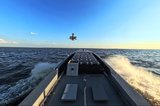
Boeing XLUUV/Orca performs at-sea mission sorties along the California coast. (Photo: Boeing)
Budgetary constraints and the annual procurement rate could impact the branch’s intention to have a hybrid fleet.


The US Navy (USN) could face obstacles in accomplishing its plans to operationally integrate robotic and autonomous systems into its fleet by 2027, with a fleet of 134 large unmanned surface and underwater vehicles by 2054, as the branch’s Navigation Plan 2024 and the FY2025 Annual Long-Range Plan for Naval Vessel Construction stated.
The main challenge will be funding efforts to rapidly develop, evaluate and acquire unmanned surface vehicles (USVs) and unmanned underwater vehicles (UUVs).
In its FY2025 budget request, the branch proposed more than US$32 billion for shipbuilding investment, which included the purchase of six manned battle force ships.
Our news & analysis is now part of Defence Insight®
A Basic-level or higher Defence Insight subscription is now required to view this content.

More from Naval Warfare
-
![German Navy’s Israeli missile test points to deepening defence-industrial ties]()
German Navy’s Israeli missile test points to deepening defence-industrial ties
The test-firing of an Israel Aerospace Industries LORA ballistic missile from a German vessel highlights the Bundeswehr’s focus on speed to capability as it trials Israel’s operationally proven technology.
-
![Global submarine suppliers compete for a rapidly shrinking market]()
Global submarine suppliers compete for a rapidly shrinking market
Diminishing submarine competitions worldwide are leaving fewer acquisition opportunities, pushing contractors toward alternatives.
-
![Melting ice is rewriting Arctic naval requirements]()
Melting ice is rewriting Arctic naval requirements
As the High North opens to shipping, navies face rising demand for icebreakers, ASW vessels, uncrewed systems and surveillance assets far beyond the submarine fleet.