Networked advantage: keeping unmanned systems in the loop with battlefield radio technology
Unmanned systems are powerful intelligence, surveillance and reconnaissance (ISR) assets and communication tools, but are often isolated from wider networks, limiting their potential. Industry is now tackling this challenge, empowering UxVs to act as integrated nodes across domains.


Brought to you in partnership with Bittium
As seen in the wars in Ukraine and the Middle East, UxVs have become a crucial factor on the battlefield. Because these proliferating platforms generate huge volumes of data, they require low-latency links for real-time transmission of mission information, and command and control (C2) and ISR applications, notes Sami Savolainen, product manager for the Tough SDR product family at Bittium.
Such demands are emerging against the backdrop of a rapidly evolving battlespace, he said. There has been a shift to highly distributed capabilities and multi-domain operations (MDO), alongside the network-centric approach.
The expanding volume of sensor data from UxVs – such as live video streams – is a crucial enabler in this new military landscape. “This is driving the demand for secure, adaptive and high-performance tactical networks,” Savolainen explained.
Bittium’s answer is Tough SDR Unmanned. Launched at Eurosatory 2026, this is a radio module designed for use in reusable, mid-size UxVs. The system integrates unmanned platforms into Bittium’s TAC WIN mobile ad-hoc network (MANET), offering the same performance as Bittium Tough SDR Handheld radios.
Because it is compatible with other Bittium tactical waveforms, Tough SDR Unmanned delivers seamless integration and unified communications with the wider network, including manned platforms and other unmanned assets.
This means UxVs no longer operate in isolation but form part of a wider self-forming and self-healing network, enabling jam-resistant, mission-critical communications in challenging operational environments.
Challenging scenarios
UxVs face a range of challenges in the evolving MDO battlespace, noted Savolainen. They must operate in beyond-line-of-sight, contested environments, demanding resilient connectivity even when exposed to jamming and other forms of RF interference.
Alongside robust encryption and other security measures, the network must have the ability to adapt to the dynamic conditions of the battlespace.
“A UAV could move hundreds of kilometres across the battlespace, so the communication solution requires you to adapt in real time,” he explained.
Bittium’s Tough SDR product suite is designed for this environment. Built on a secure, software-defined architecture, it supports the company’s broadband TAC WIN waveform among others and can integrate third-party waveforms as required, an essential capability for MDO.
“This sets it apart from traditional UxV radios, which are not usually very well integrated into tactical networks,” said Savolainen.
Range of missions
The technology transforms UxVs into nodes in a wider network, whether they are unmanned aerial vehicles (UAVs), unmanned ground vehicles (UGVs) or unmanned surface vehicles (USVs). This can enhance existing mission sets by improving reliability and data-sharing capabilities, Savolainen said.
It can also introduce new capabilities through a fully networked multi-UxV operation and distributed sensors, for example, helping to deliver a meshed UGV network to improve video and information sharing.
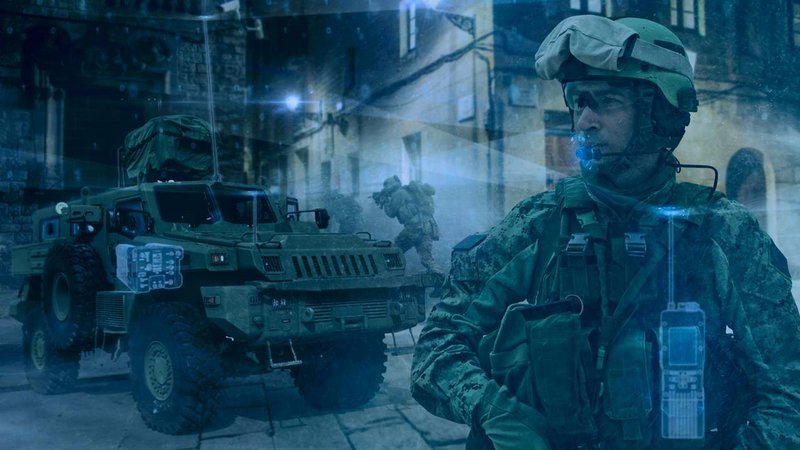
Importantly, users do not need to own or control the UxVs to benefit from the wider network: they can utilise video streams or other sensor data through the TAC WIN waveform.
“A forward observer or platoon leader could use the video stream or other sensor data through the TAC WIN network as a service,” Savolainen explained.
UxVs can also offer significant advantages even without utilising their mobility, noted Savolainen. For example, they could remain stationary on a designated part of the battlefield to serve as communication nodes, complementing the wider network and enhancing its resilience, he said.
Remote environments
How does Tough SDR Unmanned support operators in a real operational scenario? While there are myriad possibilities, there are clear benefits in a multi-domain ISR operation, said Savolainen, which could incorporate UAVs, UGVs and USVs.
“They would operate simultaneously and share data in real time with command elements and other operators, whether using our tactical radios or networking equipment like TAC WIN,” he noted.
There are also significant applications in remote, challenging environments. Savolainen pointed to Bittium’s home market of Finland, where the High North and Arctic regions are a major focus. In these areas, fixed communication infrastructure is either very limited or unavailable.
Here, UAVs could be equipped with Tough SDR Unmanned, acting as airborne relay nodes for C2 and battlefield communications. They could extend networks like TAC WIN across extremely remote areas, enabling the rapid deployment of communications and ensuring militaries could maintain command links and data sharing.
Future evolution
Bittium expects Tough SDR Unmanned to undergo trials and customer testing by the end of 2026. However, Savolainen anticipates further evolution in the coming years.
For example, the technology is likely to be adapted for a wider range of UxVs, he said. Tough SDR Unmanned is designed for mid-size platforms, but other versions could be modified for different classes.
“We will also evolve the product family to support new waveforms, higher data rates and deeper integration with networks,” Savolainen added.
He also underlined the growing importance of hybrid networking, pointing to the company’s Flexible Unifying Software Router (FUSOR), which enables armed forces to integrate tactical and hybrid networks into a resilient communications fabric.
Finally, the rapid evolution of AI and autonomy is likely to significantly impact the role of UxVs across tactical networks, according to Savolainen.
“The systems will operate with reduced operator dependency, which will impact communications across the battlespace: it will no longer just be human to human, but machine to machine,” he said. “It will be even more important to protect data and optimise robust communications through a high-performance, adaptable tactical network.”
Find out more about Tough SDR Unmanned and Bittium’s full range of battlefield network solutions


More from Studio
-
![Front-line support: how UK industry is helping tackle Ukraine’s landmine challenges]()
Front-line support: how UK industry is helping tackle Ukraine’s landmine challenges
Pearson Engineering has provided equipment and engineering expertise to the Armed Forces of Ukraine since the beginning of the full-scale Russian invasion in 2022. The British company is now working to deepen engagement with the Ukrainian defence industry, expanding its support for the country’s population and laying the foundations for future technological innovation.
-
![Integrated approach: transforming vehicle communications for a new era of warfare]()
Integrated approach: transforming vehicle communications for a new era of warfare
In the modern battlespace, military intercom systems can no longer operate in isolation. They must instead be integrated with the wider tactical network, gaining operational advantages through secure communications with dismounted soliders and other assets across domains.
-
![Active protection systems: from optional upgrade to operational requirement]()
Active protection systems: from optional upgrade to operational requirement
As battlefield threats multiply, active protection systems are becoming increasingly important for armoured vehicle survivability – but cost, integration challenges and evolving drone threats will determine how widely they can be deployed.
-
![How laser weapons could transform the economics of European air defence (Podcast)]()
How laser weapons could transform the economics of European air defence (Podcast)
Former UK Defence Secretary Lord John Hutton examines how drones, missiles, laser weapons and procurement pressures are reshaping European air defence.
-
![How Pearson Engineering combines tradition with innovation for the demining mission (Video)]()
How Pearson Engineering combines tradition with innovation for the demining mission (Video)
At Eurosatory 2026, Pearson Engineering's Group CEO Ian Bell talked about the company's role in delivering specialist armoured engineering, route-clearance and demining capabilities to military customers around the world.
-
![Ukraine experience forces rethink of counter-UAS doctrine]()
Ukraine experience forces rethink of counter-UAS doctrine
A panel session at Eurosatory 2026 brought together industry, academia and the French armed forces to assess how Ukraine’s battlefield reality is reshaping counter-UAS (CUAS) technology, air defence doctrine and Western procurement priorities.