Why cost-effective flexible networks are the key to C-UAS success
The widespread use of drones and loitering munitions in current conflicts has tilted the balance in favour of the attacking force, both operationally and economically. EOS’s Dr Andreas Schwer tackles the question of what kind of C-UAS defences are needed to protect battlefield forces, and even entire countries.


Brought to you in partnership with EOS
The drone threat is no longer just another analytical forecast in a report stacked on a shelf. Unmanned aerial systems (UAS) have become a battlefield reality, and the tactics used to deploy them evolve far faster than those reports anticipated.
As Managing Director and CEO of EOS – a developer of counter-UAS (C-UAS) systems – Dr Andreas Schwer has watched these threats transform over the past five years, and seen existing defensive technologies struggle to keep pace.
Speaking to Shephard, Schwer explains how recent conflicts are reshaping the C-UAS landscape, and how EOS is working to stay one step ahead.
Evolving UAS threats
Ukraine and, more recently, the Gulf have since demonstrated how rapidly UAS and C-UAS tactics can evolve, surfacing two distinct and pressing concerns.
The first is economic asymmetry: Ukraine showed that, with drones and other unmanned systems, a smaller force can stand a fighting chance against a much larger one.
In the Middle East, that same dynamic has become a war of attrition, according to Schwer: “Even very wealthy GCC countries will be at the limit in terms of using up [anti-drone] interceptors at two, three, four million dollars each. They can’t afford it any more. A European or Asian country with more limitation in terms of funding could not sustain this for even several weeks.”
Defence Insight Senior UAV Analyst Matthew Todhunter notes that prior to 2020, UAVs were widely viewed as tools primarily suited to asymmetric conflicts such as the global war on terror. The Nagorno-Karabakh conflict challenged that assumption, with Azerbaijan’s employment of Turkish and Israeli systems demonstrating how relatively inexpensive uncrewed aircraft could decisively shape a regional conventional conflict.
So there are limits on how far nations can afford to counter the UAS threat with traditional layered defences – missiles, rockets, short-range weapons – and they may suffer wider economic strain even if attacks are infrequent and cause little material damage or casualties. The threat is enough to disrupt commerce and tourism.
The second concern is the speed of tactical evolution. Traditional air defence models were largely designed to counter limited numbers of crewed aircraft operating cautiously to avoid attrition, Todhunter observes. Massed drones change that equation entirely, allowing attackers to saturate defences through sheer volume without concern for pilot losses.
Whether deployed as saturating swarms, as persistent cheap strikers targeting high-value assets, or as AI-enabled platforms flying unpredictable patterns, drones have proven a consistent ability to outpace C-UAS responses. As Schwer notes: “In Ukraine, they are being attacked by 20, 30 drones at the same time, causing oversaturation of airspace. You simply don’t have much of a chance to shoot them all down.”
Spending modest amounts of money, adversaries can create high uncertainty, forcing industry to react faster and think further ahead.
Existing C-UAS layered defence
The conventional response to the UAS threat is a costly, multi-layered architecture built on a simple premise: detect and neutralise threats as far from high-value assets or critical infrastructure as possible. Schwer observes: “When you have to cope with large waves of swarms, you have to start shooting them down as far away as you can to have maximum time to engage.”
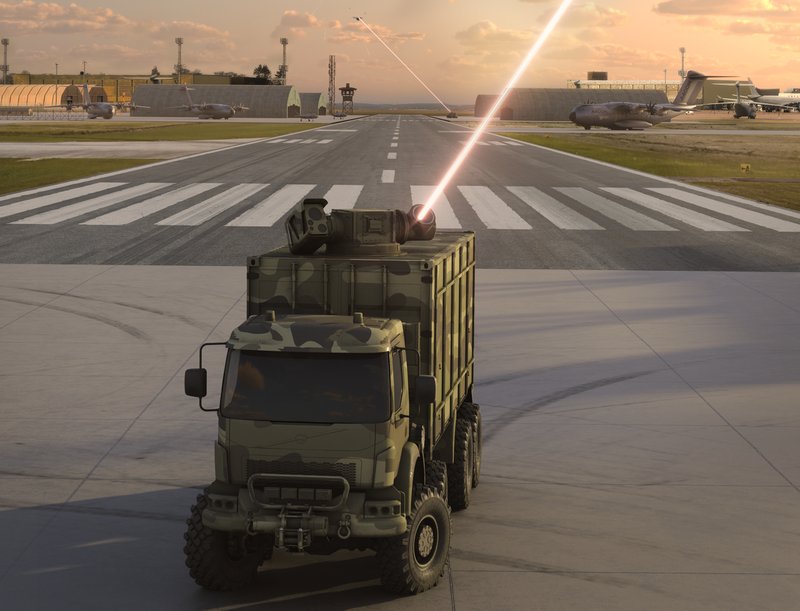
In a classic engagement scenario, the outermost layer uses missiles and rockets capable of engaging UAS at ranges of 5km and beyond. The second layer is a laser: less expensive per shot, and with a throughput of up to 30 kills per minute compared to four or five for a missile battery. These are effective between 500m and 5km. The final layer – the fallback if saturation overwhelms those above – is the air defence cannon with roughly four to five kills per minute at ranges of 500m to 2.5km.
This is, by design, a system of trade-offs. And those trade-offs are getting harder to justify. Battlefields in Ukraine and the Middle East have repeatedly shown that “the local optimum is not necessarily the global optimum”, as Schwer puts it.
Russian tactics in Ukraine illustrate the problem. Initial drone waves are sent in unarmed, acting as decoys to draw and deplete air defences. Subsequent waves – flying in the radar shadow of the first – carry the actual payload. The objective is straightforward: exhaust the defender before striking. The danger, Schwer remarks, is that “once you’ve shot all of the first wave down, you have nothing left over for the second one.”
Similar challenges apply to critical infrastructure. UAS approaching an electricity substation may not be targeting it at all, but are heading for a higher-value objective further on. “If you look at one small group of drones, you might get that impression, but if you see the full picture nationwide, you can see they’re targeting something completely different,” Schwer notes.
Either way, it is a war of attrition, and the defender is losing ground.
Emerging solutions
EOS is responding with a portfolio of complementary effectors designed to address different points of failure in the existing layered model.
In the directed-energy tier, the company’s Apollo family of laser weapons represents a capability few outside the US can match. EOS and Israel’s Rafael are, Schwer notes, the only companies offering a 100kW laser system on the market outside America, and foresees economies of scale: “We believe that the laser weapon will become a standard defence system for all those C-UAS applications in the future. It’ll become a mass volume product.”
At the cannon layer, EOS’s Slinger system is ready for integration on future main battle tanks. Explaining why this capability is needed when MBTs are routinely fitted with active protection systems (APS), Schwer explained: “Those systems are good against RPGs and rockets, but they are of limited use against drones for the simple reason that you have only about six effectors on board. The third or fourth loitering munition will get through.”
Notably, the system operates autonomously, as when those enemy loitering munitions are detected closing at speed, “there is no more time to think about whether you shoot or don’t shoot.” Schwer is however clear about the company’s wider philosophy on autonomy: “The system is autonomous only if it is engaging an unmanned target; if the target detected could potentially be manned, something normally evident by its size and shape, there is always a human-in-the-loop.”
The introduction of a mesh network addresses a different problem set: including the vulnerability of hybrid combat vehicle fleets operating with incompatible systems. In Ukraine, attacking Russian drones “typically take out the high-value assets first, which are the C2 and radar vehicles, and then the rest of the platoon is more or less lost”, Schwer explains.
EOS’s solution distributes both sensor coverage and C2 intelligence across the entire formation. Each vehicle carries a single flat-panel radar providing sectorial coverage, linked via standard NATO radios – modules costing around $10,000 each – that form a self-organising mesh. C2 software is downloaded into every weapon station, eliminating the dedicated command vehicle as a single point of failure. Remaining units can automatically reconfigure to maintain full hemispherical coverage: “Each tank is covering a different sector and they’re exchanging information. They can see whatever’s happening and shoot down anything flying in.”
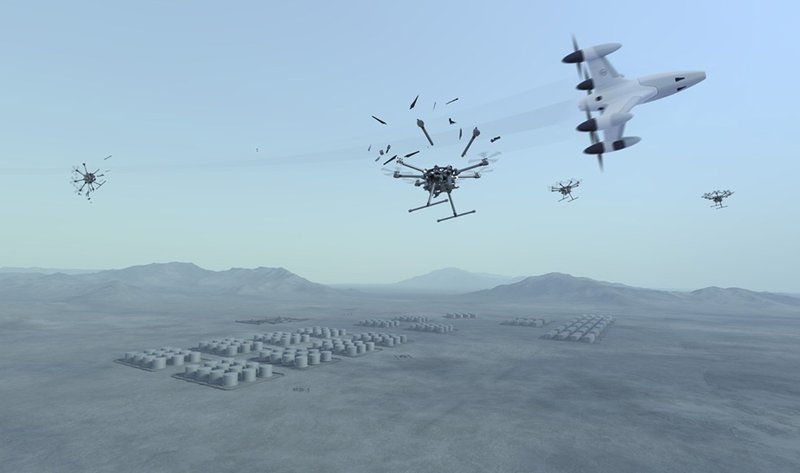
Finally, EOS’s interceptor drones offer a counter to mass swarm attacks. These systems kill by kinetic impact alone, a design choice with significant implications for deployment and collateral damage risk. “We can easily store them in small launchers alongside the runway of a [civil] airport, because they have no explosives inside,” Schwer explains. Kept continuously charged, they are launchable within two seconds of a command, and are effective at ranges of 8 to 9km.
With a low unit cost, they can be deployed in quantities of 50 to 100 simultaneously, with the C2 system pairing each interceptor to an individual attacking drone. If an interceptor misses its target, it can return to base; if destroyed, it falls without any detonation risk.
Taken together, the portfolio reflects EOS’s stated objective. Schwer puts it simply: “We want to become the number one in anti-drone warfare worldwide.” Achieving that goal may ultimately depend less on technological progress than on whether procurement cycles can match the pace of the threat.
These themes will be explored further during the panel session “Countering the Swarm: AI, Lasers and the Future of C-UAS” at Eurosatory on Monday 15 June from 15:00-16:00.
See EOS at Eurastory at Hal 5A Stand H335




More from Studio
-
![How Pearson Engineering combines tradition with innovation for the demining mission (Video)]()
How Pearson Engineering combines tradition with innovation for the demining mission (Video)
At Eurosatory 2026, Pearson Engineering's Group CEO Ian Bell talked about the company's role in delivering specialist armoured engineering, route-clearance and demining capabilities to military customers around the world.
-
![Ukraine experience forces rethink of counter-UAS doctrine]()
Ukraine experience forces rethink of counter-UAS doctrine
A panel session at Eurosatory 2026 brought together industry, academia and the French armed forces to assess how Ukraine’s battlefield reality is reshaping counter-UAS (CUAS) technology, air defence doctrine and Western procurement priorities.
-
![Networked advantage: keeping unmanned systems in the loop with battlefield radio technology]()
Networked advantage: keeping unmanned systems in the loop with battlefield radio technology
Unmanned systems are powerful intelligence, surveillance and reconnaissance (ISR) assets and communication tools, but are often isolated from wider networks, limiting their potential. Industry is now tackling this challenge, empowering UxVs to act as integrated nodes across domains.
-
![Air defence at scale: Europe’s challenge of cost, integration and sustainability]()
Air defence at scale: Europe’s challenge of cost, integration and sustainability
The evolution of aerial threats is driving renewed investment in ground-based air defence across Europe. Yet beyond capability, a more pressing challenge is emerging: how to sustain air defence at scale, as rising costs, limited stockpiles and industrial production constraints place increasing pressure on existing structures.
-
![The path to a safer future – why technological innovation is key to successful mine clearance]()
The path to a safer future – why technological innovation is key to successful mine clearance
Landmines continue to present a persistent and constantly evolving global threat, and advances in technology are improving how the challenges posed by minefields are managed, while reducing risks to human life. The growing capabilities of autonomous and robotic systems, coupled with advanced sensor capabilities, are now fuelling industry’s responses to this pervasive danger.
-
![“The challenge is not demand, but delivery”: why rapid building of industrial capability is key to Europe’s future defence]()
“The challenge is not demand, but delivery”: why rapid building of industrial capability is key to Europe’s future defence
In today’s complex security landscape, military requirements are rapidly evolving across all domains. As European defence spending rises, industry is under growing pressure to expand production capacity, strengthen supply chains and accelerate delivery timelines to meet operational demand.