Ukraine experience forces rethink of counter-UAS doctrine
A panel session at Eurosatory 2026 brought together industry, academia and the French armed forces to assess how Ukraine’s battlefield reality is reshaping counter-UAS (CUAS) technology, air defence doctrine and Western procurement priorities.


Brought to you in partnership with EOS
Ukraine has rewritten the economics of air defence. Cheap drones are forcing costly interceptions, saturating forces and exposing the limits of electronic warfare (EW). The answer is not a single technology, but a layered system – and a doctrine able to keep pace with it.
The Eurosatory panel’s starting point was consensus. What is happening in Ukraine, CEO of EOS Dr Andreas Schwer said, is a fundamental shift, “a democratisation of war where it is no longer up to the superpower to dominate by just putting capital in place.”
The open-field battle has effectively ended: loitering munitions and kamikaze drones mean that any vehicle exposed for more than a few minutes is a sitting target.
Redefining warfare?
For Dr Élie Tenenbaum, director of the Security Studies Centre at the French Institute of International Relations (IFRI), the defining feature is massification.
Five years ago, a busy battlefield might see dozens of uncrewed aerial systems (UAS) in the air at any one time. Ukraine now regularly sees thousands, and they are responsible for a significant and growing share of casualties.
The implication is stark: the affordability of interception has become the central challenge. Shooting down cheap threats with expensive interceptors is “an inversion of the cost-exchange rate” that no Western military can sustain at scale.
Col François-Régis Dabas, Director of the French Army’s Strategic Studies Centre, introduced a useful framing from the Future Combat Command’s perspective: what has emerged is not simply a more congested airspace but a fully fledged new battle zone at very low altitude - industrialised, as he put it, “at scale in Ukraine.”
The distinguishing feature is that the threats themselves are, individually, “non-significant assets, but when they concentrate, they are in a position to saturate our shield”.
The classical dialectic between sword and shield, in other words, is being fought with weapons that cost almost nothing.
The limits of EW
EW was, historically, the CUAS workhorse but Ukraine has exposed its fragility. The adaptation cycle between jamming and counter-jamming – frequency-hopping, fibre-optic guidance, increased autonomy – has been compressed from years to months to weeks. Tenenbaum was precise: a jamming system can now expect to be countered or evaded within three weeks of deployment, on both sides of the front line.
“Electronic warfare is perishable,” he said, adding that it must now sit inside a wider architecture: multi-sensor, multi-effector, modular and fast enough to adapt.
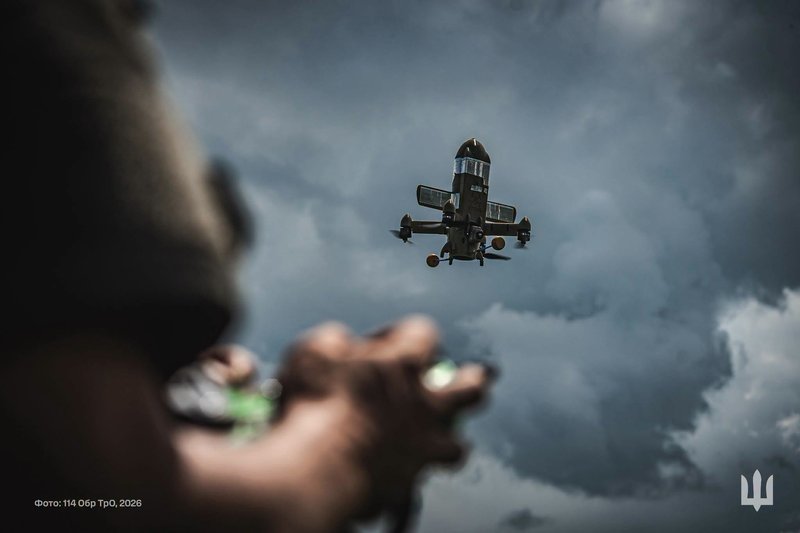
The sheer scale and speed of development of UAS warfare in Ukraine means that a new battlespace has effectively been created. (Photo: Armed Forces of Ukraine)
The corollary, which Johannes Pinl, founder and CEO of MARSS Group, illustrated with a live example, is autonomy. With hundreds of incoming targets, “the human in the loop is the bottleneck”. The kill chain must be automated as far as possible – from detection and classification to countering – because operators cannot manage dozens of simultaneous threats manually.
The threat, he added, is becoming multi-domain and fully autonomous across air, surface, underwater and land: “The only way to defend against an autonomous threat is to be autonomous yourself. Otherwise, you’re too late.”
The autonomy question
The panel’s sharpest exchange came on the subject of autonomy, which remains a politically, legally and operationally charged topic.
Dabas drew a hard distinction between trusting a partner and trusting a robot. “No military leader will trust a machine,” he said, underlining that trust is not a starting point; it is an outcome of testing, qualification, certification, doctrine, education and operational evaluation.
For artificial intelligence (AI)-enabled systems, French doctrine rests on three political-level principles: respect for the law of armed conflict at all times; sufficient human control throughout the system’s use; and permanent responsibility of the human chain of command.
Crucially, Dabas argued that “the machine is not autonomous” in any holistic sense; autonomy is delegated by function, by circumstance and by the commander’s prior analysis of the operational environment.
Maj Gen (ret) Jean-Marc Vigilant, associate research fellow at the French Institute for International and Strategic Affairs (IRIS) and a former French Air and Space Force senior commander, sought to reconcile the positions. The French armed forces, he confirmed, will not field lethal autonomous weapon systems (LAWS).
“It is clear that we won’t have LAWS. We will make sure that we still have a man in the loop,” Vigilant said. But AI will govern perception, mobility, coordination and effector selection. “In the end, the man will be the one providing the mission and the limits of the mission.”
Tenenbaum cut through the philosophical discussion by citing Ukraine’s operational reality: “When you have personnel shortages, massive threats, and the [current] speed of those threats, there is an operational need to automate as much as you can.”
Schwer went further, pointing to the civilian dimension: “We have to think about all the critical infrastructure, such as commercial airports, nuclear power plants, and any other kind of urban infrastructure.” In those environments, without soldiers present and with no time for human decisions, full automation is not a preference but a necessity, he argued.
Layered defence, rethought
For EOS, the answer lies in layered defence, and that means much more than the traditional division into short-, medium- and long-range systems. Schwer argued that an effective defence network must also be layered by effect: EW, interceptor drones, cannons, missiles and directed energy, all orchestrated by intelligent command and control (C2).
Lasers are becoming central because they address the economic imbalance per shot directly. Schwer said EOS has signed the first export contract for a 100kW laser weapon system, expected to be fielded by mid-2027.
One laser intercept, he noted, can cost less than US$10, with a modern energy weapon able to defeat up to 20 or 30 drones per minute. But lasers are not a wholesale replacement for existing defences. The future is “a healthy mix of everything”, with AI helping decide which effector is best suited to which threat.
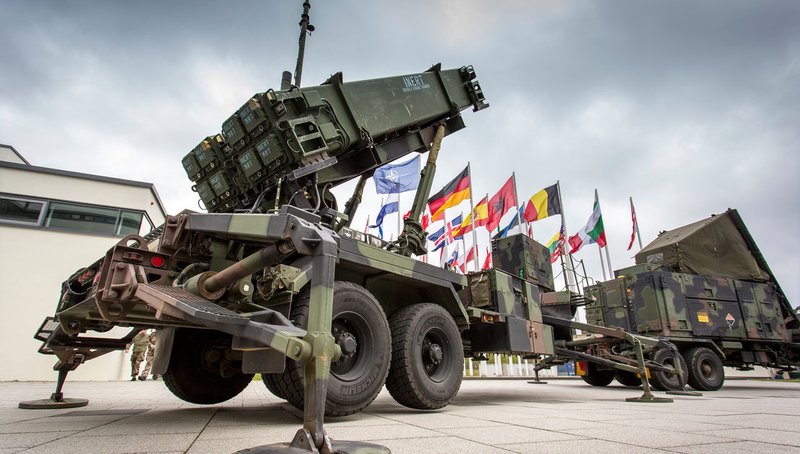
High-end interceptors will still have a role to play, but must form part of a truly layered network that matches effectors to threats economically and effectively. (Photo: NATO)
Pinl described a similar architecture for high-value fixed sites: EW at the outer perimeter, missiles in the medium range, interceptor drones and lasers at shorter range, with air-burst cannon as the last line. Each element has different costs and capabilities. The value lies in networking them locally and centrally, so the system learns from one wave and prepares for the next.
For Western governments, the reckoning is uncomfortable. “It is a cat and mouse game, and we are far behind in the Western world,” Pinl said. Europe, he estimated, is roughly five years behind the Middle East, where the threat arrived earlier, and budgets were committed sooner.
Can doctrine catch up?
Doctrine has even further to travel. Vigilant noted that NATO is actively trying to “capture all the lessons learned from the battlefield to inject into doctrinal work,” anchored at the Joint Analysis, Training and Education Centre in Bydgoszcz, Poland.
His core argument is that “drones do not substitute for combined arms, they will enable them and reinforce them. This is just a new military tool in the box, but it does not change the very nature of warfare.”
For Tenenbaum, a training revolution is required. “CUAS is now an all-arms mission,” he said. Every branch needs its “ABCs” of CUAS. They also need to train as they fight: live, under threat, with drones being shot down and AI systems collecting the data they need to improve. Human and machine training are not alternatives – they are the same exercise, run in parallel.
Industry has a role here, too. Pinl argued that CUAS contracts increasingly need training centres and data feedback loops built in.
Schwer however brought the discussion back to cost: “If you have to protect your power station, you don’t have the multi-million-dollar budget.” Getting costs down – through industrialisation, scale, and autonomous operation – has become a condition for the defence of civilian society.
The UAV threat has changed the logic of the fight. The challenge now is whether technology, doctrine and procurement can move at the same speed as the threat.




More from Studio
-
![How Pearson Engineering combines tradition with innovation for the demining mission (Video)]()
How Pearson Engineering combines tradition with innovation for the demining mission (Video)
At Eurosatory 2026, Pearson Engineering's Group CEO Ian Bell talked about the company's role in delivering specialist armoured engineering, route-clearance and demining capabilities to military customers around the world.
-
![Networked advantage: keeping unmanned systems in the loop with battlefield radio technology]()
Networked advantage: keeping unmanned systems in the loop with battlefield radio technology
Unmanned systems are powerful intelligence, surveillance and reconnaissance (ISR) assets and communication tools, but are often isolated from wider networks, limiting their potential. Industry is now tackling this challenge, empowering UxVs to act as integrated nodes across domains.
-
![Air defence at scale: Europe’s challenge of cost, integration and sustainability]()
Air defence at scale: Europe’s challenge of cost, integration and sustainability
The evolution of aerial threats is driving renewed investment in ground-based air defence across Europe. Yet beyond capability, a more pressing challenge is emerging: how to sustain air defence at scale, as rising costs, limited stockpiles and industrial production constraints place increasing pressure on existing structures.
-
![The path to a safer future – why technological innovation is key to successful mine clearance]()
The path to a safer future – why technological innovation is key to successful mine clearance
Landmines continue to present a persistent and constantly evolving global threat, and advances in technology are improving how the challenges posed by minefields are managed, while reducing risks to human life. The growing capabilities of autonomous and robotic systems, coupled with advanced sensor capabilities, are now fuelling industry’s responses to this pervasive danger.
-
![“The challenge is not demand, but delivery”: why rapid building of industrial capability is key to Europe’s future defence]()
“The challenge is not demand, but delivery”: why rapid building of industrial capability is key to Europe’s future defence
In today’s complex security landscape, military requirements are rapidly evolving across all domains. As European defence spending rises, industry is under growing pressure to expand production capacity, strengthen supply chains and accelerate delivery timelines to meet operational demand.