“The challenge is not demand, but delivery”: why rapid building of industrial capability is key to Europe’s future defence
In today’s complex security landscape, military requirements are rapidly evolving across all domains. As European defence spending rises, industry is under growing pressure to expand production capacity, strengthen supply chains and accelerate delivery timelines to meet operational demand.


Brought to you in partnership with Rheinmetall
Recent conflicts and procurement decisions have underlined a key point: the ability to produce, scale and deliver equipment at pace is now as critical as the military capability itself. As defence spending surges in Germany and its NATO partners, industry must be ready to meet the pace, scale and scope of the task ahead.
This is becoming a defining challenge across the European defence sector. Rheinmetall, one of the continent’s largest defence companies, is now evolving into a cross-domain technology company as it adapts to the new environment.
Tackling new domains
In particular, the group is rapidly expanding capabilities in the naval and space domains. This development is exemplified through its acquisition of shipbuilder Naval Vessels Lürssen (NVL), which was concluded in March and will see the establishment of a full-service German systems house to develop and manufacture naval and coastguard vessels and maritime autonomous surface systems.
Likewise, Rheinmetall is pursuing growth in the space sector, including through investment in Finnish company ICEYE, a market leader in synthetic aperture radar (SAR) satellites, part of the group’s focus on the delivery and use of space-based reconnaissance data in the tactical battlefield.
Such expansion reflects a broader shift within the defence sector towards capabilities linked to satellite technology, uncrewed systems and digitalisation, alongside demand for more traditional operational equipment.
“Expanding our value chain is essential to securing delivery,” explained René Gansauge, Chief Operations Officer of Rheinmetall AG. “By bringing key capabilities in-house, we reduce dependencies and increase reliability while increasing output.”
Enhancing production
Across Europe, defence manufacturers are bolstering capabilities across the board to meet the growing needs of the Bundeswehr and other armed forces. For Rheinmetall, this includes production capacity, both through adding additional lines at existing plants and the development of greenfield sites, alongside rapid recruitment of staff.
Notable examples include the construction of Europe’s largest ammunition factory in Unterluess, Lower Saxony, developed in just 15 months with investment of almost €500 million. In the coming years, the new facility will be able to produce up to 350,000 artillery shells every year.
Such expansion is underway across the rest of the continent, including on NATO’s crucial eastern flank. The group is building a new plant to produce 155mm artillery ammunition in the Lithuanian town of Baisogala, operated by the joint venture (JV) Rheinmetall Defence Lietuva. Production capacity is envisioned at tens of thousands of projectiles per year already, with a direct investment of up to €300 million.
On the other side of Europe, the company is pushing forward with its UK Gun Hall project in Telford, England, with engagement under way with local manufacturers and steel producers to build the facility. This forms part of the wider defence cooperation between the UK and Germany envisaged under the Trinity House Agreement.
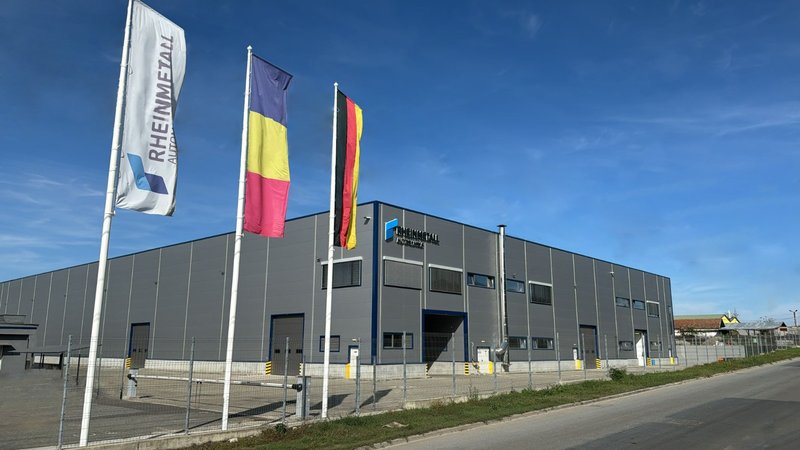
Such activity builds both on Rheinmetall’s own expertise, as well as relationships with other companies across the supply chain. This includes a comprehensive local production network in Romania based on Rheinmetall’s subsidiaries in the country and a range of new partnerships with local firms. This will focus on domestic production of the Lynx infantry fighting vehicle (IFV) at Rheinmetall Automecanica and the manufacture of medium-calibre ammunition for armoured vehicles and air defence.
As Rheinmetall transitions to an exclusive focus on defence, it is converting previously civilian-focused sites into military facilities, including former automotive plants in Berlin and Neuss.
“We are expanding our production footprint across Europe at pace, through new facilities, site expansions and the conversion of existing capacity at record speed,” noted Gansauge.
Deepening the value chain
While the NVL deal is perhaps the most significant recent example of Rheinmetall’s efforts to expand through acquisition, it is just one of many in Germany and beyond, all focused on deepening the value chain as the security landscape continues to shift.
This includes the acquisition of Hagedorn-NC GmbH in Germany, whose industrial nitrocellulose production facilities are being converted for military applications, notably propellants for ammunition.
Other examples include the acquisition of ammunition specialist Muni Berka GmbH; South Africa-based Resonant, now Rheinmetall Resonant South Africa, which offers expertise in the design and construction of specialised plants, including facilities for chemical and explosive products; and majority control of Bavarian software developer blackned GmbH, which specialises in digitalisation for armed forces applications.
These acquisitions and investments are complemented by longstanding partnerships with other major defence companies. Perhaps most notably, this includes ongoing work with Lockheed Martin and Northrop Grumman on the F-35 programme.
Similarly, the Leonardo-Rheinmetall Military Vehicles JV is forming a European hub for military combat vehicles, with a primary focus on Italy’s new main battle tank and the Lynx programme to meet Rome’s Army Armoured Combat System requirement.

These partnerships are also helping to accelerate Rheinmetall’s growing focus on new domains, such as space, as seen through the JV with ICEYE.
Rheinmetall’s activity here is not confined to Europe. For example, in June 2026 the company announced an investment package of $41 million across its US sites in Michigan, Ohio and Maine in order to expand production capacity, modernise operations and strengthen supply chain resilience.
This will support work across key programmes including the XM30 Combat Vehicle and Mobile Tactical Cannon, along with missile, subsystem and component production. Commenting on the decision, Matt Warnick, CEO of American Rheinmetall, said: “At a time when speed, scalability and certainty are paramount, expanding existing capabilities provides a decisive advantage.”
Wherever they are located, such investments, partnerships and expansion efforts reflect a wider recognition across the defence sector that industrial resilience and scalable production capacity are becoming increasingly central to long-term military readiness in Europe and beyond.
“The challenge today is no longer demand; it is delivery,” concluded Gansauge. “The ability to convert large order volumes into operational capability at speed is becoming a decisive factor in all domains.”



More from Studio
-
![How Pearson Engineering combines tradition with innovation for the demining mission (Video)]()
How Pearson Engineering combines tradition with innovation for the demining mission (Video)
At Eurosatory 2026, Pearson Engineering's Group CEO Ian Bell talked about the company's role in delivering specialist armoured engineering, route-clearance and demining capabilities to military customers around the world.
-
![Ukraine experience forces rethink of counter-UAS doctrine]()
Ukraine experience forces rethink of counter-UAS doctrine
A panel session at Eurosatory 2026 brought together industry, academia and the French armed forces to assess how Ukraine’s battlefield reality is reshaping counter-UAS (CUAS) technology, air defence doctrine and Western procurement priorities.
-
![Networked advantage: keeping unmanned systems in the loop with battlefield radio technology]()
Networked advantage: keeping unmanned systems in the loop with battlefield radio technology
Unmanned systems are powerful intelligence, surveillance and reconnaissance (ISR) assets and communication tools, but are often isolated from wider networks, limiting their potential. Industry is now tackling this challenge, empowering UxVs to act as integrated nodes across domains.
-
![Air defence at scale: Europe’s challenge of cost, integration and sustainability]()
Air defence at scale: Europe’s challenge of cost, integration and sustainability
The evolution of aerial threats is driving renewed investment in ground-based air defence across Europe. Yet beyond capability, a more pressing challenge is emerging: how to sustain air defence at scale, as rising costs, limited stockpiles and industrial production constraints place increasing pressure on existing structures.
-
![The path to a safer future – why technological innovation is key to successful mine clearance]()
The path to a safer future – why technological innovation is key to successful mine clearance
Landmines continue to present a persistent and constantly evolving global threat, and advances in technology are improving how the challenges posed by minefields are managed, while reducing risks to human life. The growing capabilities of autonomous and robotic systems, coupled with advanced sensor capabilities, are now fuelling industry’s responses to this pervasive danger.
-
![Why cost-effective flexible networks are the key to C-UAS success]()
Why cost-effective flexible networks are the key to C-UAS success
The widespread use of drones and loitering munitions in current conflicts has tilted the balance in favour of the attacking force, both operationally and economically. EOS’s Dr Andreas Schwer tackles the question of what kind of C-UAS defences are needed to protect battlefield forces, and even entire countries.