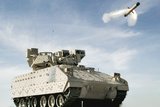
New UAS family promises man-portable close air support
QuadCas:MXT can carry up to six anti-personnel projectiles and return to the user after firing. (Image: BothwellRoyal)
The QuadCAS UAS range developed by BothwellRoyal comprises two single-use remote anti-personnel weapons and a multi-projectile reusable carrier.


Swedish-South African defence startup BothwellRoyal has unveiled QuadCAS, a UAS it says is designed specifically for close air support.
The system has three variants. QuadCAS:M250x and QuadCAS:M500 are single-use remotely operated kinetic anti-personnel weapons, with the M500 described as having an explosive yield equivalent to an 81mm mortar shell.
QuadCAS:MXT meanwhile is a multi-use platform that can carry a payload of two, four or six anti-personnel projectiles and returns to its operator those projectiles have been fired. QuadCAS weighs under 2kg and several can be carried by a soldier, the company says.
QuadCAS is currently in final stages of testing and will be open for orders by the end of March, with delivery availability later this year.
BothwellRoyal founder Robert MacMurray said: ‘With its lightweight and portable design, the QuadCAS range offers a cost-effective solution that can make a major difference in combat situations and significantly reduce the chance of collateral damage.’
Related Equipment in Defence Insight

More from Land Warfare
-
![Coming to America: companies look to tap into US with multi-domestic strategy]()
Coming to America: companies look to tap into US with multi-domestic strategy
Non-US companies are increasingly looking to establish subsidiary and partnerships to access the potential billions of dollars of vehicle and land systems contracts and there has already been some success.
-
![Front-line support: how UK industry is helping tackle Ukraine’s landmine challenges]()
Front-line support: how UK industry is helping tackle Ukraine’s landmine challenges
Pearson Engineering has provided equipment and engineering expertise to the Armed Forces of Ukraine since the beginning of the full-scale Russian invasion in 2022. The British company is now working to deepen engagement with the Ukrainian defence industry, expanding its support for the country’s population and laying the foundations for future technological innovation.
-
![AUSA 2026: companies adapt munitions and missiles for greater effect at lower costs]()
AUSA 2026: companies adapt munitions and missiles for greater effect at lower costs
Rather than developing entirely new weapons, defence companies are looking to build on existing weapons and systems to deliver greater capability, control costs and accelerate fielding.
-
![AUSA 2026: industry looks to make commercial platforms a military reality]()
AUSA 2026: industry looks to make commercial platforms a military reality
With a production rate of more than 10 million vehicles annually, the US commercial car and vehicle manufacturing base is second only to China. Defence companies are looking at how the vehicles, technology and manufacturing capability can support programmes.
-
![With changing patterns in Middle Eastern procurement, is Europe missing out?]()
With changing patterns in Middle Eastern procurement, is Europe missing out?
Traditional suppliers are struggling to meet the Middle East’s armoured vehicle modernisation needs, creating opportunities for South Korean manufacturers and regional defence industries.
-
![AUSA 2026: CUAS market expands as suppliers target new threats and operational requirements]()
AUSA 2026: CUAS market expands as suppliers target new threats and operational requirements
New developments from MARSS, MyDefence, Mountain Horse Solutions and Rafael suggest that future counter-drone protection will increasingly depend on combining advanced detection, rapid interception and integrated defensive networks.