Germany signs $15 million deal for Black Hornet 4 nano-drones
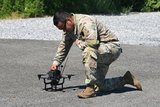
The contract for the UAVs includes parts and training. (Photo: FLIR Defense)
Teledyne FLIR Defense has delivered more than 33,000 Black Hornet uncrewed aerial vehicles (UAV)s to 45 countries and are being used Ukrainian forces in the war against Russia.


Teledyne FLIR Defense has been awarded a US$15 million contract from Germany’s Federal Office of Bundeswehr Equipment, Information Technology and In-Service Support (BAAINBw) for Black Hornet 4 (BH4) personal reconnaissance systems.
The contract is being fulfilled by the company’s local partner European Logistic Partners (ELP) GmbH of Wuppertal, Germany as the contractor for BAAINBw. It is being fulfilled within a two-year agreement and will deliver Black Hornet 4 systems, parts and training.
BH4 UAVs are designed to provide enhanced covert situational awareness to small fighting units they have a 12-megapixel daytime camera and high-resolution thermal sensor. At just 70g a platform can fly for more than 30 minutes, more than 2km, and function in rain and 25kt winds. Flight performance is augmented by advanced obstacle avoidance capabilities, the company claimed.
Related Articles
AUSA 2023: Black Hornet 4 nano-UAS described as the previous version ‘on steroids’
New Zealand turns to proven UAS to meet rapid procurement for army
Teledyne FLIR Defense Wins $91 million deal for Black Hornet 4 UAS
Ketil Vanebo, VP of UAS Norway operations at Teledyne FLIR Defense, stated that there was an increasing number of customers for BH4.
“We are seeing increased adoption of the Black Hornet UAS throughout Europe as regional and global tensions remain high and the system gives warfighters a distinct edge when conducting missions,” Vanebo said.
In October last year, Teledyne FLIR Defense won a contract worth $25 million supply the US Army with BH4 under a five-year deal which could be worth up to $91 million, adding to the total $215 million spent on Black Hornet 3 UAVs by the army.
The BH4s for the US Army are being acquired under the Soldier Borne Sensor (SBS) programme Phase II which includes controllers, spare parts and training.
Related Programmes in Defence Insight
Soldier Borne Sensor (SBS) (Phase II) [USA]
Related Equipment in Defence Insight


More from Air Warfare
-
![India’s military integration drive faces interoperability hurdles]()
India’s military integration drive faces interoperability hurdles
Senior military leaders have highlighted the need for interoperable systems, common data standards and closer cooperation between India's armed services.
-
![UK A400M Saudi deployment highlights airlifter’s role as Airbus pursues upgrades]()
UK A400M Saudi deployment highlights airlifter’s role as Airbus pursues upgrades
Airbus is developing new capabilities for its A400M transport aircraft as European countries consider future airlift requirements and the UK plans to deploy the aircraft to Saudi Arabia.
-
![The new generation of defence companies emerging from the US UAV boom]()
The new generation of defence companies emerging from the US UAV boom
As the Pentagon accelerates procurement of low-cost, lethal UAVs through its Drone Dominance Program, emerging suppliers will need to demonstrate manufacturing capacity, supply chain resilience and reliability.
-
![US Coast Guard faces key procurement decisions after C-130J and MQ-9B orders]()
US Coast Guard faces key procurement decisions after C-130J and MQ-9B orders
The service is updating several parts of its aviation fleet including fixed-wing and rotary-wing aircraft and procuring uncrewed aircraft to boost its maritime surveillance.