Italy finally funds naval missile projects
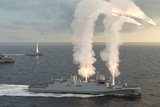
The FC/ASW missile will be delivered in two variants. An anti-ship missile and a land-attack variant that would allow naval forces to have one missile to complete two roles. (Photo: MBDA)
The Italian MoD’s multi-year programme documents (DPP) detailing its current and planned acquisition projects has provided new details of funding for its 2023–25 naval missile programmes.


The Italian Ministry of Defence (MoD) has confirmed that funding has been provided for the Future Cruise and Anti-Ship Weapon (FC/ASW) project and for the Marte-Extended Range (Marte-ER) anti-ship missile.
Italy joined the Franco–British FC/ASW project in June 2023 when a Letter of Intent (LOI) was signed at the Paris Air Show. Although the project started 2017 it has progressed through conceptual and evaluation phases under contract to European missile manufacturer MBDA.
Under the LOI, dialogue will be ongoing to see how the three countries progress the FC/ASW programme. With some initial funding, Italy will begin to participate in the development phase
Our news & analysis is now part of Defence Insight®
A Basic-level or higher Defence Insight subscription is now required to view this content.


More from Naval Warfare
-
![Quantum Systems enters maritime domain with Baltic-focused USV and UUV]()
Quantum Systems enters maritime domain with Baltic-focused USV and UUV
Quantum Systems has launched into the maritime domain with Seavex and Subvex, aiming to close a Baltic Sea ISR gap opened by infrastructure sabotage.
-
![Suppliers await next step in Australia’s mine warfare transition]()
Suppliers await next step in Australia’s mine warfare transition
Australia’s mine countermeasure capability remains in flux as the Huon-class nears retirement, but accelerated investment in autonomous systems is opening a path for industry.
-
![Can the US Navy ask Indo-Pacific allies to do more while training with them less?]()
Can the US Navy ask Indo-Pacific allies to do more while training with them less?
As the Iran War draws US ships and marine corps units away from the Indo-Pacific, curtailed exercises and a temporary carrier gap are exposing tensions between Washington’s demand for more self-reliant allies and the joint training needed to realise that ambition.
-
![How could Rheinmetall’s GMF 140 fit with ongoing programmes in North America?]()
How could Rheinmetall’s GMF 140 fit with ongoing programmes in North America?
With Canada committed to its River-class replacement and the USN pursuing a lower-cost frigate, Rheinmetall will need to demonstrate where the GMF 140 can fill a capability gap in the North American fleet.
-
![Australian industry programme builds pipeline for Virginia-class sustainment]()
Australian industry programme builds pipeline for Virginia-class sustainment
Australian businesses can now bid to support Virginia-class submarine sustainment in Western Australia, as momentum around the Henderson Defence Precinct also builds.