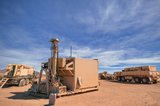
Northrop Grumman announces next test phase for US Marine Corps G/ATOR system
Northrop Grumman Corporation today announced the next system test phase for the Ground/Air Task Oriented Radar (G/ATOR) system. G/ATOR will provide the US Marine Corps with a highly-mobile multi-mission radar with enhanced capabilities which replaces five legacy Marine Corps ground-based radars.
Testing of the fully populated G/ATOR array, complete with all transmit/receive modules, radiating elements, prime power and distribution, RF manifold, and associated control and processing electronics is taking place at the company’s antenna test facility in Norwalk, Conn.
This is the second G/ATOR array to undergo comprehensive testing. A prototype partial G/ATOR array was successfully tested last year at the Norwalk antenna facility, and expanded testing on that first radar array continues at the company’s engineering and manufacturing complex in Baltimore.
This newest series of tests includes detailed verification that the G/ATOR’s active electronically scanned array (AESA) hardware will support all of the system’s multi mission capabilities including counterfire target acquisition, air defense, weapons cueing and air traffic control. The tests are intended to demonstrate all required AESA functions including beam generation, steering and control, performance at full rated power, operating bandwidth and automated array calibration techniques. Upon completion of this testing, this array will be integrated with the other G/ATOR components for systems level integration testing and subsequent environmental testing.
“Thorough testing of all aspects of the second G/ATOR array will continue to demonstrate the mission functionality and versatility that the US Marine Corps needs to fight in this modern battlespace,” said Pat Newby, vice president of Weapons and Sensors for Northrop Grumman’s Land & Self-Protection Systems Division. “This series of tests builds on the successes already achieved in testing the first G/ATOR AESA, and will further confirm our commitment to top quality systems that offer our warfighting customers unprecedented operational capabilities.”
G/ATOR is a highly mobile multi-mission radar with enhanced capabilities which replaces five of the six Marine Corps ground-based radars, providing significant increases in operational capabilities as well as large reductions in operations and maintenance costs. G/ATOR is the first ground based, multi-mission radar to be developed by the US Department of Defense.
Source: Northrop Grumman