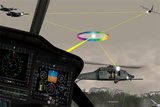
Bandwidth challenges existing data link order


For almost four decades NATO’s Link 16 tactical data link has proved its worth as a vital communications conduit for air operations, but thoughts are now turning to its successor.
The Link 16 tactical data link (TDL) is used throughout NATO and among allied nations to share track and tactical data between air platforms, and between aircraft, land and sea platforms or installations involved in the air battle.
When Link 16 commenced its roll out in the 1970s/early 1980s it was revolutionary, with the TDL transmitting across an ultra-high frequency waveband of 960MHz-1.215GHz. The ‘secret sauce’ in Link 16’s approach
Our news & analysis is now part of Defence Insight®
A Basic-level or higher Defence Insight subscription is now required to view this content.

You may also like

More from Five Eyes Connectivity Special Report
-
![Australian CHORUS is on song]()
Australian CHORUS is on song
The Australian Department of Defence announced on 11 May that it is exploring ways to integrate laser-based optical and RF communication technologies onto a single …
-
![Tactical data link provider expects major new order this month]()
Tactical data link provider expects major new order this month
Looking to the future of the Multifunctional Informational Distribution System Joint Tactical Radio System (MIDS JTRS), BAE Systems expects an imminent new production contract and …
-
![Fire Scout set to gain Link 16]()
Fire Scout set to gain Link 16
Northrop Grumman is set to receive new contracts from the US Navy over the next two years to integrate Link 16 on the MQ-8C Fire …
-
![Australian Army to acquire EW attack capability]()
Australian Army to acquire EW attack capability
Procurement of a new Australian Army electronic attack capability is set to begin this year. Indeed, acquisition of a force-level EW system that includes an …
-
![U-2 Dragon Lady shows plenty of life]()
U-2 Dragon Lady shows plenty of life
A popular phrase in the US is ‘if it ain’t broke, don’t fix it’. In aviation, one could think of the DC-3 and the 747, …
-
![Light shines on Five Eyes SIGINT collection mechanisms]()
Light shines on Five Eyes SIGINT collection mechanisms
Although the mechanisms by which the ‘Five Eyes’ partners share their intelligence have been shrouded in secrecy for some years, revelations in recent years have …