The speed of relevance: how companies can navigate the new era of European defence procurement
European militaries face a rapidly evolving security landscape and defence production must accelerate to meet surging demand for platforms and equipment. Industry needs to adapt to ensure it gets its products into the hands of the end user, Evelyn Rafferty, Senior Director Aerospace and Defence - Europe at Plexus told Shephard’s Gerrard Cowan.


This In Conversation interview is brought to you by Shephard in partnership with Plexus Group.
Europe is in a period of historical transition, Rafferty noted, fuelled by the war in Ukraine and pressing demands for increased defence spending. The urgency can be seen in such EU initiatives as the ReArm Europe Plan/Readiness 2030 and in the comprehensive national strategic defence reviews issued by governments across the region.
The pace of evolution presents challenges to traditional defence procurement cycles, which simply were not built to handle the demands they face today, Rafferty said.
“Look at the rapid, iterative nature of technology deployed in Ukraine, especially with uncrewed systems. The hardware and software are evolving in cycles of months, if not weeks,” she noted.
The change is not simply driven by demand, but by the nature of modern defence capabilities, which are being redefined by software advances and particularly the rise of artificial intelligence (AI).
“European militaries are feeling the immense pressure of this speed of relevance,” warned Rafferty. “They can no longer afford to wait years for a perfect asset; they need a defence-ready posture delivered right now, which means we have to drastically accelerate how fast we scale technology from the lab to the front line.”

Compounded challenges
“This rapid acceleration creates a massive operational disconnect for traditional defence manufacturers and developers,” said Rafferty. The industry has historically operated on a model designed for low-volume, highly customised “artisan” builds, she noted. However, the sheer scale of modern rearmament demands manufacturing partners who can rapidly transition low-volume prototypes into production at full industrial volume and scale.
“This creates a wave of compounding challenges,” said Rafferty. First, because technology is continuously evolving, any manufacturing plant must be incredibly flexible to support constant modifications and technology insertions without halting production.
Second, manufacturers must be capable of developing a highly resilient and defence-capable supply chain at a time when lead times for critical microelectronics are highly volatile, she warned.
And finally, she pointed to “a harsh economic challenge we have to address: the cost-exchange asymmetry”. This is exemplified by the reality that it is financially unsustainable to stop a commercial drone worth €500 with a €2 million missile.
“Closing that gap means we must optimise the manufacturing process for ultra-efficient, cost-effective volume scaling from the very beginning,” Rafferty emphasised.
Gaining the EMS advantage
These challenges can frustrate defence manufacturers on a range of levels, leading to bottlenecks in both technology and talent terms. This is where electronics manufacturing services (EMS) specialists like Plexus come in.
The company provides specialised engineering depth and flexible manufacturing for European customers through its UK and Romanian facilities. Supported by its expert teams, the company can empower OEMs by collaborating in the evolution of their designs, she explained, ensuring their capabilities are complementary and helping to deliver on the end mission.
“Defence OEMs typically lack the capabilities to design for manufacturing excellence and the resources to rapidly scale production. By partnering with an experienced EMS which has proven experience to rapidly scale, we enable the success of our customers with our talented resources,” Rafferty said.
Adapting to complexity
Flexible manufacturing support is critical today, when defence supply chains are becoming increasingly complex and more nations are focusing on sovereignty and resilience. Indeed, “the era of globalised, single-source procurement is over”, Rafferty stated.
For example, she pointed to shifting mandates on the European Defence Technological and Industrial Base(EDTIB), which mean that national content rules and regional compliance are non-negotiable conditions of entry.
“If a non-compliant or ‘covered foreign entity’ component shows up during a formal government audit, it can jeopardise an entire programme,” she warned. “To survive, defence firms have to move the conversation away from basic, reactive parts sourcing and transition to predictive resilience.”
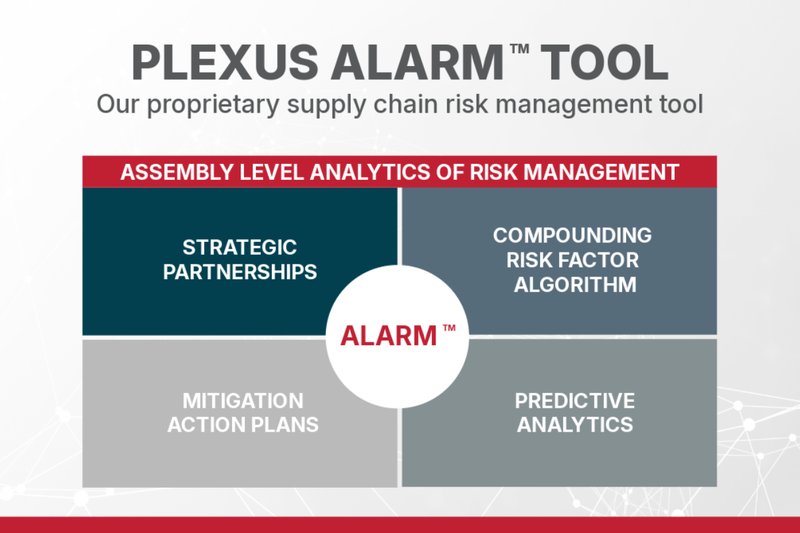
Plexus can manage this complexity through proprietary toolsets, such as DRIVE (Differentiated Risk Insight & Valued Execution) and ALARM (Assembly Level Analytics of Risk Management). These tools use real-time predictive analytics to identify component obsolescence risks in the medium term, delivering an ability to design out single-source vulnerabilities while also securing identical quality and compliance standards across a regional footprint.
“At the initiation of any engagement we seek to fully understand the objectives of our customers and the markets they are seeking to serve, as we understand the criticality in ensuring the supply chain strategy delivers and meets the objectives of the end customers,” Rafferty explained.
From TRL to MRL
How does this partnership work on a practical level? Rafferty pointed to the challenge of moving a subsystem from a Technology Readiness Level (TRL) 6 prototype to the demands required for volume production.
“You can have a brilliant TRL 6 proof-of-concept product that has had no consideration from a Manufacturing Readiness Level (MRL) perspective,” she explained. “If your design requires a master technician to spend 400 hours hand-tuning a single sensor array, it will never survive the ramp to volume.”
To succeed, MRL advancement must be pursued in parallel with the technology journey. Plexus helps ensure customers can integrate a rigorous Design for Excellence (DfX) analysis at the earliest TRL stages, she said, focusing on manufacturability, physical error-proofing (or “poka-yoke”) automated testability from day one.
With such an approach, “you ensure your technology can be seamlessly and cost-effectively hardened for the operational environment,” she said.
Local strength
The shifting landscape of the European defence market means a local presence is no longer an optional extra for international suppliers, but “a mandatory gatekeeper”, said Rafferty. EU and UK government customers require regional content, localised sustainment and ironclad data sovereignty.
All this means it is crucial to support militaries in their home markets as they engage upon rapid ramp-ups of major programmes. But building such a presence brings a range of challenges. For one, it is incredibly time-consuming and expensive, she noted.
To overcome these hurdles, defence companies can work with locally based partners, providing a convenient avenue for frictionless scaling. For example, Rafferty said that Plexus operates design-led manufacturing centres of excellencein Livingston, Scotland, and in Oradea, Romania, which “allow global companies to immediately achieve regional compliance, hit stringent localisation targets, and seamlessly navigate complex EU export controls and ITAR/EAR boundary layers using identical, zero-defect quality systems.”

High-growth segments
There has been growing demand for the facilities, Rafferty noted, with the company supporting innovators who are responding to the most acute threats to the continent. At present, this means its focus is heavily anchored in high-growth segments like unmanned aerial systems (UAS), counter-UAS, and secure battlefield communications.
Plexus frequently works with businesses that have created disruptive, cutting-edge software or drone platforms and provides them with the automated, highly reliable, integration functional testing systems for higher-level assemblies that they need, she said. This fills critical knowledge gaps, providing specialised engineering depth in areas like thermal management and signal integrity that such high-growth firms often lack internally.
“A great example of our work involves our regional defence hub in Oradea scaling critical tactical communication platforms to support European mission-critical infrastructure,” Rafferty said. “These are highly sophisticated, high-density electronic modules operating in congested and contested spectrums.”
Supporting the innovators
Such partnerships can be invaluable for new entrants and start-ups in the burgeoning European defence sector today. For Rafferty, many such companies possess “fantastic innovation and creative technologies”. However, they often face a significant challenge: a struggle to isolate the activities that are core and strategic to their operation, versus those that can dilute their resources and render them ineffective.
“To be best aligned for success, it’s key to engage with experienced partners for those non-core activities, enabling your team to focus on strategic activities and thus accelerating your success,” she said.
“Furthermore, late changes often are more expensive and time-consuming than a proactive approach developed during the product development phase,” Rafferty explained.
Future opportunities
Flexible, local support from providers like Plexus could help manufacturers adapt to a rapidly evolving environment in critical areas of modern defence technology. While the future is uncertain, a range of trends indicate strong potential for continued change in the coming years.
For example, Rafferty pointed to a move towards cross-border cooperation, with European Commission initiatives and other factors driving a “Europe for Europe” collaborative model. “This allows an advanced hub, like our facility in Romania, to directly support and scale programmes for defence primes in the UK, Germany, France, or the Nordics,” she said.
Additionally, she pointed to the rise of autonomous mass, with a move away from relying solely on a small handful of multi-billion-euro, legacy platforms to a growing embrace of thousands of low-cost unmanned assets. This will have a significant impact on long-term sustainment and the availability of certified sub-contractors, she warned.
In this shifting environment, EMS partners with the right technical expertise, manufacturing capabilities and local knowledge will be essential.
“The industrial base will have to rely heavily on partners who can manage the entire lifecycle, providing continuous component-level repair, tech insertions and electronics refurbishments to maintain fleet readiness.”




More from Industry Spotlights
-
![Orchestrating operational readiness across every defence domain]()
Orchestrating operational readiness across every defence domain
Are all systems ready for the next mission? Have upgrades been applied? Are all assets aligned to deploy together, on time and fully prepared? In modern defence operations, readiness is no longer measured platform by platform. It is measured by how well people, assets, data and decisions move together — across land, sea and air.
-
![Extending mission readiness: where XR adds real value in pilot, crew and maintenance training]()
Extending mission readiness: where XR adds real value in pilot, crew and maintenance training
Extended reality (XR) is becoming increasingly relevant in military aviation training, adding a flexible layer to an integrated ecosystem spanning the pilot, crew, and maintenance domains.
-
![Dominating the spectrum: ASELSAN’s EW capabilities take center stage at MSPO 2026]()
Dominating the spectrum: ASELSAN’s EW capabilities take center stage at MSPO 2026
ASELSAN is showcasing its advanced electronic warfare (EW) capabilities at MSPO 2026, highlighting technologies designed to detect, analyse, disrupt and deceive threats across increasingly contested electromagnetic environments.
-
![“Creating a decision advantage”: how C-UAS is evolving to reduce the operator burden]()
“Creating a decision advantage”: how C-UAS is evolving to reduce the operator burden
In Conversation… Speaking to Shephard’s Gerrard Cowan, Dr Brian Shand, Director – Advanced Concepts & Technology at L3Harris, explains how, as operators face growing numbers of low-cost drones, C-UAS providers must focus on reducing operator workload, transforming fragmented sensor data into effective decision-making.
-
![Shield the warfighter, win the fight (video)]()
Shield the warfighter, win the fight (video)
BAE Systems’ Intrepid Shield™ approach delivers full-spectrum electromagnetic protection to detect, exploit, and counter advanced threats.
-
![How joint ventures are expanding Rheinmetall's munitions portfolio (video)]()
How joint ventures are expanding Rheinmetall's munitions portfolio (video)
Roman Köhne, CEO of Rheinmetall's Weapon and Ammunition Division, discusses the company's announcements at Eurosatory 2026, including developments in defence technology, precision systems, industrial partnerships and future capability programmes.