AI-enhanced combat radios: how to turn comms networks into an EW advantage
Artificial intelligence (AI) is transforming defence communications, boosting situational awareness and electronic warfare (EW) capabilities across the battlespace. Bittium’s new partnership with MarshallAI will significantly enhance networked technology, turning radios into cutting-edge sensors with a range of applications.


Brought to you in partnership with Bittium
AI has long been a focus for Bittium, with the Finnish company’s Integrated Spectrum Situational Awareness concept allowing tactical radios to act as EW sensors via a simple software upgrade. This approach integrates equipment already in use by troops with new electromagnetic capabilities, transforming existing networks into multi-sensor EW assets.
This opens up a range of opportunities for armed forces, complementing the capabilities of dedicated EW systems. For example, it empowers radios to automatically monitor the spectrum, performing analysis and detecting unknown emissions, a crucial advantage in a rapidly evolving landscape.
Creating resilient communications
Matti Passoja, director of product management – defence and security, at Bittium, noted that military communications are built on resilience.
“Resilience is all about adapting,” he said. “When something changes in the network or in the environment, communications have to adapt.”
AI can significantly enhance this capability. For example, Passoja pointed to its applications in spectrum analysis: “How do we use the spectrum? What channels do we use to communicate? With the help of AI, that could be automatically decided and adjusted on the fly.”
Here, AI would not replace dedicated EW systems but serve as a highly capable, complementary element, Passoja stressed. Specialist EW equipment is often highly advanced and demanding in terms of size, weight and power (SWAP), he noted; AI-enabled radios would be built with existing infrastructure, making the technology cost-effective and avoiding additional demands in terms of equipment support.
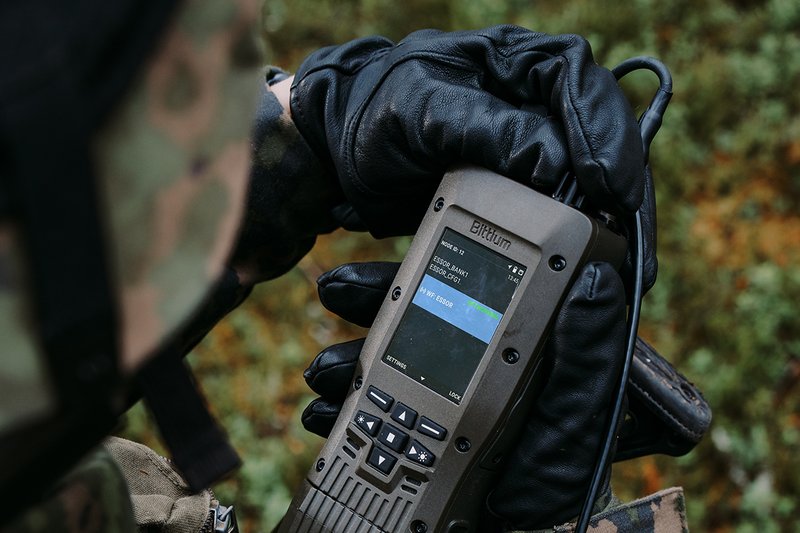
Utilising existing hardware and software also reduces the training burden, Passoja added: “At Bittium we ensure that a six-month conscript can easily use our technology during their service – that’s the requirement we always have from our customer and that’s our target with AI.”
Importantly, the use of radios for complementary EW coverage could also pose problems for opposing forces, he explained. Dedicated standalone EW systems represent highly valuable targets, “but when you’re using these communication radios as a sensor, it’s a different approach. You have lots of low-cost nodes, so it becomes more difficult for the adversary to target these EW systems.”
The importance of partnerships
Bittium’s new team-up with MarshallAI will significantly enhance AI-enabled tactical communications in the coming years, Passoja said.
MarshallAI is a Finnish pioneer of AI solutions with a particular focus on signal processing. Bittium acquired a 24.9% stake in the company in September 2025 and has licensed its principle AI tool, with the partners now jointly developing the technology for Bittium’s product families.
Passoja said Bittium had been monitoring the evolution of the AI sector for some time, both domestically and internationally. “We clearly recognised MarshallAI as one of the leaders in this space,” he said, noting that the two companies previously worked together on European Defence Fund-backed research projects.
Marcus Nordström, CEO of MarshallAI, added that the business has been working on defence and critical communications since 2016. However, partnering with Bittium will take this to another level.
“We have abilities that benefit Bittium because we can introduce even more features and analysis layers on top of the sensor information that they get from these devices,” he explained.
There could be a range of ways in which users interact with AI through their radios, added Nordström. For example, the AI tool could be programmed to search for anomalies in the environment, or to provide warnings in particular situations.
He underscored the importance of ease of use: “They will be completely turnkey and automated for users, while adding wholly new capabilities.”
It is also vital to build trust among users in the emerging technology. The systems will be completely closed and focus on local edge analysis capabilities, said Nordström, ensuring security.
Additionally, he noted that Bittium is a trusted specialist when it comes to critical communications in defence environments, “so there is already a natural level of trust” for military operators.
Using AI in an evolving battlespace
Bittium and MarshallAI are working on enhancing AI in multiple areas, said Passoja, including sensing and cognitive radios. He highlighted the need to process significant volumes of data at the edge.
“When we look at the future battlefield, most assets will be connected to the network. We will then get a lot of data which must be processed to form the situational awareness picture,” he said, highlighting the importance of AI in delivering this capability.
AI is set to be a crucial element in a quickly evolving battlespace, concluded Nordström, offering significant opportunities.
“It is not just about equipment like tanks and other platforms – it is going to change,” he said. “We face new threats that impact how we sense things, so we need to build our situational awareness. AI will be vital in communications, sensing, surveillance and understanding rapidly changing scenarios in the battlefield.”
Find out more about the potential for AI in battlefield comms and sensing - schedule a meeting with Bittium at Eurosatory 2026.

You may also like

More from Studio
-
![How Pearson Engineering combines tradition with innovation for the demining mission (Video)]()
How Pearson Engineering combines tradition with innovation for the demining mission (Video)
At Eurosatory 2026, Pearson Engineering's Group CEO Ian Bell talked about the company's role in delivering specialist armoured engineering, route-clearance and demining capabilities to military customers around the world.
-
![Ukraine experience forces rethink of counter-UAS doctrine]()
Ukraine experience forces rethink of counter-UAS doctrine
A panel session at Eurosatory 2026 brought together industry, academia and the French armed forces to assess how Ukraine’s battlefield reality is reshaping counter-UAS (CUAS) technology, air defence doctrine and Western procurement priorities.
-
![Networked advantage: keeping unmanned systems in the loop with battlefield radio technology]()
Networked advantage: keeping unmanned systems in the loop with battlefield radio technology
Unmanned systems are powerful intelligence, surveillance and reconnaissance (ISR) assets and communication tools, but are often isolated from wider networks, limiting their potential. Industry is now tackling this challenge, empowering UxVs to act as integrated nodes across domains.
-
![Air defence at scale: Europe’s challenge of cost, integration and sustainability]()
Air defence at scale: Europe’s challenge of cost, integration and sustainability
The evolution of aerial threats is driving renewed investment in ground-based air defence across Europe. Yet beyond capability, a more pressing challenge is emerging: how to sustain air defence at scale, as rising costs, limited stockpiles and industrial production constraints place increasing pressure on existing structures.
-
![The path to a safer future – why technological innovation is key to successful mine clearance]()
The path to a safer future – why technological innovation is key to successful mine clearance
Landmines continue to present a persistent and constantly evolving global threat, and advances in technology are improving how the challenges posed by minefields are managed, while reducing risks to human life. The growing capabilities of autonomous and robotic systems, coupled with advanced sensor capabilities, are now fuelling industry’s responses to this pervasive danger.
-
![“The challenge is not demand, but delivery”: why rapid building of industrial capability is key to Europe’s future defence]()
“The challenge is not demand, but delivery”: why rapid building of industrial capability is key to Europe’s future defence
In today’s complex security landscape, military requirements are rapidly evolving across all domains. As European defence spending rises, industry is under growing pressure to expand production capacity, strengthen supply chains and accelerate delivery timelines to meet operational demand.