Eurosatory 2026: Partnership deals surge as industry prepares for defence spending growth
Patrice CAINE, Chairman and CEO of Thales, and François PROVOST, CEO of Renault Group. (Photo: Thales)
Dozens of partnership agreements, joint ventures and industrial cooperation arrangements were announced at Eurosatory 2026, highlighting how defence companies are expanding production capacity, localising manufacturing and accelerating capability development in anticipation of rising defence spending.


Partnerships, memorandums of understanding (MoUs) and strategic cooperation agreements emerged as one of the defining themes of Eurosatory 2026, with dozens of announcements made during the exhibition as companies sought to position themselves for a new phase of defence-industrial growth.
While the agreements covered a broad range of technologies, from drones and autonomous systems to missiles, sensors and protected vehicles, many shared common objectives: expanding production capacity, strengthening sovereign industrial capabilities, localising manufacturing and accelerating the delivery of new capabilities.
The trend reflects growing expectations that European and allied defence spending will continue to increase over the coming years, creating demand not only for new platforms and weapons but also for resilient supply chains and expanded manufacturing capacity.
Several agreements focused on scaling production through cooperation with commercial industry partners and international manufacturing networks.
Among the most notable was a strategic partnership between Thales and Renault Group to industrialise production of the Toutatis loitering munition. The collaboration combines Thales’ defence expertise with Renault’s automotive manufacturing capabilities, with production planned to begin in 2027 as France seeks to expand sovereign drone and loitering munition production.
A similar emphasis on industrial capacity was evident in an agreement between Lockheed Martin and GM Defense. The companies said they would explore opportunities to strengthen defence supply chains, expand manufacturing capacity and apply commercial production expertise to defence programmes.
Elsewhere, DEUTZ and HDC Solutions signed a cooperation agreement covering resilient energy systems and autonomous emergency power solutions, while Lithuanian company RSI Europe signed an MoU with Ukrainian developer The Fourth Law to establish drone production in Lithuania under the Build with Ukraine initiative.
Localisation and sovereign production were also recurring themes throughout the exhibition.
Indian defence company MKU and Indonesian firm Republikorp agreed to establish electro-optics manufacturing capabilities in Indonesia, including technology transfer and local production of night-vision and thermal-imaging systems.
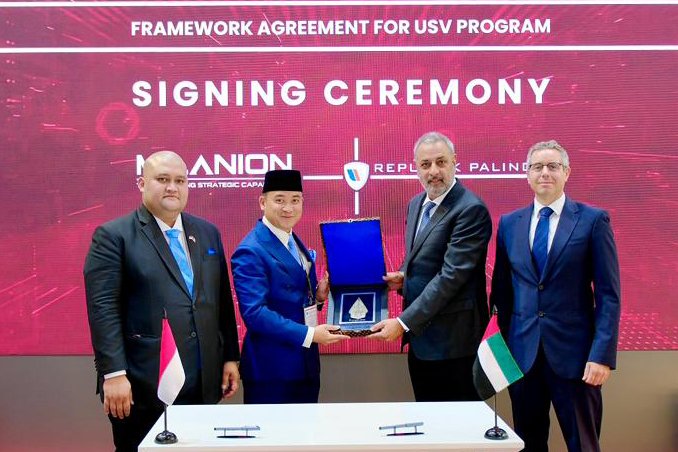
Indonesia was also the focus of an expanded agreement between Milanion Group and PT Republik Palindo Internasional (RPAL), which deepened cooperation on unmanned surface vessel development for the Indonesian Navy.
European governments’ increasing emphasis on domestic production and industrial resilience was reflected in agreements involving Poland, Ukraine and Greece.
Thales and Polish defence manufacturer Mesko signed an MoU covering cooperation on 70mm rocket systems, including assembly of rocket motors and production of key components in Poland. Meanwhile, AviaNera Technologies, part of Czech-based CSG, signed a strategic partnership agreement with Ukrainian Armor to support the development and supply of propulsion systems for missile and unmanned platforms, with plans to explore future localisation in Ukraine.
In Greece, Shield AI and EFA Group agreed to collaborate on the development and integration of autonomous systems using Shield AI’s Hivemind software as the foundation for sovereign national capabilities.
Another prominent theme was the growing use of partnerships to combine specialised technologies into integrated systems.
Counter-uncrewed aerial system (C-UAS) developments were particularly visible. Alpine Eagle and Origin Robotics announced plans to integrate Origin’s Blaze interceptor into Alpine Eagle’s Sentinel architecture, while DroneShield and Defenture signed an agreement focused on combining mobile counter-drone technologies with tactical vehicle platforms.
Milrem Robotics was among the most active companies in this area, announcing agreements with CNIM Systèmes Industriels covering unmanned engineering reconnaissance capabilities and with Frankenburg Technologies to explore robotic counter-UAS solutions. Both agreements reflected growing interest in combining autonomous platforms with specialist payloads and mission systems.
The trend towards modularity and open architectures was also evident in a partnership between Norwegian company STORM Adapt Group and UK-based ISTEC Services. The companies combined STORM’s Rapid Adapt and Deploy System architecture with ISTEC’s weapon-mount technology to create a platform-agnostic solution that can be fitted to multiple vehicle types without permanent modification.
Electro-optics and sensing technologies generated a number of significant agreements. Safran Electronics & Defense and THEON signed an MoU to establish a joint venture focused on electro-optical and infrared systems for unmanned aerial vehicles. The companies said the venture would combine Safran’s expertise in stabilised gimbals and ISR systems with THEON’s sensor technologies to address growing demand for intelligence, surveillance, reconnaissance and targeting capabilities.
Similarly, Savox Communications and Beechat Network Systems agreed to evaluate interoperability between tactical communications systems, while Thales and Aura Aero announced cooperation on a sovereign medium-altitude long-endurance unmanned aerial vehicle intended for intelligence, surveillance and reconnaissance missions.
The exhibition also highlighted the continuing importance of industrial partnerships in the land domain.
EODH and KNDS expanded their long-standing relationship through a new agreement covering production work associated with the Boxer 8x8 vehicle family, while other agreements focused on vehicle integration, autonomy and platform modernisation.
Beyond Europe, several agreements demonstrated the increasingly international nature of defence-industrial cooperation.
Canadian company Actagon and Indigenous-owned Des Nedhe Group announced plans to collaborate on advanced defence technologies, while a number of agreements involved technology transfer, localisation and co-production arrangements spanning Europe, Asia and North America.
Taken together, the volume and diversity of agreements announced during Eurosatory highlighted a broader shift in industry strategy. Rather than pursuing capability development independently, companies are increasingly seeking partners that provide complementary technologies, manufacturing expertise, production capacity or access to regional markets.



More from Eurosatory 2026
-
![Eurosatory 2026: IDV expands with new Viking and CL2X UGV]()
Eurosatory 2026: IDV expands with new Viking and CL2X UGV
At Eurosatory 2026, uncrewed ground vehicles (UGVs) are front and centre of IDV’s display, with a new variant of the Viking and the new CL2X on show.
-
![Eurosatory 2026: How the deep-strike, loitering munition market skyrocketed to $13.8 billion in three years]()
Eurosatory 2026: How the deep-strike, loitering munition market skyrocketed to $13.8 billion in three years
Ukraine’s rapid development of long-range, deep-strike loitering munitions has helped turn the sector into a market worth an estimated US$13.2 billion. The reasons behind this were outlined during Eurosatory 2026, as other countries embark on the early stages of procuring this capability.
-
![Eurosatory 2026: New public security needs drive personal protection equipment modernisation]()
Eurosatory 2026: New public security needs drive personal protection equipment modernisation
European law enforcement and public security agencies are entering a new cycle of investment in personal protection equipment (PPE), driven by evolving threat profiles, officer welfare requirements and advances in materials technology.
-
![Eurosatory 2026: Red Cat eyes South American market for USV-led EEZ surveillance]()
Eurosatory 2026: Red Cat eyes South American market for USV-led EEZ surveillance
Success with the US Army’s Black Widow programme may have strengthened Red Cat’s international position, but executives believe the next growth opportunity lies in uncrewed surface vessels.
-
![Eurosatory 2026: Why security agencies are expanding UAS operations across Europe]()
Eurosatory 2026: Why security agencies are expanding UAS operations across Europe
Uncrewed aerial systems (UAS) are an increasingly important tool for Europe’s law enforcement and public security agencies, with the past two years seeing rapid growth in operational deployment, procurement and regulatory acceptance.
-
![Eurosatory 2026: Recovery, reconnaissance, autonomy and air defence shape land systems developments]()
Eurosatory 2026: Recovery, reconnaissance, autonomy and air defence shape land systems developments
New recovery vehicles, reconnaissance platforms, autonomous fire-support systems and short-range air-defence capabilities on display at Eurosatory 2026 highlighted how land forces are adapting to evolving battlefield requirements.