Northrop Grumman advances airborne connectivity for US Air Force
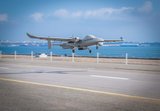
SPOC supports a low-SWaP radio that is scalable, upgradable and flexible to fit on different platforms. (Image: Northrop Grumman)
Northrop Grumman has carried out a flight test of its Software Programmable Open Mission Systems Compliant (SPOC) multifunction processor for the US Air Force, highlighting the ability to integrate current and future platforms using data links.
‘With the maturity of our technology, we have the solutions today that will provide unparalleled mission effectiveness,’ said VP communications solutions Jenna Paukstis. ‘We are connecting platforms that will benefit the joint force and provide them with real-time battlespace awareness across air, space, land and sea.’
SPOC supports a low-SWaP radio that is scalable, upgradable and flexible to fit on different platforms. The SPOC design also provides an integration environment for communications that can reduce cost, risk and time to deploy.
Related Articles
USAF seeks more Link 16 installation work for HC-130Js
ELTA Systems launches new airborne radio for network-centric operations
Northrop Grumman details bid for US Navy TACAMO aircraft replacement
Installed aboard Northrop Grumman’s airborne testbed flown from NAS Patuxent River, SPOC connected with a ground station in a live, over-the-air test using advanced waveforms.
The test flight is part of a USAF contract to develop and demonstrate a solution to help define the air force’s next generation radio approach.
More from Air Warfare
-
Canadian observer status reinforces GCAP’s strength in emerging ‘middle power’ bloc
The significant setback seen by FCAS earlier this year has secured GCAP’s position as Europe’s future sixth-generation fighter, while Canada’s potential observer status could push the programme into the next stage.
-
UK air focus: Drone spending trails European frontline states despite $10.46 billion valuation
Despite the UK having the third-largest military UAV market in Europe, the country appears to be underinvesting in the capability relative to the size of its economy, particularly when compared with Baltic and eastern European states.
-
Proteus: Forging the future of autonomous rotorcraft
As the home of British helicopters, Leonardo has worked with the UK Ministry of Defence for over a decade to advance technologies underpinning uncrewed rotorcraft. Today, in partnership with UK Defence Innovation and the Royal Navy, Leonardo is spearheading the next step in that journey: from remotely piloted technologies to fully autonomous systems.
-
US Air Force to add new capabilities to its in-service and future T-7A fleet
As the T-7A programme recovers from delays and rising costs, the USAF is signalling new opportunities in anti-jamming GPS, collision avoidance, advanced flight controls and pilot interface improvements.
-
“Fifth-gen capability without the cost”: how autonomous strike can change the face of air warfare
In Conversation… Armor Harris, Senior Vice President for Aircraft at Shield AI, talks to Shephard’s Gerrard Cowan about why cost-effective autonomous aircraft are a game-changer for air forces worldwide, and the key roles played by VTOL and AI as enabling technologies.
-
Additional delays might hit Pentagon’s critical air programmes, GAO warns
B-52 modernisation, Sentinel, MH-139A, T-7A and Air Force One replacement are among the US Air Force programmes the GAO says remain at risk of further schedule slips and cost growth due to acquisition and management challenges.