MQ-28A Ghost Bat: Australia’s drone charts the future of loyal wingman UAVs
Boeing Australia’s Ghost Bat concluded demonstrations four months ahead of schedule. (Photo: Boeing Australia)
Boeing Australia’s MQ-28A Ghost Bat stands as the oldest “loyal wingman” currently in development, with potential European opportunity on the horizon for the uncrewed aerial vehicle.


Boeing’s MQ-28A Ghost Bat stands as Australia’s first indigenously developed uncrewed aircraft and one of a few loyal wingman-type, fixed-wing drones currently being designed by industry, as countries look to bolster their armed forces and prepare for the next generation of warfare.
In development since around 2013 for the Royal Australian Air Force (RAAF) with its first public unveiling in 2019, the drone has undergone a rigorous testing programme to date.
Developed under a A$1 billion (US$659 million) contract with Boeing, the MQ-28A sits as part of a larger A$4.3 billion (US$2.8 billion) investment by the government in drone capabilities to enhance the Australian Defence Force (ADF).
Related Articles
Avalon 2025: Australia reimagines Ghost Bat as a proving platform and targets future versions
Paris Air Show 2025: Teaming success for E-7 and MQ-28 as Ghost Bat targets Europe
Ghost Bat drone makes first deployment in latest milestone
While the Australian government has invested in the system, Ghost Bat is now seen as a proving platform for understanding autonomy, testing further uncrewed aerial vehicle (UAV) developments, rather than as a system that would be deployed as part of a future force makeup. The “grandchild of Ghost Bat” would likely be the first drone added to the RAAF’s service inventory.
With a maximum take-off weight of 3,000kg and a stated range of 3,704km, a vital feature of the Block 1 prototype is its 2.5m long nose cone with a 1.5m³ volume designed as snap-on/snap-off, allowing for rapid interchange between roles.
Customers


Data from Shephard Defence Insight, October 2025.
According to Shephard Defence Insight, the RAAF currently has four MQ-28A aircraft in its inventory, with one also stationed in the US.
The US Navy previously disclosed that it was involved in the testing of the MQ-28A in April 2025, which could position the Ghost Bat as a potential pick for the latter’s collaborative combat aircraft (CCA) programme plans. The US Air Force also said in 2022 that it would use the MQ-28A for testing purposes feeding into its own CCA programme, where it then selected UAVs from Anduril and General Atomics Aeronautical Systems (GA-ASI).
Accelerated testing roadmap
In September 2025, Boeing Defence Australia disclosed that the aircraft had completed the RAAF capability demonstration test campaign in June – four months ahead of schedule.
The company revealed it had performed flight trials to demonstrate its operational capabilities with the MQ-28A completing 150 flight hours with more than 20,000 hours of virtual tests.
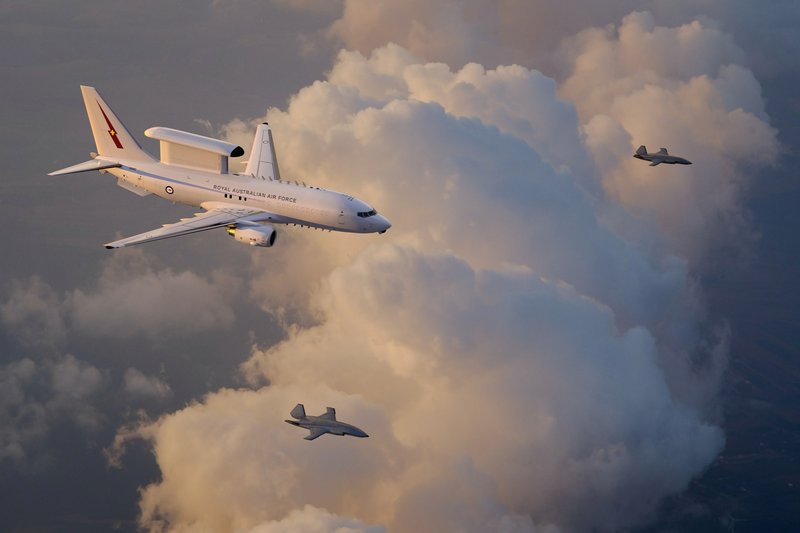
These capability demonstrations (CD25) included teaming with an E-7A Wedgetail airborne early warning and control aircraft and data sharing between multiple MQ-28A aircraft, transmitting it back to a crewed platform. Further trials for CD25 that were planned also included integration with F/A-18 and F-35A combat aircraft.
All of the validated capabilities will reportedly be present in the MQ-28A’s latest iteration, the Block 2 MQ-28, which is currently in production. It is currently building three Block 2 aircraft, with tests on the first aircraft expected by the end of the year.
In March 2025, Boeing further confirmed that the next stage for the MQ-28A demonstrator would be an air-to-air weapons fire testing which is planned for 2026, to further assess the maturity of the platform and its capabilities with a view to applying it into a future force mix.
European opportunity
Alongside Australian testing and US interest, the Ghost Bat has garnered significant potential interest from European allies as they too assess their future force fleet.
“A primary advantage of the Ghost Bat compared to its CCA competitors is how long it has been in development and its maturity. Boeing Defence Australia appears to have begun the aircraft’ s development in 2013, with the Australian government then investing A$40 million (US$28.7 million) for three prototypes,” Matty Todhunter, Shephard senior UAV analyst said.
At Paris Airshow in June 2025, Boeing Defense and Space president and CEO Steve Parker disclosed that it was in discussions with the UK on its MQ-28A as part of a set of wider conversations and interest from European countries for the UAV.
More broadly, Boeing further stated that it saw “significant opportunity in Europe because of their aspirations of autonomy”.
Newer UAVs targeting the European market specifically, namely the recently revealed CA-1 Europa offering from Helsing, appear visually similar to the MQ-28A Ghost Bat, Shephard Defence Insight noted.
Indeed, Ghost Bat MQ-28A stands as just one contender, out of several, which could be put forward as an option for various European countries’ loyal wingman requirements. Discussions on whether the aircraft would fit the bill for the UK’s Loyal Wingman programme had already been floated in 2023.
With efforts to field a sixth-generation fighter jet ongoing, there is also the need for a loyal wingman to accompany it – as well as acting as a UAV to fly and fight alongside fourth or fifth-generation fighters like the Typhoon or the F-35.
Various countries are undergoing loyal wingman programmes to select and field a MALE drone like the MQ-28A.
The UK Ministry of Defence has discussed whether the MQ-28A Ghost Bat could satisfy the country’s loyal wingman requirement. Likewise, Poland highlighted the Ghost Bat specifically for its loyal wingman requirement in 2023. Two years later, at MSPO 2025, Boeing augmented its offering to Poland’s crewed fighter programme by pitching the crewed aircraft alongside the Ghost Bat.
Related Programmes in Defence Insight
Collaborative Combat Aircraft (CCA) [USN]
Collaborative Combat Aircraft (CCA) [Germany]
Collaborative Combat Aircraft (CCA) [Australia]
Related Equipment in Defence Insight



More from Air Warfare
-
![New US Army UH-60M Black Hawk order bridges uncertain path to MV-75 transition]()
New US Army UH-60M Black Hawk order bridges uncertain path to MV-75 transition
The US$234 million award for 16 Sikorsky UH-60Ms preserves near-term production, but funding uncertainty and an undefinitised contract leave the US Army’s long-term Black Hawk requirements unresolved.
-
![V-22 Osprey safety upgrade moves towards wider fleet installation under $35.5 million deal]()
V-22 Osprey safety upgrade moves towards wider fleet installation under $35.5 million deal
Bell Boeing will supply 73 additional ODSSHI kits as NAVAIR prepares to introduce predictive drive-system monitoring across US and Japanese V-22 fleets.
-
![AFA 2026: US Air Force examines uncrewed cargo aircraft for contested logistics]()
AFA 2026: US Air Force examines uncrewed cargo aircraft for contested logistics
The US Air Force is evaluating demonstrators for uncrewed cargo missions as it considers logistics requirements across the Pacific and other contested environments.
-
![Germany air focus: Europe’s leading near-term air market targets domestic industry]()
Germany air focus: Europe’s leading near-term air market targets domestic industry
Between 2026 and 2032, almost a quarter of EU aircraft spending is expected to come from Germany. While crewed programmes seek modernisation and replacement, uncrewed opportunities look to introduce entirely new capabilities, with both highlighting sovereignty and domestic production.
-
![Europe risks losing control of CUAS production capacity as manufacturers look abroad]()
Europe risks losing control of CUAS production capacity as manufacturers look abroad
European counter-drone developers are securing early orders in the Middle East while slow domestic acquisition processes threaten to redirect production capacity, expertise and investment away from Europe.