Live-fire trials clear way for Spike NLOS missile integration with latest Apache helicopter
The AH-64E V6 model of the Apache has been operational with the US Army since 2021. (Photo: US Army)
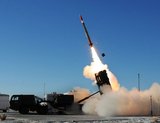
Lockheed Martin Missiles & Fire Control’s Precision Strike team has successfully fired two Rafael Spike NLOS all-up rounds (AURs) from the Boeing AH-64E V6 Apache attack helicopter. The trials were carried out on 26 January at Yuma Proving Ground in Arizona.
The live fire event verifies the Spike NLOS Long Range Precision Munitions Directed Requirement (LRPM DR) system’s integration onto the Apache platform and allows it to enter qualification testing.
‘The successful integration of Spike NLOS on the Apache platform demonstrates Lockheed Martin’s continued commitment to 21st century security solutions that help our customers complete their missions,’ said Tom Bargnesi, programme management senior manager of the Precision Strike team. ‘The system’s expansion onto additional platforms, along with its mission-focused defence capabilities, ensures it will help the US Army stay ahead of ready in an ever-evolving threat environment.’
Related Articles
Airbus H145M successfully fires Spike ER2 missile
US Army orders more EO fire control system components for Apache attack helos
US F-15EX successfully tests new missile stations
The demonstration saw two Spike NLOS AURs fired from an AH-64 at stationary targets in separate scenarios.
Spike NLOS system will next begin testing to qualify the design for airworthiness release (AWR). Once AWR is awarded, the system is scheduled be fielded on the US Army’s AH-64E V6 fleet by September 2024.
According to Shephard Defence Insight,, the US Army plans to acquire 791 AH-64Es (a combination of new and remanufactured aircraft) to fulfil its attack helicopter requirements. The service intends to sustain the Apache fleet through the year 2040.
Related Programmes in Defence Insight
Related Equipment in Defence Insight
More from Air Warfare
-
NATO’s GlobalEye selection reflects a move towards greater European defence autonomy
The joint acquisition of Saab’s GlobalEye AEW&C aircraft by 11 allies marks the end of NATO’s more than four-decade reliance on a US-built airborne early warning platform.
-
NATO expands high-altitude intelligence capability with MQ-4C Triton purchase
The proposed drone acquisition is intended to form part of a distributed structure of surveillance capabilities, complementing systems such as the RQ-4D Global Hawks already acquired by NATO.
-
US Air Force lays the groundwork to move the F-15EX acquisition to lots 7 and 8
Procurement of the Eagle Passive Active Warning Survivability System for future production lots signals the air force's commitment to an expanded 267-aircraft Eagle II fleet while sustaining full electronic warfare capability on every fighter.
-
US Air Force unveils new details of Next Generation Airlift aircraft to replace C-17 and C-5
New planning documents reveal how the service is defining the aircraft expected to succeed the C-17 and C-5, including its initial requirements and procurement roadmap.
-
Could CUAS demand open a new market for armed trainer aircraft?
As affordable counter-drone solutions become a military priority, repurposing training aircraft could emerge as a credible option to prepare for emergency scenarios.
-
A new shape in the sky? Mapping out the F-47’s configuration
As images of what might be an F-47 prototype or proof-of-concept vehicle emerge from the Nevada desert, what do they tell us about the aircraft’s capabilities and enabling technologies?