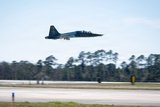
Germany requests major F-35 Lightning II-related FMS package
A USAF F-35A lands at Spangdahlem Air Base in Germany on 2 May 2022. (Photo: USAF/Tech Sgt Anthony Plyler)
Following the shock announcement in March that Germany intends to buy the F-35A Lightning II Joint Strike Fighter, Berlin has lodged a major $8.4 billion FMS request.


The US State Department on 28 July announced its approval of an $8.4 billion potential FMS deal for Germany, covering the supply of F-35A Lightning II Joint Strike Fighters, munitions and related equipment.
‘The Defense Security Cooperation Agency delivered the required certification notifying Congress of this possible sale today,’ the State Department noted.
Germany is requesting 35 F-35A aircraft, 37 Pratt & Whitney F135-PW-100 engines and an extensive weapons package, comprising:
- 105 AIM-120C-8 Advanced Medium Range Air-to-Air Missiles (AMRAAM) and four guidance sections for the AIM-120C-8.
- 75 AGM-158B/B2 Joint Air-to-Surface Standoff Missiles-Extended Range (JASSM-ERs) plus two inert missiles with test instrumentation kits and two Separation Test Vehicles
- 344 GBU-53 StormBreaker precision-guided glide bombs plus three Guided Test Vehicles and eight Captive Carry Reliability Trainers
- 162 BLU-109 2,000lb hardened penetrator bombs plus 30 inert bombs
- 264 MK-82 500lb general-purpose bombs plus six inert bombs
- 180 tail kits for the GBU-31 Joint Direct Attack Munition (JDAM)
- 246 tail kits for the GBU-54 Laser JDAM
- 75 AIM-9X Block II+ Tactical Sidewinder missiles plus 30 more for training
- 15 AIM-9X Block II+ guidance control units plus five more for combat arms training and maintenance.
F-35 OEM Lockheed Martin plus Pratt & Whitney, Boeing and Raytheon have been named as prime contractors of the aforementioned equipment, with industrial offset arrangements a distinct possibility.
Also included are avionics, EW equipment, navigation systems, training services, and engineering and logistics support.
The F-35A in German Air Force service would replace Tornado multirole fighters with a more advanced platform: JASSM-ER, for instance, would enable long-range conventional precision strike.
The new fifth-generation fighters would also be capable of undertaking nuclear strike missions armed with the B61-12 bomb.
For many years this was a contentious political issue in Germany but it is now arguably of lesser importance than the increased threat of Russian aggression against NATO amid Moscow’s war on Ukraine.
Shephard Defence Insight notes that the German Air Force operates 86 Tornados, 45 of which are nuclear mission-capable Tornado IDS aircraft.
‘The proposed sale [of F-35As and associated weapons] will improve Germany’s capability to meet current and future threats by providing a suitable replacement for Germany’s retiring Tornado aircraft fleet in support of NATO’s nuclear sharing mission’ as the centrepiece for European deterrence, the State Department noted.
Related Programmes in Defence Insight
Tornado Replacement (F-35A) [Germany]
Related Equipment in Defence Insight


More from Air Warfare
-
![July drone digest: Sovereign production takes centre stage at Farnborough]()
July drone digest: Sovereign production takes centre stage at Farnborough
Farnborough International Airshow (FIA) 2026 revealed the growing scale of the UK’s uncrewed ambitions, with companies showcasing new CCA, autonomous wingmen and surveillance drones, while sovereign production emerged as a key factor for multiple programmes.
-
![FIA 2026: Bell highlights MOSA-driven growth path for MV-75 Cheyenne]()
FIA 2026: Bell highlights MOSA-driven growth path for MV-75 Cheyenne
Bell Flight’s modular open-systems approach for the US Army’s MV-75 Cheyenne could open doors for international allies and suppliers once locked out by closed rotorcraft architectures.
-
![Maximise survivability with advanced electronic warfare (video)]()
Maximise survivability with advanced electronic warfare (video)
BAE Systems’ all-digital EW delivers 360-degree threat awareness in contested environments, boosts survivability, and cuts lifecycle costs.
-
![US Air Force seeks avionics upgrades for ageing T-38 Talon as T-7A Red Hawk delays persist]()
US Air Force seeks avionics upgrades for ageing T-38 Talon as T-7A Red Hawk delays persist
The USAF is looking for commercial avionics solutions to improve the T-38 Talon’s reliability, readiness and flight safety as continued T-7A Red Hawk delays increase the likelihood that the legacy trainer will remain in service longer than planned.
-
![British Army’s Project Corvus selection highlights new era of drone sovereignty]()
British Army’s Project Corvus selection highlights new era of drone sovereignty
The UK’s choice of the Tekever AR5 for Project Corvus reflects a wider shift in military drone procurement towards solutions that centre on sovereignty and domestic production, moving away from overseas reliance.