Germany greenlights F-35 jet purchase for nuclear strike role
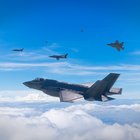
Germany's F-35s will replace its ageing fleet of Tornadoes. (Photo: Lockheed Martin)
Germany is buying the F-35A conventional take-off and landing variant of the fighter jet.


The German Parliament’s budget committee has greenlit the purchase of 35 Lockheed Martin F-35s for the German Air Force.
The F-35s will replace ageing Tornadoes in the nuclear-carrying role in a deal worth €8.3 billion ($8.8 billion).
The Foreign Military Sale (FMS) includes engines, role-specific mission equipment, spare and replacement parts, technical and logistic support, training and armament.
Related Articles
Remarkable turnaround sees Germany pick F-35 and Eurofighter ECR
Singapore leaves door open to F-35 variants
UPDATED: FCAS is ‘on the way to first flight’, says Airbus
German Air Force head Lt Gen Ingo Gerhartz said in a statement: ‘There is only one answer to Putin’s aggression: unity in NATO and credible deterrence. That is precisely why the decision for the F-35 is without alternative,’
Gerhartz added that, combined with further development of the Eurofighter Typhoon; the German Air Force was taking ‘an important step’ towards the future.
Deliveries of the aircraft will begin in 2026. The first eight F-35s will be stationed in the US for pilot and ground crew training.
From 2027, aircraft will be stationed at Büchel Air Base to enable nuclear participation.
Over 875 F-35s have been delivered and are in service with numerous air forces.
Related Programmes in Defence Insight
Tornado Replacement (F-35A) [Germany]
Related Equipment in Defence Insight

You may also like
More from Air Warfare
-
![Northrop–Hermeus deal underscores push to pair startup speed with defence know-how]()
Northrop–Hermeus deal underscores push to pair startup speed with defence know-how
Northrop Grumman plans mission systems testing following its Hermeus agreement, highlighting how established defence contractors are partnering with newer companies to accelerate development and bring autonomous capabilities to military customers.
-
![Advances in AI sensing technology reshape how UAV operators interpret battlefield data]()
Advances in AI sensing technology reshape how UAV operators interpret battlefield data
AI-powered sensing technologies are advancing battlefield intelligence capabilities, with companies including Sightline Intelligence and Arkeus developing smaller, more sophisticated systems to help military UAV operators process data and identify threats.
-
![Propulsion for the autonomous era]()
Propulsion for the autonomous era
For decades, advanced military propulsion has centred on enabling ever-more capable fighters and bombers – delivering more thrust, more range, greater power, and thermal management, plus longer service lives. Those requirements remain essential. However, the rise of autonomous systems, advanced effectors, and autonomous collaborative platforms is redefining what that propulsion must deliver.
-
![Czech Republic UAV focus: moderate market value masks limited supplier opportunities]()
Czech Republic UAV focus: moderate market value masks limited supplier opportunities
The Czech Republic’s shift towards smaller uncrewed aerial vehicles has reshaped its procurement priorities, leaving nearly three-quarters of the market unawarded. Yet with this value concentrated in just two programmes, the highest-value opportunities could contain a high level of risk.
-
![RAF Protector fleet grows as UK maritime surveillance role takes shape]()
RAF Protector fleet grows as UK maritime surveillance role takes shape
The RAF’s expanding Protector RG1 fleet could play a growing role in UK maritime surveillance following its first domestic operational sorties, with further aircraft deliveries scheduled through 2027.
-
![Leonardo details Proteus’s path to autonomous anti-submarine missions for the Royal Navy]()
Leonardo details Proteus’s path to autonomous anti-submarine missions for the Royal Navy
Leonardo’s integration of Shield AI’s Hivemind software could enable its Proteus uncrewed helicopter to conduct independent anti-submarine warfare missions, supporting the Royal Navy’s plans for a future hybrid air wing.