Connecting the layers: how networks can secure the future of European air defence
The rise of drones has reshaped the threat landscape for all European militaries. For industry, future defensive strategies must carefully balance a mix of passive and active measures to address the evolving danger, based around a highly integrated and responsive network of sensors and effectors.


Brought to you in partnership with Rheinmetall
The most critical lesson from recent conflicts is that the lower airspace – up to 3,000 metres above ground level – now belongs to drones, according to Reto Maurer, Senior Vice President of Sales at Rheinmetall Air Defence.
“It’s now no longer the legacy threats like aircraft or cruise missiles in this layer – it’s drones,” he warned.
This has a natural impact on air defence. Traditional options like high-end combat aircraft or ground-based air defence (GBAD) systems using interceptor missiles are no longer capable of achieving air superiority on their own within this specific airspace layer, Maurer said, “due to the sheer volume, low radar cross-section and cost asymmetry of unmanned aerial vehicles (UAVs)”.
Calibrated mixture
This means that future air defence strategies will have to change, requiring a carefully calibrated mixture of measures – both passive and active – designed to disrupt, degrade and neutralise the operational effects of pervasive drone deployments. This demands a genuinely layered air defence architecture built upon an intelligent and unified command-and-control (C2) system.
“This approach ensures that high-value, limited interceptors are preserved for high-end threats, while massed, low-cost threats are neutralised using cost-appropriate measures,” Maurer said.
The fundamental requirement is for a robust and adaptable network that can combine sensors and effectors to maximise their capabilities and efficiency, he added. This paradigm shift to integrated air and missile defence (IAMD) is an essential response to the rise of stealthier, more numerous and less predictable threats across the airspace, from hypersonic missiles to low-altitude cruise missiles and massed drone swarms.
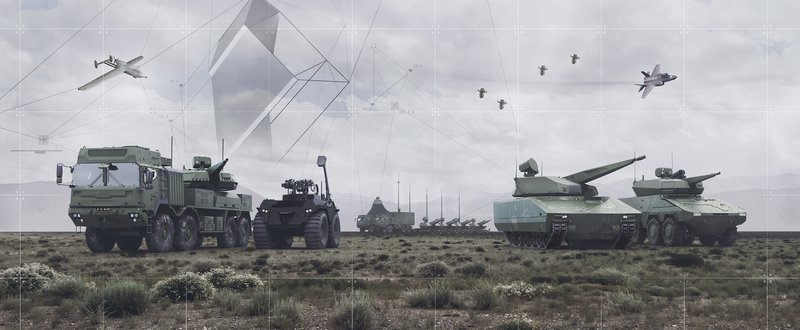
“Networking has become absolutely critical and foundational to modern air defence. The decisive capability in contemporary and future conflicts is undeniably the ability to seamlessly connect sensors, C2 systems and effectors, whether missiles, lasers or guns, into a unified, coherent web, rather than relying on isolated, siloed platforms,” Maurer said.
Extending Oerlikon’s legacy
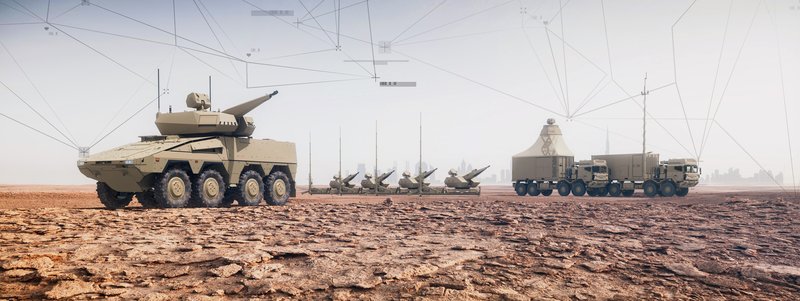
Such networking capability is a fundamental focus for Rheinmetall Air Defence. Maurer highlighted the Oerlikon Skynex system, a short-range air defence (SHORAD) solution combining the Oerlikon Revolver Gun Mk3, the Oerlikon Twin Gun GDF009 TREO, surface-to-air missiles and passive electronic warfare effectors.
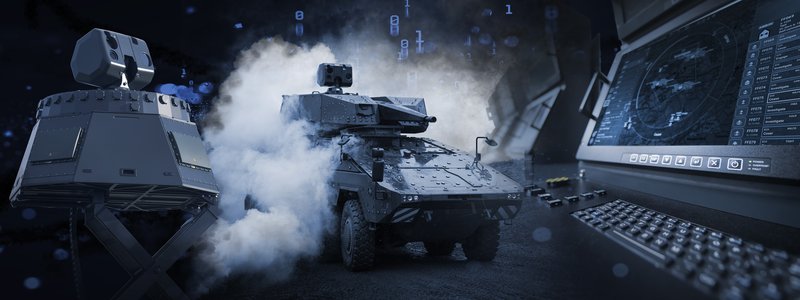
Skynex is built around the Skymaster battle management system, allowing it to connect to a wide range of sensors and radars, including the Oerlikon X-TAR3D tactical acquisition radar.
The networked approach creates a range of practical advantages. For example, Maurer noted that Rheinmetall’s Oerlikon AHEAD intelligent airburst ammunition family provides a cost-effective way to address drones, particularly faster fixed-wing threats. This could be networked with interceptor UAVs from other manufacturers, he said, offering a wider range of options depending on the nature of the scenario.
“Instead of standalone platforms, Rheinmetall integrates sensors, automated C2 and effectors into a digitised network. This ensures threat data is instantly shared across domains, allowing the system to rapidly deploy the most efficient countermeasure – from programmable ammunition to missiles – anywhere in the theatre,” he explained.
Beyond gun-based protection
Rheinmetall is further expanding its air defence portfolio beyond the traditional gun-based vital asset protection segment, he noted. The aim is to build a highly scalable, modular and cost-effective ecosystem of mobile and static SHORAD systems designed to counter complex saturation attacks.
While Skynex already represents a key capability, the company is pursuing new avenues to expand its air defence offering across different requirements, including through a new partnership with South Korea’s LIG Defense & Aerospace. Likewise, additional technologies are likely to be integrated into the air defence picture in the future, he said, notably high-energy lasers.
Wider battlespace connectivity is also critical to this air defence concept, Maurer added. Fusing data across sensors in different domains – including space – eliminates isolated silos and helps build a unified operational picture.
Maurer said Rheinmetall’s new Digital Systems division has been established to address these challenges, focusing on building the elements needed to support networks and connect sensors and systems beyond just air defence to create a more comprehensive capability set.
Lessons from Ukraine
The Ukraine conflict has fundamentally reshaped air defence, Maurer said, “proving that systems must dynamically accompany fast-moving manoeuvre forces”.
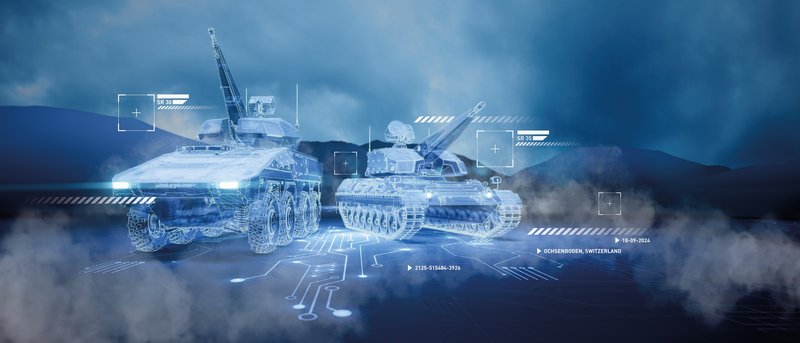
Rheinmetall’s Skyranger armoured mobile GBAD systems must confront a range of challenges in its use in Ukraine due to the sheer mass of cheap, first-person view (FPV) drones in the kill zone, he noted. The solution is manned-unmanned teaming (MUM-T), where smaller, autonomous unmanned sensors and effectors are deployed directly into the forward area to absorb drone waves and break the stalemate.
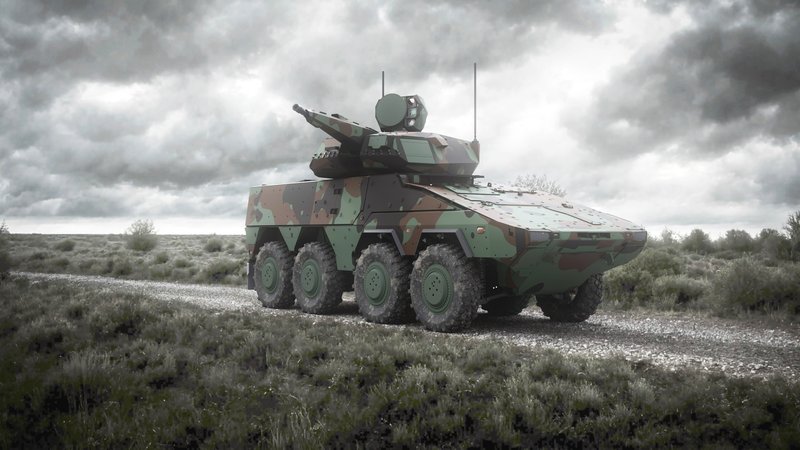
“This allows the manned Skyranger platforms to remain slightly further back in the combat support area, safely coordinating the network while providing vital force protection for high-end critical assets,” Maurer confirmed.
European ambitions
The lessons from Ukraine also underscore the urgent demand for an interoperable European air defence architecture, he noted. Historically, IAMD has been deeply fragmented across the continent, split between dozens of sovereign nations utilising incompatible platforms, sensors and weapons. Realistically, these cannot be replaced wholesale, so must instead be connected and integrated into a singular, unified shield, he said.
The answer is to adopt a modular open-systems approach, utilising standardised software interfaces and artificial-intelligence driven C2 networks – such as a shared combat cloud – to break away from siloed systems.
“In practice, this allows a sensor from one nation, like a French radar, to seamlessly share real-time tracking data and assign targets to another nation’s effector, such as a German or American missile battery, without operational delay,” Maurer noted.
From a procurement perspective, European governments need to provide the defence industry with the reliable planning foundation and stability it needs by focusing on long-term contracts, he said.
There are already signs of such an approach, including at EU level, Maurer added. For example, the Security Action for Europe Fund (SAFE) provides long-term loans to support defence investment and was used to underwrite a recent order from Romania for a package of systems, including Lynx armoured vehicles and Skyranger air defence systems.
“If we have this planning certainty and we can expect orders from the government for those capabilities, then companies will invest the means to increase the production capacity,” he noted.
Accelerating the process
The move towards layered architectures is set to accelerate in the future, with multi-mission capabilities empowering militaries to effectively combat the new threat from high-volume drones and missiles. There will need to be a combination of kinetic kills and specialised drone-versus-drone technologies, based on advanced gun systems and cost-effective, scalable, counter-mass interceptors, according to Maurer.
The nature of the threat means the defensive response must expand beyond traditional battlefields, he concluded, protecting critical civilian infrastructure and delivering on homeland security needs.
“These interceptors and defensive layers are ultimately enabled by automated, multi-domain C2 systems and space-based early warning networks, which drastically accelerate threat detection and response times across the entire air defence spectrum.”


More from Studio
-
![Front-line support: how UK industry is helping tackle Ukraine’s landmine challenges]()
Front-line support: how UK industry is helping tackle Ukraine’s landmine challenges
Pearson Engineering has provided equipment and engineering expertise to the Armed Forces of Ukraine since the beginning of the full-scale Russian invasion in 2022. The British company is now working to deepen engagement with the Ukrainian defence industry, expanding its support for the country’s population and laying the foundations for future technological innovation.
-
![Integrated approach: transforming vehicle communications for a new era of warfare]()
Integrated approach: transforming vehicle communications for a new era of warfare
In the modern battlespace, military intercom systems can no longer operate in isolation. They must instead be integrated with the wider tactical network, gaining operational advantages through secure communications with dismounted soliders and other assets across domains.
-
![Active protection systems: from optional upgrade to operational requirement]()
Active protection systems: from optional upgrade to operational requirement
As battlefield threats multiply, active protection systems are becoming increasingly important for armoured vehicle survivability – but cost, integration challenges and evolving drone threats will determine how widely they can be deployed.
-
![How laser weapons could transform the economics of European air defence (Podcast)]()
How laser weapons could transform the economics of European air defence (Podcast)
Former UK Defence Secretary Lord John Hutton examines how drones, missiles, laser weapons and procurement pressures are reshaping European air defence.
-
![How Pearson Engineering combines tradition with innovation for the demining mission (Video)]()
How Pearson Engineering combines tradition with innovation for the demining mission (Video)
At Eurosatory 2026, Pearson Engineering's Group CEO Ian Bell talked about the company's role in delivering specialist armoured engineering, route-clearance and demining capabilities to military customers around the world.
-
![Ukraine experience forces rethink of counter-UAS doctrine]()
Ukraine experience forces rethink of counter-UAS doctrine
A panel session at Eurosatory 2026 brought together industry, academia and the French armed forces to assess how Ukraine’s battlefield reality is reshaping counter-UAS (CUAS) technology, air defence doctrine and Western procurement priorities.