How laser weapons could transform the economics of European air defence (Podcast)
Former UK Defence Secretary Lord John Hutton examines how drones, missiles, laser weapons and procurement pressures are reshaping European air defence.


Brought to you in partnership with Rafael
Listen on Apple Podcasts, Amazon Music, Spotify and more.
Continuing conflicts in Ukraine and the Middle East have highlighted the rapid evolution of air warfare. Threats including uncrewed aerial vehicles (UAVs), ballistic missiles and hypersonics , combined with the economics of rearmament, are placing new pressures on European air defence systems.
On 15 September, Italian fighter aircraft deployed on NATO’s air defence mission shot down a drone that had entered Lithuanian airspace, with preliminary evidence indicating that it had crossed from Belarus. The incident highlighted the challenges facing European air defence forces.
Speaking to Shephard for the Designed for Advantage podcast series, Lord John Hutton, former UK Secretary of State for Defence and former chair of the Royal United Services Institute (RUSI), discussed how Europe could respond, fund much-needed equipment and exploit emerging air defence technologies.
The changing air defence challenge
Hutton said the conflicts in Ukraine and the Middle East were “probably changing the face of the air domain and what we understand campaigns in the air to be all about”.
Technological developments, including the rapid adoption of UAVs and the use of hypersonic, cruise and ballistic missiles, have changed the nature of air warfare. Hutton argued that militaries had previously “been slow to pick up some of the changes in technology”, meaning debate in the UK and Europe remained “largely dominated by… big platforms, big ships [and] main battle tanks”.
While those platforms continued to have an important role, Hutton said more resources needed to be devoted to thinking “about the air domain in greater detail”.
Filling capability gaps in the UK and Europe was “probably one of the biggest challenges for policymakers”, he added.
Hutton said policymakers needed to consider how air defences could be strengthened to meet emerging threats: “I think we’ve got some way to go – we’ve got limited stockpiles, we don’t really have much by way of deployed high-energy laser weapon systems across Europe and across NATO – so these are big gaps we’ve got to fill [and] we’ve got to fill them pretty quickly.”
Lessons from Lithuania
Hutton described the drone intrusion into Lithuanian airspace and NATO’s response as “a perfect example of the problem we’ve got to solve here”, arguing that Europe needed more adaptable and cost-effective air defence options.
With public finances across the UK and Europe under pressure, repeatedly deploying fighter aircraft against low-cost UAVs raised questions about the economics of air defence. Hutton nevertheless argued that an effective rearmament programme remained necessary.
“We’ve got to study the economics of the air domain very, very closely and I think that’s particularly true for the emerging technology around laser weapon systems,” Hutton said. “These offer not just a way of managing complicated stockpiles and manpower associated with big, heavy, technologically challenging weapon systems, but the question of an almost inexhaustible supply of ammunition, which I think you’re going to need.”
Hutton argued that laser weapons could form part of a layered air defence system and offer an alternative to deploying fighter aircraft against threats such as UAV swarms, in part because of their “pretty limitless supply of ammunition”.
He also described NATO’s collaborative frameworks and industrial partnerships as an “ideal platform” for mobilising resources and addressing capability gaps. With what he regarded as a narrow window for modernisation, Hutton argued that European decision-makers needed to accelerate efforts to re-equip and protect allied airspace.
Procurement and NATO
“It’s essential for the political operation of NATO that the partnership is working, not just at the political level, but all the way through down into the armed forces themselves,” Hutton said. “However, the primary obstacle facing the alliance today is not structural design, but resourcing.”
Hutton characterised modernising air defence as both a procurement and political challenge. Governments needed to authorise technology acquisitions and give armed forces the mandate and resources to buy available solutions rapidly, he argued.
He said European countries had more work to do both to accelerate air defence procurement and ensure acquisitions reflected emerging threats: “Some member countries of NATO are responding, probably in my view, better than others; some are still not really moving ahead as quickly as I think they should be.”
The role of lasers
A key advantage of laser weapons was that “they provide more than just the last line of defence”, Hutton said.
“We’ve got a range of things we’ve got to address; we’ve got to protect our critical national infrastructure; we’ve got to provide defence for forward-deployed forces on the ground who are going to come under attack, particularly from drones.”
Hutton argued that such tactical environments could make laser weapons “one of the key ways that we manage these multiple threats in the air domain”, while acknowledging the “steep challenge” facing armed forces.
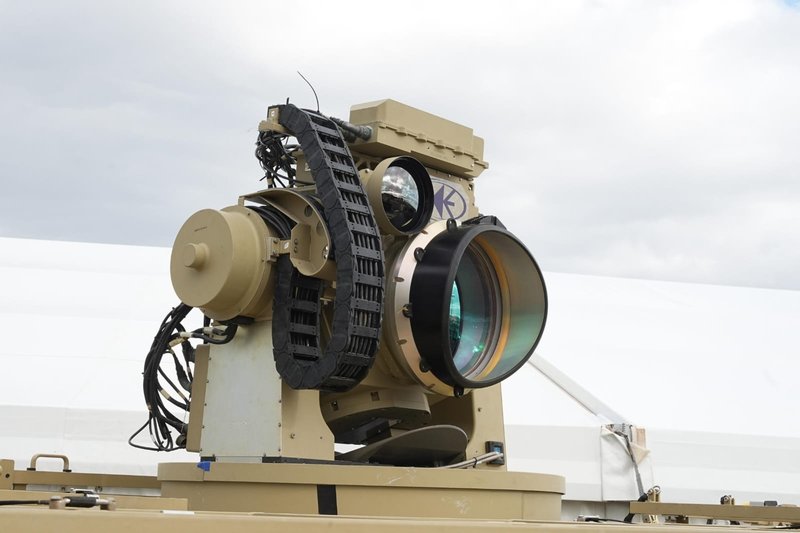
He was nevertheless optimistic about the scope for cooperation between allies.
“We’ve got to rethink a lot of our work in this space, but the great thing about this whole area is that you know people are talking to each other, particularly across the NATO space, our friends and allies around the world, [so] we’re not designing things from scratch,” he said.
Hutton also sought to challenge perceptions about the maturity, accuracy and capabilities of high-energy weapon systems. He pointed to recent combat experience, particularly in the Middle East, as evidence that some systems had reached operational maturity.
“If we’re in the marketplace and we want to acquire these weapons systems quickly, I think we’ve got a lot of people out there who could help us with that.”
Preparing for faster procurement
The pace of technological change has also raised questions about whether traditional procurement timelines are suited to Europe’s current security environment. Hutton contrasted current requirements with development cycles during the Cold War, when complex platforms could take decades to move from inception to production.
During the Cold War, allied countries had the “luxury of time because we were pretty sure there was actually a limited prospect of heavy conventional fighting in Europe”, Hutton said. The current security environment required a different procurement mindset, he argued.
“When UK armed forces have been involved in conflict, both in Iraq and Afghanistan in recent years, we did move very quickly to much more agile procurement,” he said. “We had a set of urgent operational requirements that industry were briefed about… and we produced some amazing kit very quickly – that’s the mindset we need to deploy to these new challenges we’re facing.”
Against the possibility of a future conflict involving Russia, Hutton argued that European countries “don’t have a decade to think about this” and said political support would be essential to accelerating procurement.
“I certainly think the UK MoD is perfectly capable of switching to that kind of mindset, but it’s got to be driven by the political leaders of the country, the ones who actually make the decisions about this,” Hutton said. “Whenever [the military is] given the green light [they are ready to go], but someone’s got to give them the green light to move – and that means essentially that they’re given the resources to procure.”
Despite the threats facing Europe, Hutton concluded that “the good news is that there are technologies out there that can help us deal with that threat… and if we act quickly, then we can secure the NATO airspace – and I think most people in Europe want us to do that, so let’s get on with it.”
Discover how Rafael’s directed energy weapon systems are enabling the use of laser technology for reliable air defence.




More from The Shephard Defence Podcast
-
![Intelligence innovation: From data overload to decision advantage (Podcast)]()
Intelligence innovation: From data overload to decision advantage (Podcast)
As militaries face an overwhelming flow of data, the challenge is shifting from collection to delivering fast, actionable insights that drive decision-making. Advances in AI and data integration are helping armed forces move beyond siloed systems to generate real-time intelligence across domains and allies.
-
![Layered protection: How air defence is adapting to rising drone and missile threats (Podcast)]()
Layered protection: How air defence is adapting to rising drone and missile threats (Podcast)
A surge in aerial threats – from advanced missiles to low-cost drones – is reshaping the way militaries approach air defence, driving demand for flexible, multi-layered solutions.
-
![Energy evolution: How laser defence systems are powering the next phase of air defence (Podcast)]()
Energy evolution: How laser defence systems are powering the next phase of air defence (Podcast)
Laser-based air defence is moving from promise to deployment as global threats evolve. In this special podcast, we explore how high-energy laser systems are reshaping interception strategies.
-
![How satcom is shaping the future of fast, accurate warfare (Podcast)]()
How satcom is shaping the future of fast, accurate warfare (Podcast)
"Speed is the key advantage and accuracy is the key outcome": Amazon Kuiper Government Solutions’ Rick Freeman talks to Shephard’s Georgia Lewis about how space-as-a-service is transforming defence connectivity and access to satellite capabilities.
-
![Precision on Demand: The New Age of Loitering Weapons (Podcast)]()
Precision on Demand: The New Age of Loitering Weapons (Podcast)
Loitering munitions provide vital capabilities in the disrupted and unpredictable modern battlespace, from real-time ISR to a virtually “on demand” strike capability. Rafael is looking to the future of the technology, empowering systems to operate with increasing autonomy in hostile environments.
-
![Beyond Survivability: How Active Protection Systems Are Empowering Commanders (Podcast)]()
Beyond Survivability: How Active Protection Systems Are Empowering Commanders (Podcast)
As threats diversify and intensify, APS are proving essential not just for vehicle protection but also for enhancing operational freedom, effectiveness and mission success in contested environments.