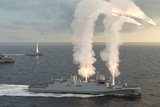
Raytheon integrates mid-course and terminal guidance for Maritime Strike Tomahawk
Block V Tomahawk launch from USS Chafee in November 2020. (Photo: USN/Ensign Sean Ianno)
Raytheon obtains Tomahawk Block Va contract modification from NAVAIR.


Raytheon Technologies is to integrate, produce, qualify, test and field Tomahawk Block Va (Maritime Strike Tomahawk - MST) seeker suites and all subsystems required to provide mid-course and terminal guidance, under a $19.59 million contract modification from US Naval Air Systems Command (NAVAIR).
‘The procured quantity of seeker suites will be installed in recertified Tomahawk missiles for the Navy,’ the DoD announced on 29 October, adding that work is expected to be completed by October 2024.
All Tomahawk Block IVs in USN service are being upgraded to the Block V/Va/Vb configuration with a longer range, dynamic targeting and (in the case of MST) the capability to hit vessels at sea.
In this context, MST was name-checked by ADM Philip Davidson, head of the US Indo-Pacific Command (INDOPACOM) during a Senate Armed Services Committee appearance in March 2021 as one of the crucial weapon systems required for US forces in the region.
The UK RN is also installing the missile on its Type 26 (City-class) frigates and MST is also earmarked for the future Canadian Surface Combatant.
Related Equipment in Defence Insight



More from Naval Warfare
-
![Quantum Systems enters maritime domain with Baltic-focused USV and UUV]()
Quantum Systems enters maritime domain with Baltic-focused USV and UUV
Quantum Systems has launched into the maritime domain with Seavex and Subvex, aiming to close a Baltic Sea ISR gap opened by infrastructure sabotage.
-
![Suppliers await next step in Australia’s mine warfare transition]()
Suppliers await next step in Australia’s mine warfare transition
Australia’s mine countermeasure capability remains in flux as the Huon-class nears retirement, but accelerated investment in autonomous systems is opening a path for industry.
-
![Can the US Navy ask Indo-Pacific allies to do more while training with them less?]()
Can the US Navy ask Indo-Pacific allies to do more while training with them less?
As the Iran War draws US ships and marine corps units away from the Indo-Pacific, curtailed exercises and a temporary carrier gap are exposing tensions between Washington’s demand for more self-reliant allies and the joint training needed to realise that ambition.
-
![How could Rheinmetall’s GMF 140 fit with ongoing programmes in North America?]()
How could Rheinmetall’s GMF 140 fit with ongoing programmes in North America?
With Canada committed to its River-class replacement and the USN pursuing a lower-cost frigate, Rheinmetall will need to demonstrate where the GMF 140 can fill a capability gap in the North American fleet.
-
![Australian industry programme builds pipeline for Virginia-class sustainment]()
Australian industry programme builds pipeline for Virginia-class sustainment
Australian businesses can now bid to support Virginia-class submarine sustainment in Western Australia, as momentum around the Henderson Defence Precinct also builds.