Cutting-edge harbor security, surveillance & protection system (Sponsored)
The stakes are high as loss of port services can have far reaching strategic and economic ramifications.


This article is brought to you by IAI.
From terrorist assault, sabotage and cyber-attack through to smuggling and other criminal activities, seaports today are challenged with a range of threats that can harm vessels, facilities and employees - disrupting or even halting continuous operation.
Addressing the need to provide comprehensive port protection against the myriad present and future dangers, ELTA Systems Ltd., the defense electronics subsidiary of Israel Aerospace Industries (IAI), Israel’s largest aerospace and defense company, has leveraged its rich technological heritage and culture of innovation to field Port Guard (ELI-3320); a unique, proven, fully integrated, end-to-end security solution designed for the complex operating environment of modern port facilities.
Port Guard
Port Guard provides operators and authorities with full situational awareness together with the necessary tools to react to events in real-time regardless of environmental conditions. The system is efficient, minimizing costs and labor requirements while addressing all aspects of port surveillance and defense.
Port Guard’s interconnected and interoperable sensors and systems fuse large quantities of collected data into coherent actionable intelligence. All the surveillance systems - in the air, on the ground, at sea and underwater - are managed from a centralized location supporting remote access to enable effective off-site operation.
The system incorporates IAI-ELTA’s cyber security and intelligence system know-how to quickly generate automated recommended actions, alleviating the heavy cognitive load placed on operators and decision makers and allowing them to focus attention and resources in the most efficient manner.
Port Guard’s flexible, modular, open architecture enables the system to be tailored from IAI’s wide range of proven sensors, systems, and platforms together with existing and third-party solutions to realize an optimized configuration suited to local geography, operating conditions, and threats. Moreover, the system design is future proof: upgrades can be added for rapid adaptation to new and evolving threats.
Available sensors
Available sensors include: advanced radars employing modern technologies such as linear frequency modulation continuous wave (LFMCW) and Digital Beam Forming (DBF) for persistent surveillance and the simultaneously tracking of hundreds of ground, sea, and airborne targets; SIGINT Suite with state of the art Vector Sensor Antenna (VSA) technology for passive RF and radar detection and classification; EO/IR payloads for day/night surveillance and targeting; Drone Guard anti-drone system for detection, tracking, and mitigation of drones and small unmanned aerial vehicles; Diver Detection System (DDS) underwater sonar for detection, classification and tracking; Fiber optic Underwater Electronic Fence for harbor protection; Automatic Identification Systems (AIS) and Satellite AIS (S-AIS); and various other sensors such as License Plate Readers and Optical Threat Detection Systems.
Auxiliary equipment, such as searchlights, loudspeakers, underwater cameras, and underwater security lights are also included with the turnkey solution. These are often contracted with local suppliers to ensure local compatibility and support.
The sensors can be deployed from fixed installations incorporating strategically located towers, tethered balloons, hovering masts, and other solutions. In addition, a wide choice of mobile platforms is available to complete the security array. Airborne solutions range from satellites and fixed and rotary wing surveillance aircraft through to UAVs and small drones. Ground based platforms include manned and unmanned surveillance vehicles, including ground robotics systems. For example, IAI-ELTA’s unmanned Guardium system can be deployed to provide autonomous, all weather, day/night, 24/7 perimeter security with a variety of payloads, such as radar and EO/IR camera.
This proven system increases protection without requiring substantial deployment of human resources. Seaborne platforms include both surface craft and undersea vehicles, both manned and unmanned, equipped with the necessary sensors.
The platform is consistently learning and adapting to new threats through a built-in Machine Learning (ML) engine.— IAI
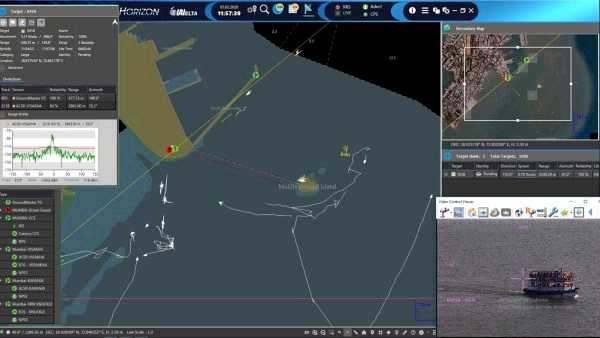
Port Guard is controlled via IAI-ELTA’s Horizon Command and Control Center (C2). Horizon manages all the sensors and systems and facilitates interchangeability to meet operational and environmental conditions. It collects data from the sensors, automatically correlates the information and creates a unified situational awareness picture that enables the timely deployment of countermeasures against all the interests and threats. Horizon connects to distributed small local port C2 stations to provide unified, full arena situational awareness.
The platform is consistently learning and adapting to new threats through a built-in Machine Learning (ML) engine. Horizon is also equipped with built-in, advanced decision-making and Artificial Intelligence (AI) algorithms for threat analysis and treatment.
Operators sit at well-equipped workstations with extensive management tools, including Situation Awareness Picture generation, Call-to-Action commands, events logger, correlation, and connectivity to external systems. Secure & High-Speed Communication – wireless or wireline - from the sensors to the Operation Center and relevant personnel facilitates remote operation, an especially useful feature that enables senior personnel to effectively manage events even when they not physically present at the facility.
On the Horizon
Horizon is augmented by IAI-ELTA’s highly advanced, next-generation, multi-intelligence System, which can be integrated to deliver cutting edge analysis of the vast amount of data provided by Port Guard’s extensive sensor suite. Horizon converts all multi-domain sensor data and turns it into actionable intelligence to establish information superiority and support optimized decision making.
The system is able to uncover hidden activities and targets that would otherwise remain obscure. Moreover, it can automatically trigger mission-critical alerts, threats, targets and events in the relevant operational context. Artificial Intelligence (AI) Tools enable tailoring the solution to be optimized in accordance with specific preferences, time and resolution. IAI-ELTA, through its dedicated Cyber Division, can equip Port Guard with a full Cybersecurity Suite to harden the entire network against malicious cyber-attacks. Alternately, Cybersecurity can be entrusted to local providers as per Customer requirements. Port Guard can be integrated with Security Operations Centers (SOC) and Cyber Early Warning Centers (CEWC) as part of national level protection efforts.
Early detection and timely and effective response are of critical importance in achieving port security. Multiple layers of advanced sensors constitute the foundation for this effort but are not sufficient on their own. Rather, advanced tools must be included to efficiently analyze the incoming data and present the necessary information to decision makers in a clear and timely manner so that effective action can be taken on time. Port Guard, with its comprehensive array of sensors, state of the art management and analysis tools, and future proof flexibility is the ideal answer to present and future port security challenges.
For additional information please contact IAI.


More from Industry Spotlights
-
![Patria OPTIME and ILIAS: Orchestrating operational readiness across every domain]()
Patria OPTIME and ILIAS: Orchestrating operational readiness across every domain
Patria OPTIME is a sustainment concept that integrates MRO and lifecycle services into one solution, powered by the ILIAS digital defence platform
-
![Patria NEMO Navy: Unlocking unmatched versatility and protection for modern naval forces]()
Patria NEMO Navy: Unlocking unmatched versatility and protection for modern naval forces
The Patria NEMO Navy mortar system marks a revolutionary advance in maritime defence technology, offering unparalleled benefits to customers who demand performance, adaptability and safety in their naval operations.
-
![“Communicating at mission speed”: why data security is essential for operational success]()
“Communicating at mission speed”: why data security is essential for operational success
In conversation… Everfox’s Chairman and Chief Executive Officer Dave Wajsgras and Managing Director, International, Colin McKinty discuss the critical importance of information security in defence, minimising insider risk and the company’s international growth strategy with Shephard’s Andrew White.
-
![“Engage with the operational problem”: how software innovation can boost UK defence]()
“Engage with the operational problem”: how software innovation can boost UK defence
In Conversation… Shephard’s Andrew White talks to Zafer Şen, CEO and co-founder of OBSS, about the future of command-and-control software in the age of artificial intelligence, and his company’s ambitions in the UK defence market.
-
![“A survivable architecture”: why resilient communications are no longer a luxury]()
“A survivable architecture”: why resilient communications are no longer a luxury
In Conversation… Military communications must adapt to a rapidly evolving battlespace, characterised by decentralised forces and an increasingly contested electromagnetic spectrum. To survive and thrive, it is vital to prioritise resilient systems and networks, Faisal Munir, President – Mission-Critical Communications at L3Harris Technologies, told Shephard’s Gerrard Cowan.