The C-UAS challenge: Finding the threat before it finds you
How Teledyne FLIR Defense C-UAS solutions – and sensors optimized for third-party systems integrators – deliver early drone detection and decision advantage for UAS threat response


Enjoy free access to this sponsored article, all content provided by Teledyne FLIR Defense
“You can’t defeat what you can’t find.”
Teledyne FLIR Defense’s fundamental operating principle underpins its portfolio of counter-uncrewed aerial system (C-UAS) technologies that enable persistent detection, classification, tracking and defeat of airborne threats through third-party effectors.
Whether operating in permissive or non-permissive environments, early warning and identification of threats is crucial to the successful defeat of malicious or non-cooperative UAS. Providing operators this enhanced situation awareness also optimizes the decision space to select the most appropriate course of action.
Cost-effective, flexible, and operationally proven, Teledyne FLIR Defense offers customers precision sensors and software for platform integration as well as fully integrated C-UAS solutions to secure critical assets, fixed installations, platforms and personnel, even in the most complex of environments.
Customers include the Armed Forces of Ukraine (AFU) and the US Department of War (DoW), which last year stood up Joint Interagency Task Force (JIATF) 401 to synchronize the development, testing, procurement and deployment of C-UAS solutions across the armed forces and other government agencies.
Integrated C-UAS by Teledyne FLIR Defense
Battle-tested and proven in Ukraine, Teledyne FLIR Defense’s mobile Cerberus® XL first deployed with the AFU in the summer of 2023.
In March 2026, it was selected by JIATF 401 to become part of a wider, integrated C-UAS solution with the additional capability of AeroVironment and BlueHalo’s (AV’s) Titan 4 autonomous RF defeat solution.
The so-called “Titan Cerberus XL” (as designated by AV) is already supporting undisclosed US customers around the world as a rapidly deployable C-UAS solution for base protection.
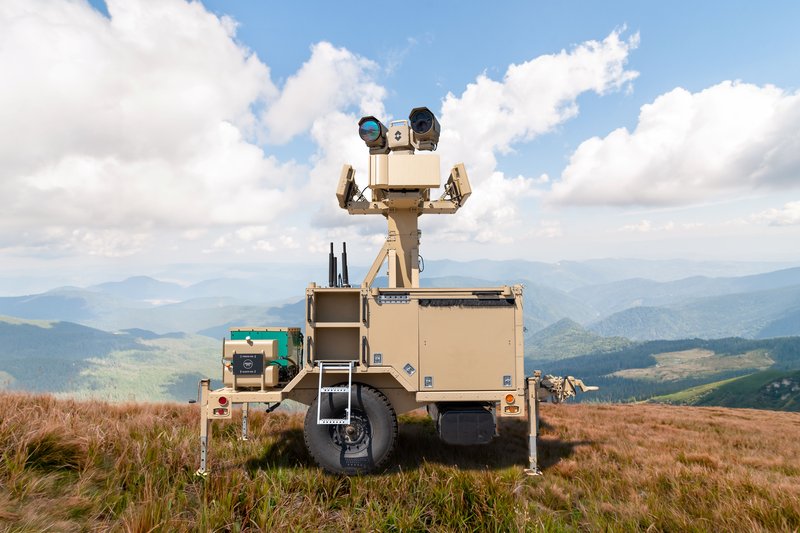
Cerberus® XL C‑UAS integrates long‑range radar, EO/IR, and RF sensing with command‑and‑control and AI/ML tools. The rugged architecture supports sensor- and effector-agnostic configurations for detection, tracking, and mitigation.
Designed to detect Group 1 and 2 UAS at extended ranges in austere environments, Cerberus XL supports autonomous perimeter and border protection with an integrated sensor suite that includes Teledyne FLIR Defense’s Ranger® R20SS-3DX radar and Ranger® HDC-MS electro-optical/infrared (EO/IR) camera.
When it comes to defeat integration, Cerberus XL is effector-agnostic and capable of cueing a wide range of kinetic and non-kinetic countermeasures to defeat the threat.
Examples of threat engagement systems integrated to date include AV’s RF-based Titan 4 and Kongsberg Defense & Aerospace’s RS4 Remote Weapon System, which is cued by the company’s Integrated Combat Solution (ICS).
Artificial intelligence/machine learning (AI/ML) algorithms enable the rapid detection, classification and tracking of up to 512 UAS simultaneously.
Also in service with the DoW is Teledyne FLIR Defense’s Argus™ XL — designed to provide fixed sites with air dominance awareness (ADA) and C-UAS capabilities.
Easy to train, deploy, operate and maintain, the fixed-mast Argus XL uses the same radar and camera payloads as Cerberus XL, providing operators with 360-degree situation awareness and target identification at “tactically significant ranges” Similar to Cerberus XL, the Argus XL is also effector-agnostic.
Teledyne FLIR Defense’s LVSS C-UAS solution is designed to handle ADA and C-UAS mission profiles with highly mobile requirements. The skid-based system includes a three-dimensional (3D) radar, EO/IR camera and RF detection sensors, providing operators with early warning detection and classification as well as capacity to cue non-kinetic countermeasures to neutralize the threat.
Capable of deployment as a self-contained unit in as little as 40 seconds, LVSS is easily retrofitted on board ground vehicles operating at the tactical edge of the battlefield.
Also in development is the latest member in Teledyne FLIR’s family of C-UAS solutions – Argus Lite – which is being designed as a cost-efficient and lighter-weight system capable of providing operators with shorter-range detection and engagement of threats.
Teledyne FLIR Defense’s digital backbone
C-UAS solutions are underpinned by Teledyne FLIR Defense’s open architecture. Command and control (C2) and AI/ML software which comply with the DoW’s Modular Open Systems Approach are available to customers.
Teledyne FLIR’s Cameleon™ C2 software is optimized to assist operators threatened by overwhelming amounts of data in an already congested and contested operating environment. It fuzes complex radar, EO/IR, RF and mitigation data, compressing it into an easy-to-understand graphical user interface.
Cameleon automatically archives data (radar tracks, video streams, timestamps and geospatial coordinates) for post-mission analysis and forensic work and enables the data dissemination to selected decision-makers across the battlespace.
Intuitive and easy-to-use, Cameleon can also function as an independent C2 system, enabling interoperability with government-furnished equipment and third-party systems through software-based integration and updates.
AI/ML algorithms enhance the autonomous detection, classification and tracking of threats, supporting the human in the loop, who then selects the most appropriate course of action to neutralize the threat.
Sensor supplier to systems integrators
Responding to emerging demand signals from defense and security customers, Teledyne FLIR Defense is a global supplier of C-UAS-optimized sensors to third-party systems integrators.
Best-selling products include Ranger HDC MS and MR cameras and the TacFLIR® 280-HDEP medium-range, multi-spectral surveillance system. Hundreds of Ranger HDC cameras will be deployed at the upcoming FIFA World Cup across North America.
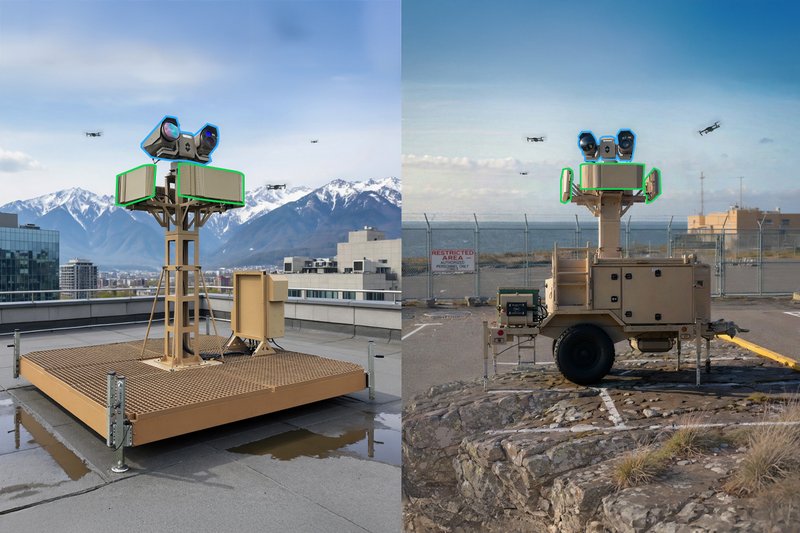
The Teledyne FLIR Ranger® HDC‑MS mid‑wave EO/IR system paired with Ranger R20‑3DX radar detects micro‑UAS beyond 3km and tracks up to 512 targets; it is deployable in fixed or mobile configurations for integration.
In April, Poland’s WB Group awarded Teledyne FLIR a US$35m contract to equip reconnaissance vehicles with TacFLIR-280-HDEP. Vehicles will benefit from daylight and thermal imagery, supported by a video processor and aided target recognition (AiTR).
Also available is the smaller TacFLIR 380-HLD which includes digital, high-definition EO/IR imaging and an integrated laser designator to optimize the performance of precision-guided munitions from tactical ground vehicles.
Teledyne FLIR also supplies a selection of X-band radars to systems integrators. Options include the Ranger® R20SS-3DX; Ranger® R8SS-3D; and R10-3D.
- The R20SS-3DX detects micro-UAS targets as far as 5km in range, employing digital beamforming technology to provide persistent surveillance of a 90-degree azimuth and 45-degree elevation with 2Hz refresh-rate.
- Man-portable or carried on board a ground vehicle, the electronically-scanned, mid-range R8SS-3D can detect UAS threats up to 4km in range. It offers customers low false-alarm rates and high levels in operational availability.
Future-proofing C-UAS capabilities
Closely aligned with the demands of the contemporary operating environment, Teledyne FLIR Defense continues to evolve its family of software-defined C-UAS solutions through iterative upgrades and targeted innovation.
Ongoing developments, which include an on-the-move (OTM) radar capability designed to protect fast-moving convoys and high-speed maritime platforms, prove Teledyne FLIR Defense’s clear focus on delivering adaptable, mission-ready systems for increasingly contested domains.




More from Industry Spotlights
-
![Orchestrating operational readiness across every defence domain]()
Orchestrating operational readiness across every defence domain
Are all systems ready for the next mission? Have upgrades been applied? Are all assets aligned to deploy together, on time and fully prepared? In modern defence operations, readiness is no longer measured platform by platform. It is measured by how well people, assets, data and decisions move together — across land, sea and air.
-
![Extending mission readiness: where XR adds real value in pilot, crew and maintenance training]()
Extending mission readiness: where XR adds real value in pilot, crew and maintenance training
Extended reality (XR) is becoming increasingly relevant in military aviation training, adding a flexible layer to an integrated ecosystem spanning the pilot, crew, and maintenance domains.
-
![Dominating the spectrum: ASELSAN’s EW capabilities take center stage at MSPO 2026]()
Dominating the spectrum: ASELSAN’s EW capabilities take center stage at MSPO 2026
ASELSAN is showcasing its advanced electronic warfare (EW) capabilities at MSPO 2026, highlighting technologies designed to detect, analyse, disrupt and deceive threats across increasingly contested electromagnetic environments.
-
![“Creating a decision advantage”: how C-UAS is evolving to reduce the operator burden]()
“Creating a decision advantage”: how C-UAS is evolving to reduce the operator burden
In Conversation… Speaking to Shephard’s Gerrard Cowan, Dr Brian Shand, Director – Advanced Concepts & Technology at L3Harris, explains how, as operators face growing numbers of low-cost drones, C-UAS providers must focus on reducing operator workload, transforming fragmented sensor data into effective decision-making.
-
![Shield the warfighter, win the fight (video)]()
Shield the warfighter, win the fight (video)
BAE Systems’ Intrepid Shield™ approach delivers full-spectrum electromagnetic protection to detect, exploit, and counter advanced threats.
-
![How joint ventures are expanding Rheinmetall's munitions portfolio (video)]()
How joint ventures are expanding Rheinmetall's munitions portfolio (video)
Roman Köhne, CEO of Rheinmetall's Weapon and Ammunition Division, discusses the company's announcements at Eurosatory 2026, including developments in defence technology, precision systems, industrial partnerships and future capability programmes.