Next-generation tactical UAS: Advancing European defence capabilities
Gambit 6, the latest innovation in GA-ASI’s Gambit Series, delivers advanced multi-role capabilities for air-to-ground missions. Artist’s rendering
As Europe confronts its most unstable security environment since the Cold War, defence planners recognise that advanced, dependable and flexible Uncrewed Aerial Systems (UAS) are central to a force that competes and prevails on today’s battlefield.


Enjoy free access to this sponsored article, all content provided by GA-ASI
Europe’s proximity to major conflicts demands that it strengthens its defences to deter threats. The primary danger comes from adversaries with sophisticated battlefield technologies, such as integrated air defences and long-range weapons, paired with the industrial capacity to sustain multi-year campaigns.
General Atomics Aeronautical Systems, Inc. (GA-ASI) is responding with its next-generation Gambit family of uncrewed autonomous fighters. The latest addition to the Gambit Series, Gambit 6, is tailored to some of Europe’s most pressing tactical needs — air-to-ground operations, including electronic warfare, suppression of enemy air defences and precision strike.
GA-ASI’s Gambit
Gambit represents GA-ASI’s commitment to innovation and adaptability.
The series is built on a modular architecture that allows for the rapid and cost-effective production of mission-specific variants. Approximately 70 per cent of the components, including the landing gear, baseline avionics and chassis, are shared across all Gambit models, enabling interoperability and reducing production costs.
In addition to Gambit 6, the Gambit Series includes other variants tailored for specific missions.
Gambit 1 is optimised for long-endurance Intelligence, Surveillance and Reconnaissance (ISR) missions, while Gambit 2 is designed for air-to-air combat. Gambit 3 focuses on adversary air roles in training scenarios, and Gambit 4 offers stealth combat reconnaissance capabilities. Gambit 5, introduced in 2024, is a carrier-based platform designed for maritime operations.
All Gambit aircraft are designed to be hard to detect and hard to disrupt, incorporating a signature-reducing internal weapons bay, advanced autonomy and compatibility with cutting-edge sensors and weapons systems.
This combination results in a highly adaptable platform for operations in contested environments.
Affordable mass
Gambit was developed across two previous generations of Unmanned Combat Aerial Vehicle (UCAV) prototypes. The goal was to create a way to get advanced platforms on the battlefield in high numbers at lower costs.
The spiralling costs associated with crewed fighters mean that while they remain indispensable, it has become cost-prohibitive to meet today’s threats with crewed multi-mission stealth fighters alone. Even if allied nations could afford it, there are insufficient human pilots or production throughput to meet the demand.
GA-ASI’s answer was to develop the Gambit common core, which eliminates the costs associated with multi-mission systems and allows nations to field mission-specific UCAVs in high numbers at an affordable price.
For example, when deployed in large numbers, Gambit 6 will force adversaries to spread their air-to-air defences thinly, creating strategic opportunities for coalition forces to exploit.
Networked uncrewed operations
Adopting Gambit opens opportunities for European nations to complement their widespread adoption of GA-ASI’s MQ-9B medium-altitude, long-endurance multi-mission ISR aircraft. These include the United Kingdom, Belgium, Germany, Denmark and Poland, among others.
While Gambit 6 is tailored for air-to-ground operations, GA-ASI’s MQ-9B SkyGuardian® and its maritime variant SeaGuardian® are set to play a critical role in enhancing Europe’s security.
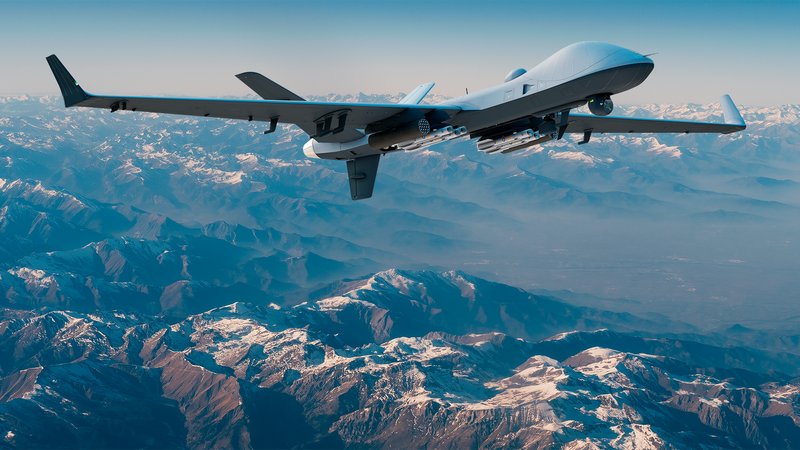
Deployed worldwide, GA-ASI’s multi-role, multi-domain MQ-9B is recognised as the longest-endurance and most versatile UAS in its class.
With more than 30 hours of endurance, the MQ-9B provides actionable intelligence across land and maritime domains in high-threat situations and gives commanders the option to deliver lethal effects when required.
Key features of the MQ-9B:
- Extended Endurance: Long on-station times enable sustained ISR and precision strike.
- Advanced Sensors: Multi-intelligence payloads, including a maritime radar, an Automatic Identification System (AIS) and electro-optical/infrared cameras, provide comprehensive situational awareness.
- Payload Capacity: Nine external hardpoints plus internal payload volume support advanced sensors, survivability upgrades and kinetic payloads.
- Airspace Certification: Certified to operate in national airspace without special exemptions, MQ-9B enables both military objectives and civilian missions, such as search and rescue or maritime/border surveillance.
The MQ-9B’s adoption throughout Europe presents many opportunities for expanded networked operations.
For example, the MQ-9B SeaGuardian offers long-endurance ISR capabilities and interoperability with existing P-8A Poseidon aircraft already in NATO’s inventory.
The MQ-9B’s open architecture and modular design enable seamless integration with other systems, including the Gambit Series, paving the way for networked UAS operations.
This synergy allows Europe to develop a robust interconnected UAS fleet capable of addressing both air-to-ground and maritime threats.
And MQ-9B is only becoming more capable.
GA-ASI last year announced it was developing an Airborne Early Warning and Control (AEW&C) mission package. As stealthy cruise missiles, advanced fighters and massed drone attacks become more common, such a capability is no longer optional — it is essential.
Developed in partnership with Saab, this MQ-9B configuration allows operators to detect, track and respond to threats ranging from high-altitude aircraft to low-flying drones, a capability particularly relevant in Europe, where rapid reaction to emerging threats is critical.
GA-ASI is also integrating long-range weapons onto the MQ-9B, including Kongsberg’s Naval Strike Missile and Lockheed Martin’s Long-Range Anti-Ship Missile.
Strategic benefits and NATO alignment
Both Gambit 6 and the MQ-9B platforms offer not only advanced operational capabilities but also significant strategic benefits.
By adopting these systems, European nations can achieve greater alignment with NATO partners, including the U.S. Air Force. The U.S. Air Force is evaluating a Gambit derivative, the YFQ-42A, as part of its Collaborative Combat Aircraft (CCA) programme.
Based on the Gambit 2 concept, the YFQ-42A is designed to complement human-crewed fighters like the F-35 and Next-Generation Air Dominance (NGAD) systems, expanding sensing, weapons capacity and survivability in contested airspace.

The YFQ-42A CCA will provide the U.S. and its allies with both mass and potent capability in support of emerging mission sets.
As the U.S. aims to field these systems in high numbers, European adoption of the Gambit Series could enhance allied integration and interoperability. This alignment is particularly critical as NATO strengthens its collective defence posture in response to heightened security challenges in the region.
European collaboration and sovereign capabilities
GA-ASI’s commitment to international collaboration is evident in its partnerships with European defence industries.
The company’s German affiliate, General Atomics AeroTec Systems GmbH (GA-ATS), plays a crucial role in supporting regional defence standards and providing sovereign capabilities for its platforms. GA-ATS has a long history of manufacturing and maintaining aircraft for the German military, including the NH90 helicopter and the Do228 multi-role aircraft.
This expertise ensures that European customers receive tailored solutions that meet their unique operational requirements.
“We’re eager to combine our uncrewed aircraft systems expertise with the airborne sensor and weapons system expertise of the European defence industry, starting with GA-ATS in Germany,” GA-ASI CEO Linden Blue said in a recent announcement.
“With a proven CCA design already in production today, these systems will be delivered in significant quantity with high-technology European inputs to build and sustain affordable mass for NATO’s fighter forces.”
European missionised versions of the Gambit 6 are expected to be available by 2029, with customisation and assembly supported by GA-ATS.
Meeting the challenges of modern warfare
The Gambit 6 and MQ-9B platforms are designed to address the unique challenges posed by today’s most pressing battlefield threats.
By offering persistent situational awareness and rapid strike capabilities, Gambit 6 and MQ-9B enhance the ability of European defence forces to deter aggression and maintain stability in the region.
GA-ASI’s innovative approach to UAS design and production ensures that its platforms remain at the cutting edge of technology.
With more than 9 million flight hours logged and a proven track record of delivering high-performance UAS platforms, GA-ASI continues to be a trusted partner for nations seeking to strengthen their defence capabilities with the best UAS operating in the world today.



More from Industry Spotlights
-
![Orchestrating operational readiness across every defence domain]()
Orchestrating operational readiness across every defence domain
Are all systems ready for the next mission? Have upgrades been applied? Are all assets aligned to deploy together, on time and fully prepared? In modern defence operations, readiness is no longer measured platform by platform. It is measured by how well people, assets, data and decisions move together — across land, sea and air.
-
![Extending mission readiness: where XR adds real value in pilot, crew and maintenance training]()
Extending mission readiness: where XR adds real value in pilot, crew and maintenance training
Extended reality (XR) is becoming increasingly relevant in military aviation training, adding a flexible layer to an integrated ecosystem spanning the pilot, crew, and maintenance domains.
-
![Dominating the spectrum: ASELSAN’s EW capabilities take center stage at MSPO 2026]()
Dominating the spectrum: ASELSAN’s EW capabilities take center stage at MSPO 2026
ASELSAN is showcasing its advanced electronic warfare (EW) capabilities at MSPO 2026, highlighting technologies designed to detect, analyse, disrupt and deceive threats across increasingly contested electromagnetic environments.
-
![“Creating a decision advantage”: how C-UAS is evolving to reduce the operator burden]()
“Creating a decision advantage”: how C-UAS is evolving to reduce the operator burden
In Conversation… Speaking to Shephard’s Gerrard Cowan, Dr Brian Shand, Director – Advanced Concepts & Technology at L3Harris, explains how, as operators face growing numbers of low-cost drones, C-UAS providers must focus on reducing operator workload, transforming fragmented sensor data into effective decision-making.
-
![Shield the warfighter, win the fight (video)]()
Shield the warfighter, win the fight (video)
BAE Systems’ Intrepid Shield™ approach delivers full-spectrum electromagnetic protection to detect, exploit, and counter advanced threats.
-
![How joint ventures are expanding Rheinmetall's munitions portfolio (video)]()
How joint ventures are expanding Rheinmetall's munitions portfolio (video)
Roman Köhne, CEO of Rheinmetall's Weapon and Ammunition Division, discusses the company's announcements at Eurosatory 2026, including developments in defence technology, precision systems, industrial partnerships and future capability programmes.