US Army tests Raytheon/Kord 50kW-class high energy laser weapon
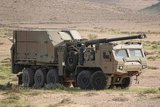
Raytheon/Kord 50kW-class high-energy laser integrated on a Stryker combat vehicle. (Photo: Raytheon)
The US Army concluded an operational assessment with the Raytheon/Kord 50kW-class high energy laser integrated on a Stryker combat vehicle at White Sands Missile Range (New Mexico). The system defeated multiple 60mm mortar rounds.


Raytheon Intelligence & Space announced on 16 May that the US Army concluded an operational assessment with the Raytheon/Kord 50kW-class high energy laser integrated on a Stryker combat vehicle at White Sands Missile Range (New Mexico).
In four weeks of continuous live-fire exercises, the directed-energy weapon system acquired, tracked, targeted and defeated multiple 60mm mortar rounds and accomplished multiple tests simulating real-world scenarios. This recent operational assessment also included defeating several small, medium and large drones.
The Raytheon/Kord 50kW-class high energy laser is part of the US Army’s Directed Energy Maneuver-Short Range Air Defense (DE M-SHORAD) programme, which aims to protect soldiers against various aerial threats, including UASs, rotary-wing aircraft, rockets, artillery and mortars.
Kord serves as the primary integrator of the system on the Stryker combat vehicle, while Raytheon Intelligence & Space provides the 50kW-class high energy laser weapon module, a specialized radar acquisition system, a beam control system and a targeting sensor.
The joint industry team — which includes Rocky Research for power and thermal management, General Dynamics Land Systems for the Stryker platform, and Applied Technology Associates for additional sensors — is preparing to deliver four DE M-SHORAD units to Army Brigade Combat Teams in 2022.
Related Equipment in Defence Insight


More from Land Warfare
-
![AUSA 2026: can converting established vehicle platforms offer route into emerging UGV market?]()
AUSA 2026: can converting established vehicle platforms offer route into emerging UGV market?
Defence manufacturers are showcasing uncrewed versions of established military and commercial vehicles at AUSA 2026 as the US Army’s Project Sustainment draws interest.
-
![How laser weapons could transform the economics of European air defence (Podcast)]()
How laser weapons could transform the economics of European air defence (Podcast)
Former UK Defence Secretary Lord John Hutton examines how drones, missiles, laser weapons and procurement pressures are reshaping European air defence.
-
![Singapore confirms fully automated SIGMA SPH as new precision-strike system emerges]()
Singapore confirms fully automated SIGMA SPH as new precision-strike system emerges
Singapore has confirmed plans to introduce a fully automated howitzer alongside an emerging precision-strike capability whose weapon type and deployment status have not been disclosed.