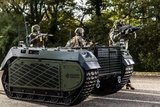
BAE Tridon MK2 fitted with Chess Dynamics fire control system
The BAE Systems Tridon MK2 is designed to plug national gaps in air defence.
The collaboration between the defence giant and the gunfire control specialist will help deliver a modular anti-drone solution.


The Tridon MK2 ground-based air defence system from BAE Systems Bofors has been fitted with a fire control system from Chess Dynamics.
The Tridon MK2, launched at this year’s Eurosatory in Paris, is a 40mm anti-aircraft system that is both self-propelled and remote-controlled. Depending on the ammunition and sensor suite added to it, can effectively stop both ground and air attacks at a distance of up to 7.5 miles (12 km). This flexibility of armament and versatility of sensor inputs means the Tridon MK2 is a modular ground-based aerial defence unit.
On its launch, BAE Systems highlighted its ability to act as an anti-drone defence system, particularly aiming at NATO procurement in the light of Russia’s ongoing war against Ukraine, and it’s anti-NATO stance.
Lena Gillström, president of BAE Systems Bofors, introduced the Tridon MK2 as “the ideal solution for combat operations, where soldiers need a proven, high-precision and reliable anti-aircraft system to keep the skies clear and protect troops and infrastructure”.
Chess Dynamics, based in the UK, specialises in surveillance, tracking and gunfire control. Its collaboration with BAE Systems Bofors has added sophisticated fire control technology to the Tridon MK2.
Chess has delivered a variant of its Hawkeye Air Defence system. The Hawkeye AD system provides an integrated fire control solution for all types of ammunition. A high-definition thermal imager and daylight TV sensors are coupled with a high-performance laser range finder, all mounted on a dynamic direct-drive positioner. With a built-in tracker, that means the Hawkeye AD variant in the MK2 delivers precise 3-D coordinates for both air and surface targets to the weapon system’s gun control.
Whether NATO bites at the Tridon MK2 remains to be seen, but BAE Systems Bofors said it hoped the system could plug the gaps in air defence currently exploited by mass drone operations.


More from Land Warfare
-
![Boxer lands another order as contracts and opportunities build momentum]()
Boxer lands another order as contracts and opportunities build momentum
As Germany prepares its €25 billion order under the Arminius framework – the biggest Boxer procurement to date – the platform could become an increasingly powerful contender in European competitions.
-
![Trans-European iMUGS2 uncrewed systems programme set for three-day exercise in 2028]()
Trans-European iMUGS2 uncrewed systems programme set for three-day exercise in 2028
The next stage of the Integrated Modular Unmanned Ground System (iMUGS) programme, dubbed iMUGS2, was launched in November 2025. Three major demonstrations are planned before the end of 2028.
-
![British Army Land Rover replacement plan inches forward]()
British Army Land Rover replacement plan inches forward
The UK Ministry of Defence has proposed a selection date of May 2027 for the Land Rover replacement requirement, with deliveries expected through to 2036. Next month’s DVD exhibition will be a key shop window for bidders.
-
![Snow patrol and access all areas: the Arctic all-terrain vehicles market grows]()
Snow patrol and access all areas: the Arctic all-terrain vehicles market grows
The procurement and planned procurement of articulated tracked all-terrain vehicles is being driven by a need to replace older platforms and an acknowledgement of a capability gap for Arctic regions.
-
![Push strengthens for a second JLTV supplier]()
Push strengthens for a second JLTV supplier
A move, launched in May, could lead to a second supplier for the US Marines Corps’ Joint Light Tactical Vehicle requirement. Meanwhile, Wisconsin elected representatives have been pushing for necessary funding to be included in the FY27 budget.