US Army extends CROWS contract with Kongsberg
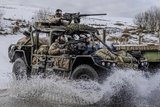
Kongsberg provides the US Army with its M151 and M153 remote weapons stations. (Photo: Kongsberg)
CROWS contract modification ‘is contingent upon future demand and annual allocations’, says Kongsberg.


Kongsberg Defence & Aerospace has obtained an extension to its five-year IDIQ contract with the US Army under the Common Remotely Operated Weapon Station (CROWS) programme.
The contract modification is worth $499.17 million ‘and is contingent upon future demand and annual allocations’, Kongsberg noted on 11 May.
According to the DoD, work will be completed by 14 September 2023.
The IDIQ contract was awarded in September 2018 as the third five-year contract with the US Army for M151 and M153 remote weapons stations under the CROWS programme.
‘The modification will support CROWS acquisition for platforms across all uniformed services and will specifically support needs for robotic and tactical vehicles, static and mobile base security, as well as littoral and maritime applications,’ a Kongsberg Defense US spokesperson said.
‘CROWS Tech Refresh systems and the supporting fire control network are already key enablers for the [US] Army’s emerging unmanned ground vehicle programmes, including Robotic Combat Vehicle (RCV) and Small Multipurpose Equipment Transport (SMET),’ the spokesperson added.
In addition to developing the remote lethality fire-control system for RCV and SMET, Kongsberg is also delivering a Multi-User Multi-Station capability to the US Army to facilitate advanced target sharing and cooperative engagement.
Related Equipment in Defence Insight


More from Land Warfare
-
![Europe commits to long-range fires but countries move in different directions]()
Europe commits to long-range fires but countries move in different directions
Sweden, Croatia and France are pursuing different rocket artillery solutions as European armies seek greater reach, survivability and industrial resilience.
-
![Polaris expands Arctic mobility offering as US military orders grow]()
Polaris expands Arctic mobility offering as US military orders grow
The Military 850 Voyageur 155 Crossover has secured orders from the US Army, Air Force and Marine Corps, addressing demand for agile Arctic mobility with passenger, cargo and towing capacity.
-
![More bidders move onto starting grid for British Army Land Rover replacement programme]()
More bidders move onto starting grid for British Army Land Rover replacement programme
The Light Mobility Vehicle segment of the UK’s Land Mobility Programme for the British Army may actually be about to make progress, or at least likely bidders seem to think so. Shephard spoke with several contenders who revealed their views on how the army should replace the ageing fleet.