Netherlands selects Elbit to meet rocket artillery requirement
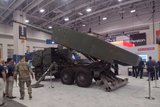
PULS supports both free-flying and precision-guided rockets and can be integrated on various tracked and wheeled chassis. (Photo: Elbit Systems)
Elbit Systems will supply 20 truck-mounted PULS artillery rocket launchers to the Royal Netherlands Army over the next five years.


Elbit Systems announced on 18 May that, under an agreement between the Israeli and Netherlands MoDs, it had been awarded a $305 million contract to supply its Precise & Universal Launching System (PULS) artillery rocket launchers to the Royal Netherlands Army.
Work will be carried out over five years and Elbit will supply 20 PULS launchers integrated on a selected truck platform, as well as rockets and missiles of various ranges plus training and support services.
Elbit describes PULS as designed with an open-architecture approach, supporting future growth and the ability to integrate legacy C4i systems.
Related Articles
Netherlands joins growing list of HIMARS customers
Lockheed and Rheinmetall team up on bespoke rocket artillery system for Germany
Rheinmetall, Elbit test-fire automated howitzer system
PULS supports firing both free-flying and precision-guided rockets and missiles with ranges between 12 and 300km. The launcher can be mounted on a range of wheeled and tracked platforms.


More from Land Warfare
-
![Canada accelerates uncrewed aerial system procurement for NATO and Arctic forces]()
Canada accelerates uncrewed aerial system procurement for NATO and Arctic forces
Canada plans to acquire at least 120 uncrewed aerial systems through two competitions with combined funding ceilings of C$32 million.
-
![Front-line support: how UK industry is helping tackle Ukraine’s landmine challenges]()
Front-line support: how UK industry is helping tackle Ukraine’s landmine challenges
Pearson Engineering has provided equipment and engineering expertise to the Armed Forces of Ukraine since the beginning of the full-scale Russian invasion in 2022. The British company is now working to deepen engagement with the Ukrainian defence industry, expanding its support for the country’s population and laying the foundations for future technological innovation.
-
![AUSA 2026: industry looks to make commercial platforms a military reality]()
AUSA 2026: industry looks to make commercial platforms a military reality
With a production rate of more than 10 million vehicles annually, the US commercial car and vehicle manufacturing base is second only to China. Defence companies are looking at how the vehicles, technology and manufacturing capability can support programmes.