Lockheed Martin unveils plans to develop new class of 500kW laser weapon
Lockheed Martin is developing a larger version of its 300kW laser. (Image: Lockheed Martin)
Lockheed Martin will scale its technology to a 500kW-class laser under a new contract, aiming to optimize efficiency and size while increasing power for high-powered directed energy weapon systems.


Lockheed Martin has announced plans to upscale its 300kW laser to 500kW class under a contract awarded by the US Office of the Under Secretary of Defense for Research & Engineering (OUSD (R&E)), a follow on to a contract from the same organisation for developing a smaller version.
The new contract is described by the company as the second phase of the High Energy Laser Scaling Initiative (HELSI) which aims to increase the laser’s power level while achieving better beam quality and optimising efficiency, size, weight and volume for the continuous-wave high energy laser sources.
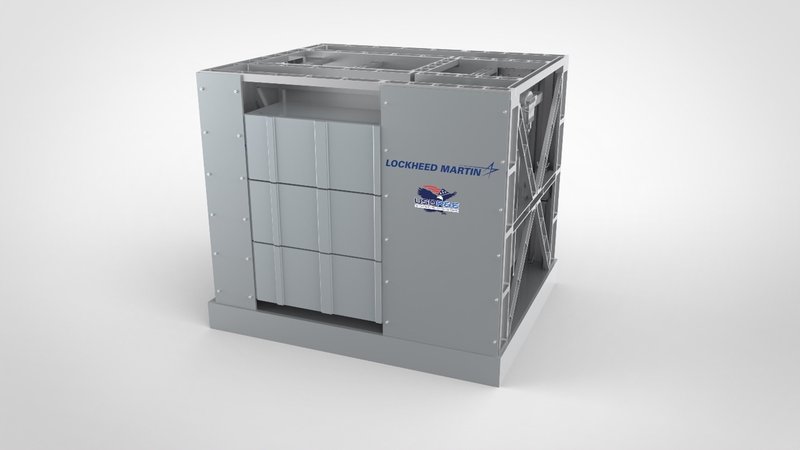
An artists’ concept of Lockheed Martin’s 500 kW-class laser for HELSI. (Image: Lockheed Martin)
Related Articles
Lockheed Martin makes case for new era of directed energy weapons
In a statement the company said ‘the 500kW-class laser will be tactically configured, utilise the beam combined architecture to support military platforms, and incorporate DoD Modular Open System Approach standards to ensure the systems interoperability and multi-mission integration.’
Earlier in July was awarded an agreement with a ceiling of $220.8 million to develop, integrate, manufacture, test, and deliver Indirect Fire Protection Capability-High Energy Laser (IFPC-HEL) prototype weapon systems. These are being developed as land-based mobile systems to protect defence sites against UAS, mortar, missile and rocket attacks.
In September 2022 the company said it had delivered ‘a tactically relevant electric 300kW-class laser to OUSD (R&E) [and it is] ready to integrate with the DoD demonstration efforts including the IFPC-HEL demonstrator laser weapon system.’
The OUSD (R&E) selected Lockheed Martin in 2019 to scale its spectral beam combined high energy laser architecture to the 300 kW-class level as part of HELSI.




More from Land Warfare
-
![Europe commits to long-range fires but countries move in different directions]()
Europe commits to long-range fires but countries move in different directions
Sweden, Croatia and France are pursuing different rocket artillery solutions as European armies seek greater reach, survivability and industrial resilience.
-
![MAAF to test Britain’s shift from armour to distributed lethality in Estonia]()
MAAF to test Britain’s shift from armour to distributed lethality in Estonia
The bilateral agreement between the UK and Estonia comes as both countries explore how dispersed troops, drones, digital targeting, anti-tank weapons and increasingly long-range fires can complement the combat mass traditionally provided by heavy armour.
-
![Polaris expands Arctic mobility offering as US military orders grow]()
Polaris expands Arctic mobility offering as US military orders grow
The Military 850 Voyageur 155 Crossover has secured orders from the US Army, Air Force and Marine Corps, addressing demand for agile Arctic mobility with passenger, cargo and towing capacity.
-
![More bidders move onto starting grid for British Army Land Rover replacement programme]()
More bidders move onto starting grid for British Army Land Rover replacement programme
The Light Mobility Vehicle segment of the UK’s Land Mobility Programme for the British Army may actually be about to make progress, or at least likely bidders seem to think so. Shephard spoke with several contenders who revealed their views on how the army should replace the ageing fleet.
-
![Northrop Grumman pushing ahead with smaller Integrated Battle Command System]()
Northrop Grumman pushing ahead with smaller Integrated Battle Command System
Northrop Grumman’s Integrated Battle Command System is in service with Polish forces and is being introduced to US forces, with further development underway on the original platform as well as a smaller, more mobile system.