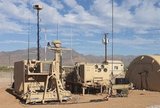
Lockheed Martin providing THAAD to US and Saudi Arabia


On 1 April the US DoD announced a modification to a contract with Lockheed Martin for the production of Terminal High Altitude Area Defense (THAAD) interceptors, bringing the value of the contract to $3.8 billion, of which $1.5 billion covers foreign military sales to Saudi Arabia.
THAAD is an anti-ballistic missile defence system designed to shoot down short to intermediate range ballistic missiles in descent or re-entry at a range of 200km. It carries no warhead, destroying incoming missiles via the kinetic energy of impact, so as to minimise the risk of detonating conventional-warhead ballistic missiles. A kinetic impact also carries no chance of detonating a nuclear-tipped ballistic missile.
First proposed in 1987, the first THAAD interceptors were deployed in 2008.
Lockheed is currently pushing for funding to develop an extended-range version of the THAAD to counter hypersonic glide vehicles, such as the Chinese WU-14, which are being developed to exploit the gap between high and low altitude missile defences.
Currently, the THAAD-ER is an industry concept only, though the company remains optimistic that the Missile Defense Agency will provide funding soon to match the weapons development of potential adversaries.
However, the Pentagon has been researching technologies such as directed energy weapons and railguns as to whether they would be better solutions to missile defence, even if they are not expected to be available before the mid-2020s.




More from Land Warfare
-
![DVD 2026: British Army’s Ajax back in the hands of users as part of a gradual return]()
DVD 2026: British Army’s Ajax back in the hands of users as part of a gradual return
The introduction of Ajax vehicles into British Army service was stopped after operator health issues were reported during an exercise, but manufacturer General Dynamics Land Systems UK believes work over the past 10 months has dealt with the problems.
-
![Europe commits to long-range fires but countries move in different directions]()
Europe commits to long-range fires but countries move in different directions
Sweden, Croatia and France are pursuing different rocket artillery solutions as European armies seek greater reach, survivability and industrial resilience.
-
![MAAF to test Britain’s shift from armour to distributed lethality in Estonia]()
MAAF to test Britain’s shift from armour to distributed lethality in Estonia
The bilateral agreement between the UK and Estonia comes as both countries explore how dispersed troops, drones, digital targeting, anti-tank weapons and increasingly long-range fires can complement the combat mass traditionally provided by heavy armour.
-
![Polaris expands Arctic mobility offering as US military orders grow]()
Polaris expands Arctic mobility offering as US military orders grow
The Military 850 Voyageur 155 Crossover has secured orders from the US Army, Air Force and Marine Corps, addressing demand for agile Arctic mobility with passenger, cargo and towing capacity.
-
![More bidders move onto starting grid for British Army Land Rover replacement programme]()
More bidders move onto starting grid for British Army Land Rover replacement programme
The Light Mobility Vehicle segment of the UK’s Land Mobility Programme for the British Army may actually be about to make progress, or at least likely bidders seem to think so. Shephard spoke with several contenders who revealed their views on how the army should replace the ageing fleet.
-
![Northrop Grumman pushing ahead with smaller Integrated Battle Command System]()
Northrop Grumman pushing ahead with smaller Integrated Battle Command System
Northrop Grumman’s Integrated Battle Command System is in service with Polish forces and is being introduced to US forces, with further development underway on the original platform as well as a smaller, more mobile system.