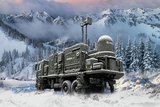
How Patria TREMOS redefines battlefield mobility
The war in Ukraine has made it clear: the battlefield waits for no one. Military operations now take place in fast-paced environments, and speed is not just about the fight itself – it is about the entire ecosystem of warfare.


Enjoy free access to this sponsored article, all content provided by Patria
For military forces to retain a tactical and strategic advantage, capability development, logistics and training must keep pace. Armed forces need capabilities - platforms, sensors and effectors — that are modular and agile throughout their entire lifecycle.
Patria TREMOS, the company’s newest mortar system, was designed to meet these exact criteria. Developed in partnership with the Finnish Army and Finnish Defence Forces Logistics Command, the first prototype was ready in less than a year. Modular to optimise available space, and versatile enough for quick refit on another vehicle, TREMOS offers robust protection and freedom for creative problem-solving. Operators control the mission tempo, not the logistics.
Understanding the changing operational landscape
Picture this: armed forces are in the heat of battle, a unit is stationed on a rugged hillside, mortar tubes locked on multiple enemy targets. Every second counts. Once they fire, they must quickly reposition to avoid incoming rounds from all directions. But the mortar system’s slow setup time and the rise of unmanned aerial vehicles (UAVs) mean their window to hide after firing is shrinking fast. The stress is already immense, and with war’s unpredictable nature, there’s always the chance something could go wrong with the vehicle itself. In that moment, what are their options?
Ukraine has shown that as sensors and effectors multiply, so does the urgency to move fast and strike first. Units rely on mobility for survival and success, and industry must respond just as swiftly to emerging needs. The pressure is on to think fast, adapt quickly and use every available resource to ensure mission success and survivability.
Enabling mobility
The advantage of mortar systems has always been their mobility on the battlefield. The ability to tow a 120mm mortar using nearly any vehicle and across multiple terrain types – including land inaccessible to field artillery – or carry lightweight 81mm mortars manually was a game changer. But when the tempo accelerates, can they keep pace?
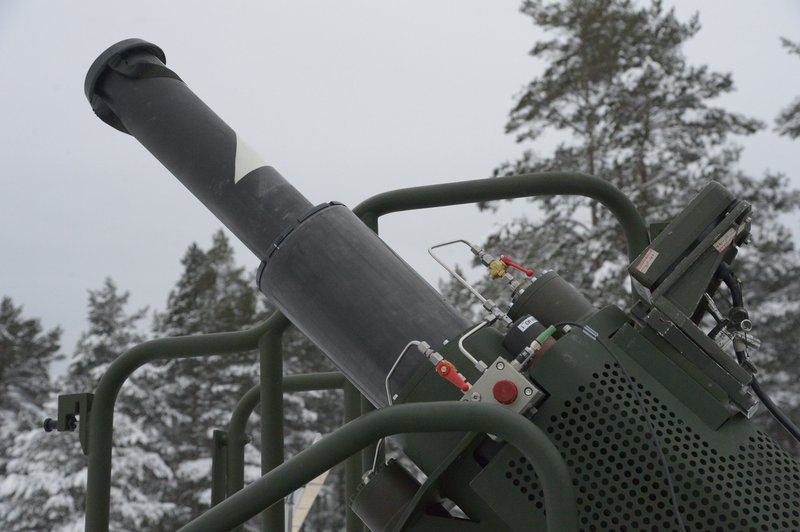
Patria TREMOS (Traditional REborn MOrtar System) was designed for exactly this. Its recoil absorber technology enables the vehicle to withstand the shock of firing without the need for separate support legs, eliminating wasted time in lowering or raising them. In practical terms, the Patria TREMOS mortar system can fire within 60 seconds of arriving at a firing position and exit it within seconds after the last shot, enabling true “shoot and scoot” tactics.
Modularity on the battlefield
Battlefields are unpredictable, especially for mortar units operating on uneven terrain under constant threat. The risk of vehicle damage is high and losing both a platform and mortar system can tip the balance of battle. What’s the alternative?
For Patria, the answer was clear: modularity on the battlefield. That is why Patria TREMOS features proven standardised container locks, allowing it to be dismounted and transferred to another platform in field conditions, provided it has sufficient load-bearing capacity. This can be done within minutes with the help of a forklift or front-end loader. To enhance crew protection, additional ballistic armour can be quickly installed on the system.
Additionally, Patria TREMOS is compatible with all qualified 120mm and 81mm smoothbore mortar ammunition, making it a truly versatile and modular system that delivers critical battlefield flexibility.
Setting a new standard for logistics
Slow procurement kills innovation. Military acquisition cycles are notoriously long, and by the time a new solution is fielded, battlefield dynamics have often shifted.
To break this cycle, Patria teamed up with Finnish Army and Finnish Defence Forces Logistics Command to deliver Patria TREMOS in record time. Beginning with detailed discussions about future mortar system demands, Patria developed the first prototype in under 12 months. Testing included Patria-led firings to verify operational safety across various platforms, followed by extensive Finnish Defence Forces testing to gather valuable feedback. Delivery of the first pre-series systems is scheduled for 2025.
Beyond the Finnish Armed Forces, the company can integrate Patria TREMOS into new customers’ vehicles within three to six months, with full readiness achievable in under a year – depending on vehicle types and the level of manufacturer cooperation. And because the system is straightforward to use and transfer, crew training is relatively simple and fast. With Patria TREMOS, forces don’t just adapt to the battlefield — they shape it.
Find out more about Patria TREMOS here.

More from Industry Spotlights
-
![Orchestrating operational readiness across every defence domain]()
Orchestrating operational readiness across every defence domain
Are all systems ready for the next mission? Have upgrades been applied? Are all assets aligned to deploy together, on time and fully prepared? In modern defence operations, readiness is no longer measured platform by platform. It is measured by how well people, assets, data and decisions move together — across land, sea and air.
-
![Extending mission readiness: where XR adds real value in pilot, crew and maintenance training]()
Extending mission readiness: where XR adds real value in pilot, crew and maintenance training
Extended reality (XR) is becoming increasingly relevant in military aviation training, adding a flexible layer to an integrated ecosystem spanning the pilot, crew, and maintenance domains.
-
![Dominating the spectrum: ASELSAN’s EW capabilities take center stage at MSPO 2026]()
Dominating the spectrum: ASELSAN’s EW capabilities take center stage at MSPO 2026
ASELSAN is showcasing its advanced electronic warfare (EW) capabilities at MSPO 2026, highlighting technologies designed to detect, analyse, disrupt and deceive threats across increasingly contested electromagnetic environments.
-
![“Creating a decision advantage”: how C-UAS is evolving to reduce the operator burden]()
“Creating a decision advantage”: how C-UAS is evolving to reduce the operator burden
In Conversation… Speaking to Shephard’s Gerrard Cowan, Dr Brian Shand, Director – Advanced Concepts & Technology at L3Harris, explains how, as operators face growing numbers of low-cost drones, C-UAS providers must focus on reducing operator workload, transforming fragmented sensor data into effective decision-making.
-
![Shield the warfighter, win the fight (video)]()
Shield the warfighter, win the fight (video)
BAE Systems’ Intrepid Shield™ approach delivers full-spectrum electromagnetic protection to detect, exploit, and counter advanced threats.
-
![How joint ventures are expanding Rheinmetall's munitions portfolio (video)]()
How joint ventures are expanding Rheinmetall's munitions portfolio (video)
Roman Köhne, CEO of Rheinmetall's Weapon and Ammunition Division, discusses the company's announcements at Eurosatory 2026, including developments in defence technology, precision systems, industrial partnerships and future capability programmes.