De-Risking the Future: Manufacturing Certainty for Unmanned Systems
How strategic manufacturing partnership solves the industrialisation triad — Scale, Compliance and Cost — for hyper-growth defence tech innovators.


Enjoy free access to this sponsored article, all content provided by Plexus
The Innovation of Sustainment: How Strategic Manufacturing De-Risks Unmanned Systems
The unmanned systems market is undergoing an explosive revolution, driven by innovative companies leveraging cutting-edge AI and autonomous capabilities. This rapid growth trajectory presents a critical challenge: the biggest barrier to mission success is no longer innovation but industrialisation.
Leading technology companies, often “software-first” innovators, face a critical “manufacturing choke point” as they attempt to transition from R&D to full-rate production for multi-billion-dollar contracts. This urgency is underscored by significant market projections: the US market is anticipated to reach $24.7 billion by 2030 , while Europe is forecasting a market size of $85.5 billion by 2034 (26.8% CAGR), fuelled by initiatives like “ReArm Europe”.
Their immense valuations, some exceeding €12 billion, place continuous pressure on flawless execution, meaning any production delay or quality failure could jeopardise investor confidence.
To secure their future, these innovators must overcome the Triad of Industrialisation Risk:
1. The Challenge of Scale and Delivery
High-growth companies are receiving multi-year contracts that demand the immediate delivery of thousands of units. Yet many lack the internal infrastructure for high-volume, high-reliability production. This creates a critical discontinuity where contractual mandates for scaled production begin well before a company’s planned internal manufacturing capabilities are operational.
This gap is not hypothetical; it’s a measurable “manufacturing bridge” timeline that presents a major risk to programme delivery. Furthermore, rapid growth often stems from a software-first core competency, which can lead to a demonstrable critical capability gap in high-reliability production and quality assurance.
Plexus positions itself as the strategic partner that solves this immediate scalability challenge. Our existing global network of certified, high-volume production facilities can bridge this crucial manufacturing gap, ensuring innovators meet stringent contractual delivery deadlines and transition successfully from prototypes to full-rate production.
2. The Compliance and Market Access Barrier
The operational speed required in the UAS market means many systems are deployed under urgent, wartime, or local military regulations that currently forego full, formalised defence compliance (eg, AS9100/MIL-STD). However, this is changing: the UK MoD, NATO and other allies are actively developing new frameworks and standards to codify these requirements within the next few years. This imminent shift represents a crucial turning point—companies that fail to prepare will face a major industrialisation bottleneck.
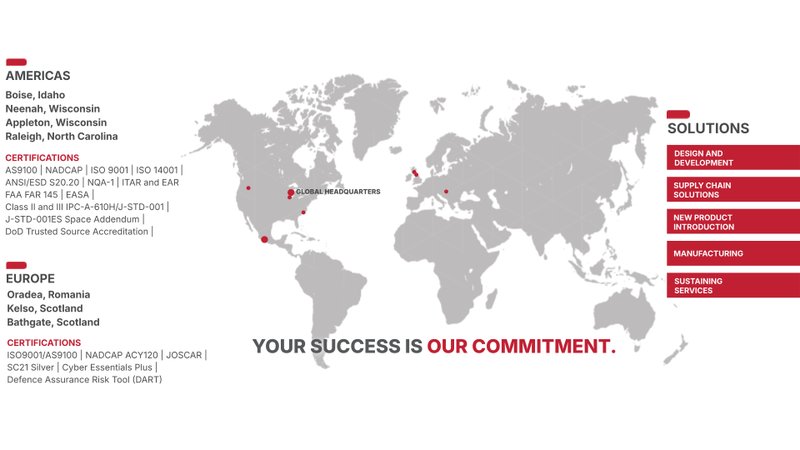
At Plexus, our UK and Romanian production sites support European ambitions, reinforcing “European Sovereignty” and local content requirements, while our US-based, ITAR-compliant facilities provide an instant and credible “Made in America” capability. These facilities maintain the highest defence-grade standards, including AS9100 certification for design and manufacturing and adherence to IPC Class 3 standards.
We possess experience supporting Manufacturing Readiness Level (MRL) and Technology Readiness Level (TRL) activities. By partnering with Plexus, innovators gain the certified infrastructure needed to meet these emerging mandates today, transforming future compliance barriers into an immediate competitive advantage.
3. Protecting Core Innovation and Cost Structure
The primary value of UAS innovators lies in their core AI and software development. Diverting crucial engineering talent to solve complex hardware production challenges represents a significant operational strain. Moreover, for systems designed to be “attritable” or expendable, maintaining cost-effectiveness is a decisive competitive factor.
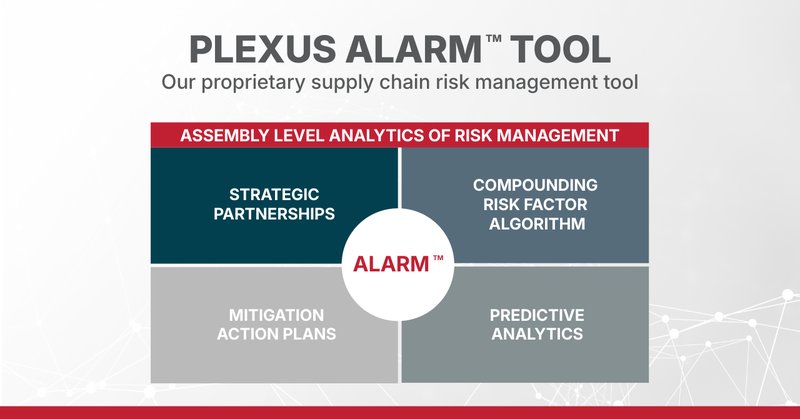
Plexus transforms the supply chain from a point of vulnerability into a core competitive strength. We employ advanced predictive tools, such as our proprietary ALARM™ tool, to anticipate potential disruptions and component obsolescence. This is critical for securing supply chains within the EMEA region and mitigating risks posed by initiatives like “ReArm Europe” which can strain regional component supply.
Our expertise in Design for Manufacturability (DFM) and value engineering is focused on optimising the product design for maximum efficiency, which drives an overall reduction of costs over the entire lifecycle of the product.
This meticulous control of the manufacturing cost structure is crucial for achieving programmes that deliver exceptional value for money to government customers and ensuring financially sound execution. By transferring the complexities of hardware manufacturing and supply chain, Plexus enables these innovators to focus their core resources on AI and software development.
Industrialising the Future of Defence
The revolution in unmanned systems demands a contract manufacturing partner that can seamlessly integrate technological complexity with geopolitical compliance and industrial scalability. Plexus is uniquely positioned as the strategic partner that provides the manufacturing certainty to turn visionary software into deployed, reliable hardware at scale.
Find out more about manufacturing certainty here.




More from Industry Spotlights
-
![Orchestrating operational readiness across every defence domain]()
Orchestrating operational readiness across every defence domain
Are all systems ready for the next mission? Have upgrades been applied? Are all assets aligned to deploy together, on time and fully prepared? In modern defence operations, readiness is no longer measured platform by platform. It is measured by how well people, assets, data and decisions move together — across land, sea and air.
-
![Extending mission readiness: where XR adds real value in pilot, crew and maintenance training]()
Extending mission readiness: where XR adds real value in pilot, crew and maintenance training
Extended reality (XR) is becoming increasingly relevant in military aviation training, adding a flexible layer to an integrated ecosystem spanning the pilot, crew, and maintenance domains.
-
![Dominating the spectrum: ASELSAN’s EW capabilities take center stage at MSPO 2026]()
Dominating the spectrum: ASELSAN’s EW capabilities take center stage at MSPO 2026
ASELSAN is showcasing its advanced electronic warfare (EW) capabilities at MSPO 2026, highlighting technologies designed to detect, analyse, disrupt and deceive threats across increasingly contested electromagnetic environments.
-
![“Creating a decision advantage”: how C-UAS is evolving to reduce the operator burden]()
“Creating a decision advantage”: how C-UAS is evolving to reduce the operator burden
In Conversation… Speaking to Shephard’s Gerrard Cowan, Dr Brian Shand, Director – Advanced Concepts & Technology at L3Harris, explains how, as operators face growing numbers of low-cost drones, C-UAS providers must focus on reducing operator workload, transforming fragmented sensor data into effective decision-making.
-
![Shield the warfighter, win the fight (video)]()
Shield the warfighter, win the fight (video)
BAE Systems’ Intrepid Shield™ approach delivers full-spectrum electromagnetic protection to detect, exploit, and counter advanced threats.
-
![How joint ventures are expanding Rheinmetall's munitions portfolio (video)]()
How joint ventures are expanding Rheinmetall's munitions portfolio (video)
Roman Köhne, CEO of Rheinmetall's Weapon and Ammunition Division, discusses the company's announcements at Eurosatory 2026, including developments in defence technology, precision systems, industrial partnerships and future capability programmes.