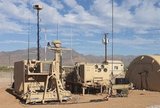
Lockheed Martin ground-based laser successfully demonstrated


Lockheed Martin has successfully demonstrated its portable, ground-based Area Defense Anti-Munitions (ADAM) military laser system in a series of tests against representative airborne targets. The system uses directed energy to provide a defence against short-range threats, such as rockets and unmanned aerial systems (UAS).
This demonstration is the latest in a series of tests conducted since August, which has seen the ADAM system has successfully engage a UAS target in flight at a range of approximately 1.5 km (0.9 miles) and has destroyed four small-calibre rocket targets in simulated flight at a range of approximately 2 km (1.2 miles).
ADAM is designed for the short-range defence of high-value areas including forward operating bases. The system uses a 10-kilowatt fibre laser to destroy targets up to 2 km (1.2 miles) away, and can precisely track targets in cluttered optical environments with a tracking range of more than 5 km (3.1 miles). The system has been designed to be flexible enough to operate against rockets as a standalone system and to UAS with an external radar cue. Its modular architecture combines commercial hardware components with the company’s proprietary software in an integrated and user friendly system.
Paul Shattuck, Lockheed Martin’s director of directed energy systems for Strategic and Missile Defense Systems, said: ‘Lockheed Martin has applied its expertise as a laser weapon system integrator to provide a practical and affordable defence against serious threats to military forces and installations. In developing the ADAM system, we combined our proven laser beam control architecture with commercial hardware to create a capable, integrated laser weapon system’.




More from Land Warfare
-
![DVD 2026: British Army’s Ajax back in the hands of users as part of a gradual return]()
DVD 2026: British Army’s Ajax back in the hands of users as part of a gradual return
The introduction of Ajax vehicles into British Army service was stopped after operator health issues were reported during an exercise, but manufacturer General Dynamics Land Systems UK believes work over the past 10 months has dealt with the problems.
-
![Polaris expands Arctic mobility offering as US military orders grow]()
Polaris expands Arctic mobility offering as US military orders grow
The Military 850 Voyageur 155 Crossover has secured orders from the US Army, Air Force and Marine Corps, addressing demand for agile Arctic mobility with passenger, cargo and towing capacity.
-
![More bidders move onto starting grid for British Army Land Rover replacement programme]()
More bidders move onto starting grid for British Army Land Rover replacement programme
The Light Mobility Vehicle segment of the UK’s Land Mobility Programme for the British Army may actually be about to make progress, or at least likely bidders seem to think so. Shephard spoke with several contenders who revealed their views on how the army should replace the ageing fleet.
-
![Northrop Grumman pushing ahead with smaller Integrated Battle Command System]()
Northrop Grumman pushing ahead with smaller Integrated Battle Command System
Northrop Grumman’s Integrated Battle Command System is in service with Polish forces and is being introduced to US forces, with further development underway on the original platform as well as a smaller, more mobile system.