Iranian threat puts Bahrain’s air defence capabilities under scrutiny
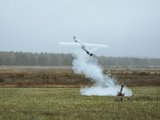
Air defence units from the US, UK and Bahrain, along with the host-nation Kuwait, took part in Exercise Sky Shield at the Udari Range Complex in 2025. (Photo: US Central Command Public Affairs)
With significant foreign military facilities to protect, Bahrain could face pressure to strengthen its short-range air defences.


Sitting in the heart of the Persian Gulf and hosting the headquarters of the US Fifth Fleet, HMS Jufair and numerous supporting elements, Bahrain joins other Gulf countries as a potential target for air and uncrewed aerial system (UAS) attack.
The reported attack targeting US forces stationed in Bahrain on 13 November 2026 highlighted the vulnerability of military infrastructure across the region. Iran claimed to have destroyed an early-warning radar installation, although US Central Command stated that two Iranian attack drones had been intercepted without causing damage or casualties. Since then, the Iranian Revolutionary Guard claimed to have carried out further
Our news & analysis is now part of Defence Insight®
A Basic-level or higher Defence Insight subscription is now required to view this content.




More from Country-focused updates
-
![Czech Republic UAV focus: moderate market value masks limited supplier opportunities]()
Czech Republic UAV focus: moderate market value masks limited supplier opportunities
The Czech Republic’s shift towards smaller uncrewed aerial vehicles has reshaped its procurement priorities, leaving nearly three-quarters of the market unawarded. Yet with this value concentrated in just two programmes, the highest-value opportunities could contain a high level of risk.
-
![Greece’s $8.1 billion naval pipeline signals opportunities beyond frigates]()
Greece’s $8.1 billion naval pipeline signals opportunities beyond frigates
Defence Insight has identified 14 upcoming Greek naval programmes, with submarine replacement, uncrewed systems and longer-term fleet renewal offering potential opportunities for suppliers.
-
![Poland land systems focus: €31 billion spending drive boosts domestic production ambitions]()
Poland land systems focus: €31 billion spending drive boosts domestic production ambitions
Poland’s potential €53 billion land procurement pipeline could give it one of Europe’s largest armoured vehicle fleets, with local production, technology transfer and future exports central to the strategy.
-
![US Navy weighs “Super Intelligence” role in designing a quieter SSN(X) attack submarine]()
US Navy weighs “Super Intelligence” role in designing a quieter SSN(X) attack submarine
NAVSEA is exploring AI-assisted design for a larger, stealthier submarine with increased weapons capacity and uncrewed-system integration, with lead-boat procurement envisaged from 2040.
-
![European funding and NATO interoperability could shape Polish helicopter plans]()
European funding and NATO interoperability could shape Polish helicopter plans
Poland is seeking to update its transport helicopters as part of a wider military aviation modernisation programme, with EU funding requirements and NATO interoperability key considerations.
-
![Poland air focus: $8.27 billion UAV market highlights value of long-term supplier relationships]()
Poland air focus: $8.27 billion UAV market highlights value of long-term supplier relationships
Poland’s growing investment in UAVs highlights how recurring procurement contracts and continuous technological development can provide suppliers with sustained opportunities beyond initial acquisitions.