“A survivable architecture”: why resilient communications are no longer a luxury
In Conversation… Military communications must adapt to a rapidly evolving battlespace, characterised by decentralised forces and an increasingly contested electromagnetic spectrum. To survive and thrive, it is vital to prioritise resilient systems and networks, Faisal Munir, President – Mission-Critical Communications at L3Harris Technologies, told Shephard’s Gerrard Cowan.


Brought to you in partnership with L3Harris Technologies
As demonstrated in the Ukraine war, military communications are now about much more than simply maintaining a connection, said Munir. The picture has become increasingly complex.
“It’s about maintaining the right connection at the right time when forces are operating in environments where the adversary is actively trying to find them, monitor them, eavesdrop on them or disrupt them,” he explained.
Those forces are far more distributed, with the battlespace characterised by a proliferation of communications nodes, most notably drones. There is significant demand for data to be passed between these nodes, from uncrewed aerial systems (UAS) to dismounted personnel, and from sensors to weapons.
At the same time, there is a growing peer threat to the US and its allies, meaning militaries face a far more contested spectrum.
“Resilient communications are vital to build a survivable architecture for the force,” Munir said. “The network that our users want in the field must have the ability to adapt and to protect information while operating in a situation where communications might be degraded or even denied.”
Changing demands
The nature of resiliency has changed, Munir said. It is now no longer simply about anti-jamming but operating through far more extensive electronic warfare (EW) effects and interference.
There should be no single point of failure, he stressed. Resilient communications today involve empowering personnel to pass information through whatever means are possible for a specific time and terrain. No single transport will be optimal everywhere at all times, so the network must be able to adapt when one path becomes degraded or is unavailable, allowing users to move seamlessly through their primary, alternate, contingency and emergency (PACE) hierarchy.
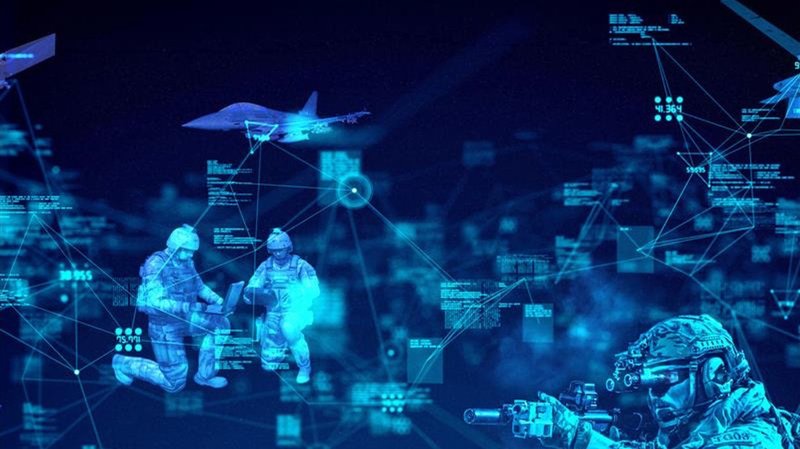
“This will involve multiple transports and multiple waveforms,” Munir said. “Our job is to ensure that forces can continue to communicate, they can sense the electromagnetic spectrum, they can see terrain differences and rapidly adapt and act as that environment shifts.”
Such resilient communications are a key focus for L3Harris on multiple levels. Capabilities includes its Falcon IV® tactical radios, which offer real-time voice, data and HD video communications in a single device; Link 16 tactical data links across a range of terminals and radios; and numerous military-off-the-shelf solutions.
When operating technology like the Falcon IV family, users access a multifunctional device that can connect warfighters through a full frequency range of waveforms; the systems can also be upgraded to include full-motion video intelligence, surveillance and reconnaissance (ISR) capabilities and other emerging technologies.
Networking nodes
Ultimately, radios and other communications systems today function as data nodes, not simply voice devices, Munir pointed out. They are sensors, they empower autonomous systems, and they are network routers, among a range of other applications.
To continue evolving these capabilities without creating additional complexity for personnel, L3Harris uses smart and software-defined networking techniques that can integrate multiple technologies and systems without the need to continually rebuild the network.
Munir highlighted the company’s Wraith offering, a high-speed, resilient networking waveform for the Falcon IV series, which provides a frequency-hopping capability to support users who face sophisticated EW attacks.
“There should be simplicity at the edge,” Munir said. “We work with leaders in the artificial intelligence (AI) field to support that rapid synthesis of data.”
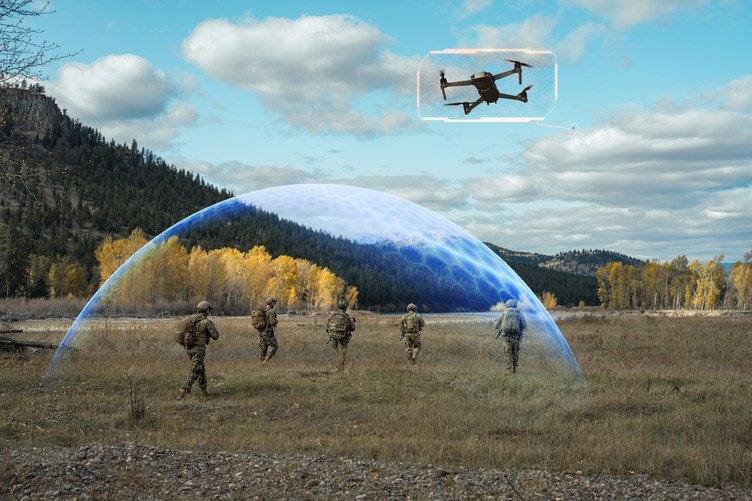
This technology has been further enhanced to help address the growing threat from drones. Munir pointed to the new Wraith Shield™ software, developed in partnership with DataShapes AI, which transforms existing tactical radios into AI-enabled radio-frequency sensing and effects platforms.
“A typical non-kinetic, counter-UAS system would be a singular device that is used to neutralise any threat at a given time. The fact that Wraith Shield’s capability is built on top of a networking waveform allows us to create an effect that is networked in nature, meaning there’s a collaborative benefit from using multiple radios in the vicinity of the threat,” he noted.
The radio as “Swiss Army Knife”
Size, weight and power (SWAP) remain a huge concern when routing multiple communication paths through different devices, Munir noted. L3Harris therefore works to make its radio systems into multifunctional tools, which he compared to Swiss Army Knives.
“The tool has multiple capabilities, and you are able to pull out the ones that you need when you need them, realising that you might not know what you will face at any given time,” he said.
Truly adaptable and resilient solutions must provide operators with a simple way of monitoring and reconfiguring networks as required. Munir pointed to the company’s MissionOps™ software package, which consolidates core tactical network management capabilities, integrating them into a single solution. This means militaries can access and manage tactical C4ISR networks through one interface, rather than dealing with a range of disparate applications.
This is built around the idea of “a single pane of glass”, said Munir: the ability to use just one application for various phases of planning and operations. Users avoid the need to repeatedly enter the same data in multiple places when they are managing or configuring networks.
The comprehensive suite is built across four key configurations and a unified interface, all designed to optimise tactical network and spectrum management. This includes ‘Plan’, enabling users to quickly initialise a network; ‘Sim’, a network modelling and analysis tool; ‘Monitor’, so that operators can stay informed of network health in real time; and ‘Manage’, enabling personnel to quickly adapt to changing mission parameters.
Delivering interoperability
Ensuring interoperability across services and nations, while balancing operational security demands, is another key challenge for modern military communications. NATO forces, for instance, often operate together and with other non-alliance partners, presenting a range of demands to deliver communications within a coalition.
Secure interoperability must be built in from the outset, said Munir. L3Harris’s suite includes a range of high-assurance radios designed for NATO allies, including Falcon IV, which operate with common standard waveforms and encryption protocols. There is also a range of common waveform or COMSEC products that can be used when NATO and non-NATO forces operate together.
Such interoperability is “fundamental in the architecture of the solutions we create,” Munir said. “It’s not something you can solve when you arrive in theatre – it has to be designed in up front.”
L3Harris regularly takes part in exercises to ensure its products meet the latest demands for effective communications, resilience and interoperability. For example, in August 2026 it participated in the US Army’s Project Convergence Capstone 6 (PC-C6) in Fort Irwin, California, where two of the company’s Falcon radio models – the AN/PRC-163 and -158C – served as part of the transport layer and delivered mobile ad-hoc network and protected waveform connectivity.
PC-C6 demonstrated the importance of interoperability, with L3Harris integrating counter-UAS sensing onto an uncrewed ground platform and sharing that data with other nodes. This “demonstrated that modular technologies allow for quick integration without significant redesign or effort, because we are following an open-architecture methodology”.
The exercise also underscored the increasingly dynamic nature of the threat environment, he said, and the need to adapt quickly in the field without significantly reconfiguring the network.
“It looked at what happens when you want to move information quickly across the system while experiencing a peer threat in in the form of electromagnetic or electronic warfare,” Munir added.
Converging technologies
All this advanced capability is vital in the modern battlespace, but it must also be sustained and maintained. Munir said L3Harris is focused on delivering forward deployment of maintenance, repair and overhaul centres around the world, for both US forces and international partners. For example, it has such facilities in Farnborough in the UK and Brisbane in Australia.
“If you have 10,000 radios in your inventory, all 10,000 should be available for the mission,” he emphasised.
As more data heads towards the tactical edge – primarily due to the growth in autonomous systems – there will be an increase in both the number of nodes and the amount of information in the battlespace. Developers like L3Harris must focus on managing this volume, Munir said, with AI set to further evolve as a supporting technology.
“AI will help determine what information matters, where it needs to go, and how networks must adapt,” he explained. “That connectivity will extend across transports to multiple domains and then into coalition partners as well.”
Adversaries evolve, so the US and its allies cannot stand still, he warned. This means not just focusing on the fastest data rate or highest bandwidth, but on adaptability and robustness. Software-defined, resilient architectures will enable operators to achieve this resiliency while leveraging current hardware.
Communications is no longer a standalone function, concluded Munir. A radio is not just a communications device, “but a computing device, sensing device, routing device, data transport device, and resilient voice device. It’s the convergence of these technologies that’s going to drive the future of this market.”


More from Industry Spotlights
-
![Orchestrating operational readiness across every defence domain]()
Orchestrating operational readiness across every defence domain
Are all systems ready for the next mission? Have upgrades been applied? Are all assets aligned to deploy together, on time and fully prepared? In modern defence operations, readiness is no longer measured platform by platform. It is measured by how well people, assets, data and decisions move together — across land, sea and air.
-
![Extending mission readiness: where XR adds real value in pilot, crew and maintenance training]()
Extending mission readiness: where XR adds real value in pilot, crew and maintenance training
Extended reality (XR) is becoming increasingly relevant in military aviation training, adding a flexible layer to an integrated ecosystem spanning the pilot, crew, and maintenance domains.
-
![Dominating the spectrum: ASELSAN’s EW capabilities take center stage at MSPO 2026]()
Dominating the spectrum: ASELSAN’s EW capabilities take center stage at MSPO 2026
ASELSAN is showcasing its advanced electronic warfare (EW) capabilities at MSPO 2026, highlighting technologies designed to detect, analyse, disrupt and deceive threats across increasingly contested electromagnetic environments.
-
![“Creating a decision advantage”: how C-UAS is evolving to reduce the operator burden]()
“Creating a decision advantage”: how C-UAS is evolving to reduce the operator burden
In Conversation… Speaking to Shephard’s Gerrard Cowan, Dr Brian Shand, Director – Advanced Concepts & Technology at L3Harris, explains how, as operators face growing numbers of low-cost drones, C-UAS providers must focus on reducing operator workload, transforming fragmented sensor data into effective decision-making.
-
![Shield the warfighter, win the fight (video)]()
Shield the warfighter, win the fight (video)
BAE Systems’ Intrepid Shield™ approach delivers full-spectrum electromagnetic protection to detect, exploit, and counter advanced threats.
-
![How joint ventures are expanding Rheinmetall's munitions portfolio (video)]()
How joint ventures are expanding Rheinmetall's munitions portfolio (video)
Roman Köhne, CEO of Rheinmetall's Weapon and Ammunition Division, discusses the company's announcements at Eurosatory 2026, including developments in defence technology, precision systems, industrial partnerships and future capability programmes.