Contract inked for Romanian Naval Strike Missile coastal defence system
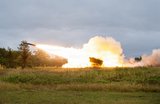
It is thought that Romania will receive four mobile launchers for its Naval Strike Missile coastal defence system. (Photo: Kongsberg)
Romania is scheduled to field its Naval Strike Missile coastal defence system from 2024.


Romania has formally ordered the Naval Strike Missile (NSM) coastal defence system under a US Foreign Military Sales (FMS) agreement with Raytheon.
On 5 January, Raytheon was awarded a $208 million contract by US Naval Sea Systems Command on behalf of Romania for the coastal defence battery.
Work towards the contract will be conducted in Norway by Kongsberg, developer of the NSM, and in the US by Raytheon.
Shephard previously reported that the Naval Strike Missile coastal defence system is scheduled for delivery in Q4 2024, replacing a Romanian Navy battery equipped with Soviet 4K51 Rubezh (SSC-3 Styx) mobile anti-ship missiles.
While the contract notice did not specify how many systems would be included in the deal, a previously published State Department approval detailed a Romanian request for two coastal defence systems comprising four mobile launchers, two fire distribution centres and other equipment.
Romania signed an agreement with the USN to purchase the system in May 2021, making it the first to procure it under a US government FMS programme.
The NSM, a long-range precision missile, has been designed to strike heavily defended land and sea targets. The missile has a terrain-following capability and uses advanced seeker and target identification technology for precise targeting.
The NSM has a 125kg HE blast-fragmentation warhead and a range of 185-555km, depending on the profile.
Options to the contract could increase its value to over $217 million.
Related Equipment in Defence Insight




More from Land Warfare
-
![Front-line support: how UK industry is helping tackle Ukraine’s landmine challenges]()
Front-line support: how UK industry is helping tackle Ukraine’s landmine challenges
Pearson Engineering has provided equipment and engineering expertise to the Armed Forces of Ukraine since the beginning of the full-scale Russian invasion in 2022. The British company is now working to deepen engagement with the Ukrainian defence industry, expanding its support for the country’s population and laying the foundations for future technological innovation.
-
![AUSA 2026: companies adapt munitions and missiles for greater effect at lower costs]()
AUSA 2026: companies adapt munitions and missiles for greater effect at lower costs
Rather than developing entirely new weapons, defence companies are looking to build on existing weapons and systems to deliver greater capability, control costs and accelerate fielding.
-
![AUSA 2026: industry looks to make commercial platforms a military reality]()
AUSA 2026: industry looks to make commercial platforms a military reality
With a production rate of more than 10 million vehicles annually, the US commercial car and vehicle manufacturing base is second only to China. Defence companies are looking at how the vehicles, technology and manufacturing capability can support programmes.
-
![With changing patterns in Middle Eastern procurement, is Europe missing out?]()
With changing patterns in Middle Eastern procurement, is Europe missing out?
Traditional suppliers are struggling to meet the Middle East’s armoured vehicle modernisation needs, creating opportunities for South Korean manufacturers and regional defence industries.
-
![AUSA 2026: CUAS market expands as suppliers target new threats and operational requirements]()
AUSA 2026: CUAS market expands as suppliers target new threats and operational requirements
New developments from MARSS, MyDefence, Mountain Horse Solutions and Rafael suggest that future counter-drone protection will increasingly depend on combining advanced detection, rapid interception and integrated defensive networks.
-
![US Army seeks CAML-Lite autonomous launcher prototypes for 2027 live-fire trials]()
US Army seeks CAML-Lite autonomous launcher prototypes for 2027 live-fire trials
The optionally crewed, C-130-transportable platforms would combine modular offensive and defensive fires with autonomous resupply, with demonstrations planned for Talisman Sabre 2027.