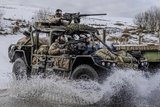
Havelsan’s Barkan UGV demonstrates varied munition firing in a step towards swarming
Havelsan test-fired a loitering munition from its Barkan UGV in mid-October. (Photo: Havelsan)
Havelsan has a focus on increasing digital battlespace capability for Turkish soldiers and test firing of a loitering munition from a Barkan UGV has marked a step towards swarming with loitering munitions.


Havelsan has successfully test-fired different types of munition from its Barkan-2 UGV using a hydro-launch from a single turret. The test has followed on from the successful launch in January 2023 of a Roketsan METE laser-guided missile from a Barkan-1 UGV.
The company announced the success of the mid-October launch on 7 November and highlighted ‘that the launch involved a diverse range of ammunition without the need for explosive materials during launch’.
As part of the trial, the Barkan-2 fired a loitering munition and completed a mission covering a 2–15km radius, but the system has been equipped with two launchers connected to a single turret.
One launcher is a laser-guided system, which was demonstrated in the earlier test, and the other deploys loitering ammunition.
The loitering munition has a range of 15km with an electric propulsion system, a flight altitude of 3000m and a flight time of 40 minutes.
An operational concept promoted by the company revolves around swarming. This was highlighted by Havelsan product development and production director Veysel Eroğlu who noted ‘KSOM (Mixed Swarm Operation Center) …recently carried out [trials] in the field [and] continue with the use of different types of payloads’.
Eroğlu said: ‘With the addition of these systems to the KSOM, the concept of using the ammunition as a swarm will also be realised in the field. At Havelsan, we use software capabilities from our digital technology unit, which is our main duty, on more platforms and payloads.
‘All of these unmanned systems, including swarm concepts – especially [technologies] put forward and pioneered by Havelsan – will be used [to lead the way] to reduce the work of our security forces in the field.’



More from Land Warfare
-
![DVD 2026: British Army’s Ajax back in the hands of users as part of a gradual return]()
DVD 2026: British Army’s Ajax back in the hands of users as part of a gradual return
The introduction of Ajax vehicles into British Army service was stopped after operator health issues were reported during an exercise, but manufacturer General Dynamics Land Systems UK believes work over the past 10 months has dealt with the problems.
-
![Europe commits to long-range fires but countries move in different directions]()
Europe commits to long-range fires but countries move in different directions
Sweden, Croatia and France are pursuing different rocket artillery solutions as European armies seek greater reach, survivability and industrial resilience.
-
![Polaris expands Arctic mobility offering as US military orders grow]()
Polaris expands Arctic mobility offering as US military orders grow
The Military 850 Voyageur 155 Crossover has secured orders from the US Army, Air Force and Marine Corps, addressing demand for agile Arctic mobility with passenger, cargo and towing capacity.
-
![More bidders move onto starting grid for British Army Land Rover replacement programme]()
More bidders move onto starting grid for British Army Land Rover replacement programme
The Light Mobility Vehicle segment of the UK’s Land Mobility Programme for the British Army may actually be about to make progress, or at least likely bidders seem to think so. Shephard spoke with several contenders who revealed their views on how the army should replace the ageing fleet.