Raytheon continues JAWS work for DARPA to coordinate kill webs
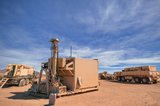
JAWS aligns with the ongoing JADC2 effort. (Image: Raytheon)
DARPA has awarded Phase 2 work to Raytheon in the Joint All-Domain Warfighting Software (JAWS) battle management planning programme.


Raytheon has received a $18.58 million contract modification from DARPA to exercise Phase 2 options in the Joint All-Domain Warfighting Software (JAWS) battle management planning programme.
Work will be completed by October 2023, the DoD announced on 13 July.
The original $10.45 million deal for Raytheon was awarded in January 2021, so the modification raises the total cumulative value of its JAWS contract to $29.03 million.
DARPA in March 2022 also exercised Phase 1 and Phase 2 JAWS options with US software company Systems and Technology Research.
JAWS is intended to feed into the wide-ranging Joint All-Domain Command and Control (JADC2) multi-domain programme, via the dynamic coordination of ‘kill webs’ in the air, land, sea and cyber domains to enable flexible decision-making.

You may also like
More from Digital Battlespace
-
![Artificial intelligence: the hope, the hype and the real-world reality]()
Artificial intelligence: the hope, the hype and the real-world reality
Artificial intelligence has supported C2 systems and decision-making for more than two decades. It has gradually built up a head of steam in the 2020s, but what is it achieving today and what role could it play in the future?
-
![SOF Week 2026: How SOF Teams Are Powering Radios, Drones and Battlefield Networks (video)]()
SOF Week 2026: How SOF Teams Are Powering Radios, Drones and Battlefield Networks (video)
At SOF Week 2026, Sean O’Neill, Senior Business Development Manager with Iris Technology, discusses the growing importance of tactical power management systems for modern military operations.
-
![SOF Week 2026: How SOF Operators Are Driving the Future of Battlefield Communications (video)]()
SOF Week 2026: How SOF Operators Are Driving the Future of Battlefield Communications (video)
At SOF Week 2026, Austin Farnham, President of Octane Wireless, discusses how direct feedback from special operations forces is helping shape the next generation of battlefield communications technology.
-
![World Defense Show 2026: Northrop Grumman to present improved C2 management system]()
World Defense Show 2026: Northrop Grumman to present improved C2 management system
The Northrop Grumman Integrated Battle Command System is in service with Poland and the US Army with another 20 countries believed to have expressed an interest.
-
![Thales looks to boost DigitalCrew system through AI and human-machine teaming trials]()
Thales looks to boost DigitalCrew system through AI and human-machine teaming trials
The Thales DigitalCrew package, first unveiled at last year’s Defence IQ International Armoured Vehicles conference, is designed to merge imaging and apply a layer of decision-making and observation algorithms to support crew and other personnel.
-
![Babcock nears first customer for Nomad AI translation tool]()
Babcock nears first customer for Nomad AI translation tool
Nomad can provide militaries with real-time intelligence, saving critical time on the battlefield.