Lockheed Martin completes next-generation long-range surveillance radar demonstrations
Lockheed Martin has successfully completed a capability demonstration in the latest phase of the US Air Force’s development of the next-generation mobile, long-range surveillance and ballistic missile defense radar.
The Dec. 16-17 demonstration for the Three-Dimensional Expeditionary Long-Range Radar (3DELRR) was the second and final required under a $25 million, 20-month technology development contract awarded in May 2009. Lockheed Martin completed an initial demonstration of critical technology elements in March 2010 and an initial preliminary design review in October 2010.
The 3DELRR will serve as the principal long-range, ground-based sensor for detecting, identifying, tracking, and reporting aircraft and missiles for the Air Force. The system will replace the Air Force’s AN/TPS-75 air surveillance radar. The Marines also are evaluating the system as a replacement for their AN/TPS-59 ballistic missile defense radar.
“Lockheed Martin has made significant investments in 3DELRR to reduce risk and drive affordability,” said program director Mark Mekker. “We have applied both new technology advances and our knowledge gained from decades of experience developing and maintaining 178 long-range surveillance radars currently operational around the world.”
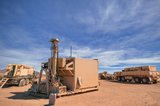
During the demonstration, Lockheed Martin unveiled a functioning system prototype to Air Force and Marine Corps officials as proof of the radar’s maturity. The radar’s design addresses 100 percent of 3DELRR requirements, including critical extended air surveillance reach for early warning from threats, such as aircraft and ballistic missiles.
The Electronic Systems Center at Hanscom Air Force Base, which is leading the acquisition for 3DELRR, plans to award one contract by early 2012 to complete the 3DELRR technology development and engineering manufacturing development phases.
Source: Lockheed Martin



You may also like

More from Digital Battlespace
-
![Artificial intelligence: the hope, the hype and the real-world reality]()
Artificial intelligence: the hope, the hype and the real-world reality
Artificial intelligence has supported C2 systems and decision-making for more than two decades. It has gradually built up a head of steam in the 2020s, but what is it achieving today and what role could it play in the future?
-
![SOF Week 2026: How SOF Teams Are Powering Radios, Drones and Battlefield Networks (video)]()
SOF Week 2026: How SOF Teams Are Powering Radios, Drones and Battlefield Networks (video)
At SOF Week 2026, Sean O’Neill, Senior Business Development Manager with Iris Technology, discusses the growing importance of tactical power management systems for modern military operations.
-
![SOF Week 2026: How SOF Operators Are Driving the Future of Battlefield Communications (video)]()
SOF Week 2026: How SOF Operators Are Driving the Future of Battlefield Communications (video)
At SOF Week 2026, Austin Farnham, President of Octane Wireless, discusses how direct feedback from special operations forces is helping shape the next generation of battlefield communications technology.
-
![World Defense Show 2026: Northrop Grumman to present improved C2 management system]()
World Defense Show 2026: Northrop Grumman to present improved C2 management system
The Northrop Grumman Integrated Battle Command System is in service with Poland and the US Army with another 20 countries believed to have expressed an interest.
-
![Thales looks to boost DigitalCrew system through AI and human-machine teaming trials]()
Thales looks to boost DigitalCrew system through AI and human-machine teaming trials
The Thales DigitalCrew package, first unveiled at last year’s Defence IQ International Armoured Vehicles conference, is designed to merge imaging and apply a layer of decision-making and observation algorithms to support crew and other personnel.
-
![Babcock nears first customer for Nomad AI translation tool]()
Babcock nears first customer for Nomad AI translation tool
Nomad can provide militaries with real-time intelligence, saving critical time on the battlefield.