Babcock nears first customer for Nomad AI translation tool
Nomad can provide militaries with real-time intelligence, saving critical time on the battlefield.
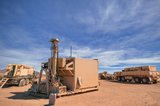
Giraffe 4A radar. (Photo: Saab)
Saab has launched a new mobile high-mast solution for its Giraffe 4A radar.
Developed with Finnish partner Conlog Oy and produced in Finland and Sweden, the high-mast solution is designed for ‘fast and efficient deployment in order to meet modern threats of low altitude such as cruise missiles and Unmanned Aerial Vehicles (UAVs) in the battlefield of today’, Saab announced in a 23 November statement.
With a high mast, Giraffe 4A will be able to function in urban environments without line-of-sight disruption from large buildings.
The C-band Giraffe 4A provides 3D air surveillance with 15 stacked beams and the capability to monitor up to 1,000 tracks, according to Shephard Defence Insight.
The AESA radar has an aircraft tracking range of up to 280km, whereas in weapons location mode it can detect targets at 100km range.
Saab is already providing Giraffe 4A radars and upgrades to Swedish Giraffe AMB surface radars under an SEK2.1 billion ($229 million) contract for an integrated sensor and C2 system for use with ground-based air defence.
Nomad can provide militaries with real-time intelligence, saving critical time on the battlefield.
Taurus operates alongside the Israel Defense Forces’ Orion system which supports mission management across tens of thousands of manoeuvring forces, from squad leaders to battalion commanders.
The plan for the new displays follows fresh investment in Kopin’s European facilities by Theon and an order for head-up displays in fielded aircraft, with funding from the US Department of Defense.
Persistent Systems received its largest ever single order for its MPU5 devices and other systems earlier this month and has already delivered the 50 units to the US Army’s 4th Infantry Division.
Turkey has joined the family of countries attempting to establish a multilayered air defence system with government approval in August 2024 for the effort landed by Aselsan. Dubbed Steel Dome, the programme joins Israel’s Iron Dome, the US Golden Dome, India’s Mission Sudarshan Chakra and South Korea’s low-altitude missile defence system.
MARSS’ NiDAR system has been deployed using sensors from static platforms to provide detection and protection for static sights, such as critical infrastructure, ports and military bases.