Russia projects ‘business as usual’ image on anticlimactic Victory Day
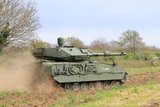
A Kamaz-43269 Vystrel 4x4 armoured vehicle with a new Spica RWS, featuring a 30mm autocannon and a 40mm grenade launcher, pictured during the 2022 Victory Day Parade in Nizhny Novgorod. (Image: OTC)
This year’s Victory Day parade in Moscow turned out to be the opposite of what was expected.


The annual parade in Moscow on 9 May usually attracts attention, but the symbolism of this year’s event was more important than ever to foreign observers given the ongoing war in Ukraine.
Many international observers, analysts and senior government officials expected that the event could be used by Russian President Vladimir Putin for important announcements, such as mass mobilisation or an official declaration of war against Ukraine.
Reality proved them wrong and no major announcements were made.
International observers and Kremlinologists had spent days leading up to Victory Day forming broad assumptions based on the information revealed by officials
Our news & analysis is now part of Defence Insight®
A Basic-level or higher Defence Insight subscription is now required to view this content.


More from Defence Notes
-
![UK urged to prioritise sea, air and space over heavy armour]()
UK urged to prioritise sea, air and space over heavy armour
A report from the Council on Geostrategy argues the UK should move away from a traditional balanced force and shift investment to naval, air and space capabilities, backed by a larger fleet of attack submarines and deeper AUKUS integration.
-
![Thales: deployment speed to determine winners in ‘production versus production’ era]()
Thales: deployment speed to determine winners in ‘production versus production’ era
At its technology summit in London, attended by Shephard, Thales UK examined the importance of speed to delivery, the growing focus on cross-domain capabilities and how procurement reform could be crucial for future battlefield advantage.
-
![Orchestrating operational readiness across every defence domain]()
Orchestrating operational readiness across every defence domain
Are all systems ready for the next mission? Have upgrades been applied? Are all assets aligned to deploy together, on time and fully prepared? In modern defence operations, readiness is no longer measured platform by platform. It is measured by how well people, assets, data and decisions move together — across land, sea and air.
-
![Global tensions drive defence supply chain scrutiny]()
Global tensions drive defence supply chain scrutiny
Governments worldwide are scrambling to decouple defence supply chains from dependency upon strategic rivals, but countries could struggle to do it all themselves.
-
![How deepening AI usage can boost efficiency and maximise effects for forces]()
How deepening AI usage can boost efficiency and maximise effects for forces
Saab has outlined how it is using artificial intelligence to make training more like electronic gaming, while the UK’s Power Size Technologies is applying the same technology to better evaluate and design vehicle capability, moving AI-enabled innovation further upstream from the frontline.
-
![From systems integrator to multi-domain solutions provider (video)]()
From systems integrator to multi-domain solutions provider (video)
Philipp von Brandenstein, Head of Corporate Communications at Rheinmetall, explains how Eurosatory 2026 marked a new stage in the company's evolution.