“Fifth-gen capability without the cost”: how autonomous strike can change the face of air warfare
In Conversation… Armor Harris, Senior Vice President for Aircraft at Shield AI, talks to Shephard’s Gerrard Cowan about why cost-effective autonomous aircraft are a game-changer for air forces worldwide, and the key roles played by VTOL and AI as enabling technologies.


Drones and missiles pose a growing threat to aircraft on the ground, endangering even the most sophisticated platforms when based far from the front line. AI-powered uncrewed systems are a crucial part of the answer, delivering dispersed solutions, range and capability at a fraction of the cost, according to Harris.
The US and its allies have spent decades developing increasingly exquisite stealth aircraft that are highly survivable in the air, but very vulnerable on the ground, he noted. As the wars in Ukraine and the Middle East have shown, inexpensive drones and other munitions pose huge dangers to even fifth- and sixth-generation fighter aircraft operating from highly sophisticated installations.
In this environment, a B-2 Spirit stealth bomber worth billions of dollars is just as vulnerable as any other aircraft parked on the tarmac of an air base. “Our adversaries realise this, so they’ve focused their attention on these capabilities to combat Western air power and the dominance we’ve enjoyed for many years,” said Harris.
Cutting-edge capability, reduced expense
The asymmetric threat has only expanded as aircraft continue to evolve, with an exponential growth in costs from the F-16 to the F-35 and onto sixth-generation platforms. The effort needed to host and protect that air power has also expanded, demanding multi-billion-dollar bases, hardened aircraft shelters and air defence provided by systems such as Patriot.
These are just the beginning of the challenges in cost and capability, noted Harris. “You also need tankers to get your aircraft into the fight, because they don’t have enough range by themselves. And you need pilots, who cost on average $10 million to train,” he added.
All of this means militaries increasingly require aircraft that cost far less than the list prices and operating budgets associated with modern crewed fighter jets – including the pilot – while providing the same capability, if not better. They need the range and mobility to operate independently of fixed bases, boosting their manoeuvrability and reducing the vulnerability that comes from concentrating assets in designated infrastructure.
Enter X-BAT
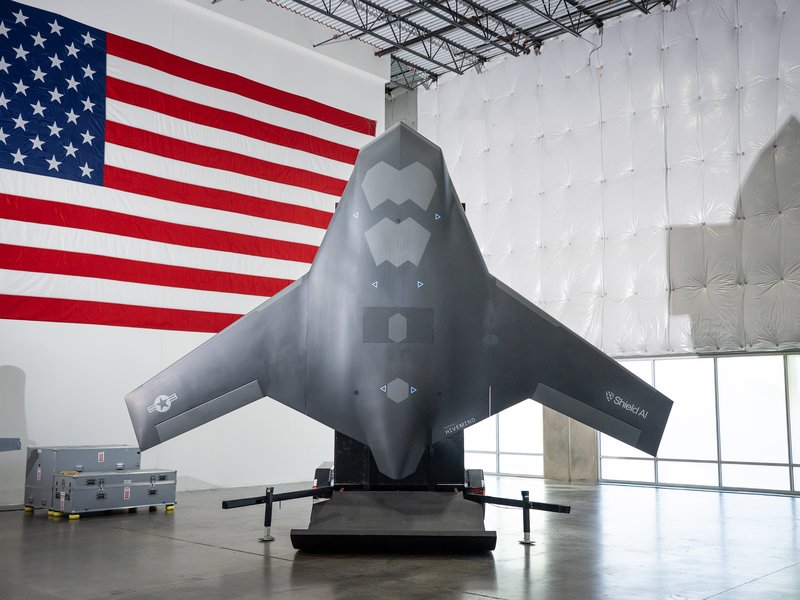
These requirements drove the development of Shield AI’s X-BAT, the world’s first AI-piloted vertical take-off and landing (VTOL) fighter jet.
X-BAT is designed for applications across the land, sea and air domains, particularly long-range strike. Powered by a GE Aerospace F110 engine, the new platform carries both air-to-air and air-to-surface weapons in its internal bays and can launch strike weapons from external hardpoints; meanwhile its sensor suite can support a range of electronic warfare (EW) demands.
“X-BAT came about through trying to solve the modern warfighter’s toughest problems: basing, survivability on the ground, and the cost curve of modern air power,” Harris explained.
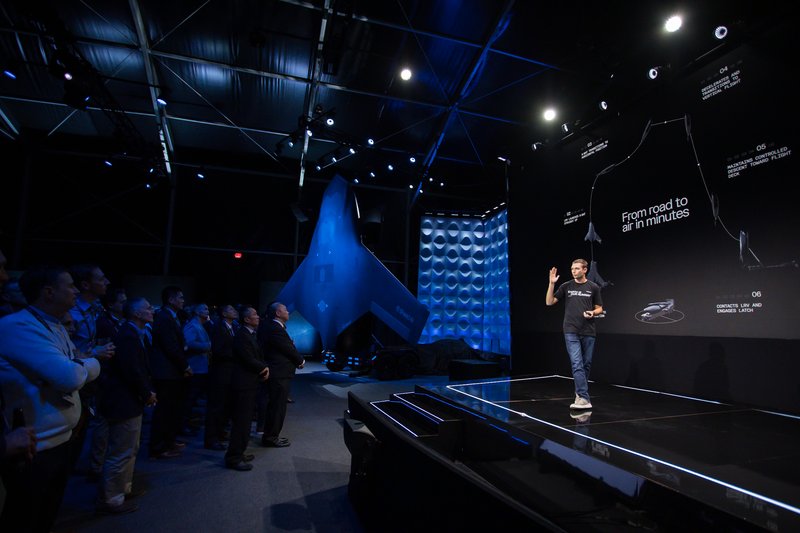
The aircraft offers a wide range of operational and logistics benefits. It can go from the road to the air in minutes, providing over 2,000nm of long-range capability. Driven by Shield AI’s Hivemind AI pilot technology, the platform can function autonomously, without the need for a pilot.
Harris highlighted the X-BAT’s size: at 26ft long with a 39ft wingspan, it is more than double the footprint of many other aircraft in the category. However, three X-BATs can fit in the space needed for one legacy fighter with their wings folded.
The VTOL advantage
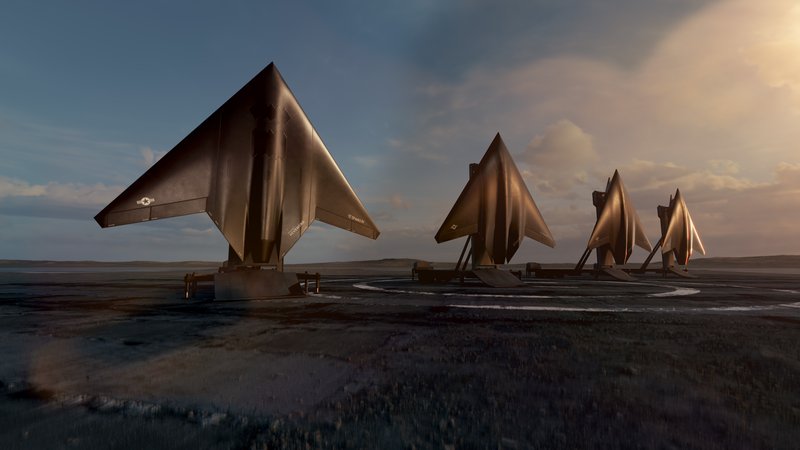
X-BAT’s tail-sitting VTOL capability is a crucial advantage, Harris explained. The design means it can launch without a runway, in challenging environments ranging from remote islands to forward bases, removing the need for traditional infrastructure.
VTOL capability means armies and air forces can operate an aviation component independently, without needing to rely on support from bases hundreds of miles away.
In a naval application, it offers the ability to project long-range strike power, without relying on a traditional large aircraft carrier.
“Nuclear-powered aircraft carriers are an incredible capability in terms of bringing a huge air wing to bear, but what if you could augment that with strike aircraft coming off other ships?” Harris asked.
Most importantly, the VTOL design boosts survivability, because “the best way to be survivable on the ground is to be mobile.”
Prototype development
Shield AI has been working over the past 18 months on developing two X-BAT prototype air vehicles, which at the time of writing were under construction in the company’s facility in Frisco, Texas. These aircraft will be flown towards the end of 2026, Harris said, conducting a range of VTOL tests.
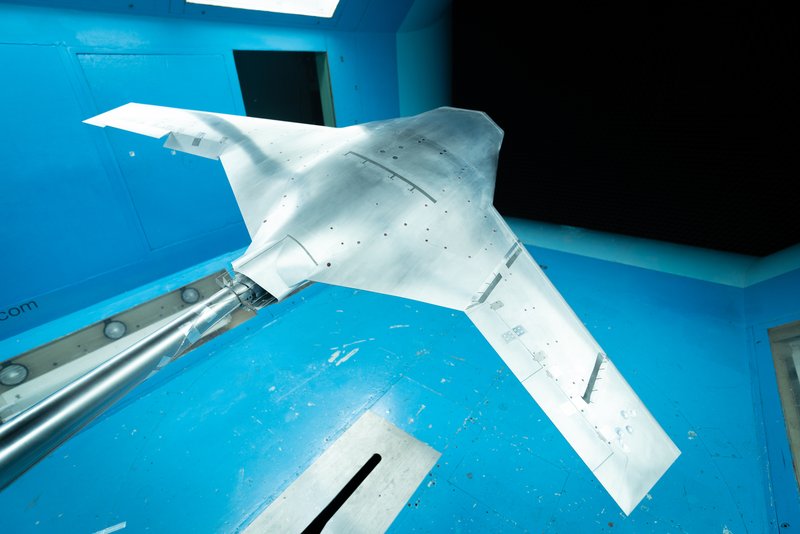
The company has followed a policy of “testing early and often”, he said, with efforts everywhere from the wind tunnel to analysis of the radar cross-section. This work has addressed a range of risks from a technical standpoint, focusing on everything from the blast deflector to the launch and recovery vehicle as well as the thrust vectoring of the engine.
There is also a crucial focus on training. Harris noted that Shield AI recently acquired Aechelon, which delivers training services and simulation through physics-based sensor modelling and synthetic reality technologies, with the company’s tools used by the US military and its allies.
“We’re bringing the autonomy into the simulation environment so that pilots and end users can train with it and become comfortable with this autonomous wingman who’s out there flying with them,” Harris explained.
Market potential
X-BAT builds on Shield AI’s experience with the V-BAT uncrewed aerial system (UAS), an intelligence, surveillance and reconnaissance (ISR) and targeting platform that has gathered extensive experience in Ukraine and other theatres. X-BAT takes this a stage further, representing “the first truly autonomous strike fighter,” according to Harris.
Other collaborative combat aircraft (CCAs) are fundamentally tethered to the crewed “quarterback” jet that coordinates them for tasks like targeting and navigation, Harris argued. “But X-BAT has the size, weight and power needed to carry its own sensors, to be fully standalone, to be autonomous. It can operate in conjunction with a manned quarterback if it needs to, but it doesn’t have to, and that’s what makes it such a game-changer.”
CCAs such as X-BAT will play a vital role in delivering combat mass at scale. The platform’s main application is long-range strike, but it can fulfil a range of roles collaboratively with other assets, including ISR, EW and air-to-air combat.
These capabilities mean there is a huge addressable market for the platform, Harris said. Shield AI is aiming for X-BAT to serve as a four-service aircraft in the US military, across the navy, army, air force and marine corps.
“It is also compelling for international air forces, armies and navies because of how it breaks the cost curve,” he said. “Everybody faces constraints on their defence budgets, so how do you get fifth-gen class air power for a fraction of the price tag?”
Flying with AI
The software side is also crucial. The Hivemind AI pilot delivers X-BAT’s autonomous capabilities and is built on three layers, Harris said.
Firstly, the perception layer uses onboard sensors to observe the world around the aircraft and make adjustments as needed. Second, the cognition layer makes decisions based on operational developments while referencing the mission intent. Finally, the action layer translates these decisions to the flight controls, ensuring the aircraft can conduct the required manoeuvre.
The same fundamental technology has been tested in action and is flying on a variety of platforms, added Harris, including V-BAT. He noted that the company has been working closely with the USAF on Hivemind and recently won a production contract to place the aircraft on the service’s CCAs. “That’s important validation from some of the toughest graders out there,” Harris said.
He further underscored the operational experience of V-BAT in Ukraine and other theatres, with Hivemind used to enable GNSS-independent navigation capabilities, among other applications. It has been flown on one-way attack missions in Ukraine, he said, significantly boosting the probability of kill.
“Hivemind has improved the V-BAT’s ability to autonomously navigate to targets, coordinating their arrival. You can bring them in from multiple vectors against a single target to degrade the adversary’s defences, while it also works in conjunction with automatic recognition algorithms to select the targets, with a human on the loop to monitor it.”
Software evolution
Shield AI is working in a range of areas to ensure the future evolution of X-BAT, added Harris. From a hardware standpoint, he noted that the US Department of Defense is driving industry towards a series of reference architectures that define interfaces for mission systems and software skills.
“We’ve been designing to those standards to enable more rapid swap and upgrade of systems in the future,” he said.
The software element will remain crucial looking forward, Harris emphasised. The victor in future conflicts is likely to be the side that can hone and update its software fastest, he said, pointing to the importance of incorporating lessons learned in pre-mission analysis and post-mission debriefs.
“Things inevitably evolve on the battlefield: they can evolve in the space of a day, or sometimes less than a day. A system’s ability to change is crucial, and that has been a key focus for us with the X-BAT.”
Find out more about X-BAT, or visit Shield AI at Farnborough International Airshow, Hall 3 Booth 3750.

More from Industry Spotlights
-
![“Start planning much earlier”: delivering defence support in an era of disruption]()
“Start planning much earlier”: delivering defence support in an era of disruption
In Conversation… The geopolitical landscape is increasingly uncertain, with the UK and its allies confronting the most unpredictable international environment for decades. To adapt, defence readiness must begin long before assets reach the front line, forging a resilient support enterprise that can thrive in a time of ongoing disruption, argue the partners of Team ORION.
-
![Patria NEMO Navy: Unlocking unmatched versatility and protection for modern naval forces]()
Patria NEMO Navy: Unlocking unmatched versatility and protection for modern naval forces
The Patria NEMO Navy mortar system marks a revolutionary advance in maritime defence technology, offering unparalleled benefits to customers who demand performance, adaptability and safety in their naval operations.
-
![“Communicating at mission speed”: why data security is essential for operational success]()
“Communicating at mission speed”: why data security is essential for operational success
In conversation… Everfox’s Chairman and Chief Executive Officer Dave Wajsgras and Managing Director, International, Colin McKinty discuss the critical importance of information security in defence, minimising insider risk and the company’s international growth strategy with Shephard’s Andrew White.
-
![“Engage with the operational problem”: how software innovation can boost UK defence]()
“Engage with the operational problem”: how software innovation can boost UK defence
In Conversation… Shephard’s Andrew White talks to Zafer Şen, CEO and co-founder of OBSS, about the future of command-and-control software in the age of artificial intelligence, and his company’s ambitions in the UK defence market.
-
![“A survivable architecture”: why resilient communications are no longer a luxury]()
“A survivable architecture”: why resilient communications are no longer a luxury
In Conversation… Military communications must adapt to a rapidly evolving battlespace, characterised by decentralised forces and an increasingly contested electromagnetic spectrum. To survive and thrive, it is vital to prioritise resilient systems and networks, Faisal Munir, President – Mission-Critical Communications at L3Harris Technologies, told Shephard’s Gerrard Cowan.
-
![Orchestrating operational readiness across every defence domain]()
Orchestrating operational readiness across every defence domain
Are all systems ready for the next mission? Have upgrades been applied? Are all assets aligned to deploy together, on time and fully prepared? In modern defence operations, readiness is no longer measured platform by platform. It is measured by how well people, assets, data and decisions move together — across land, sea and air.