First Brazilian Gripen takes flight


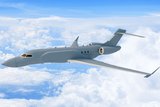
Saab has carried out the maiden flight of the first Gripen E fighter for the Brazilian air force.
The 65min sortie of aircraft 39-6001 was carried out by Saab test pilot Richard Ljungberg from the company’s Linköping, Sweden site on 26 August, during which it verified basic handling and flying qualities at different altitudes and speeds, ensuring that the aircraft’s behaviour was in line with expectations.
‘This milestone is a testament to the great partnership between Sweden and Brazil. Less than five years since the contract was signed, the first Brazil Gripen has conducted her first flight,’ Håkan Buskhe, president and CEO of Saab, said.
This aircraft is the first Brazilian production aircraft and will now be used in the joint test programme being carried out by the Swedish government and Saab, expanding the test parameters for the tactical system and sensors on-board the fighter, which once in service with the Brazilian air force as the F-39 will have the tail number 4100.
Aircraft 39-6001 is different to previous Gripen E test aircraft in that it has a new cockpit layout including a large wide area display, two small head down displays, and a new head up display, as well as an updated flight control system.
‘For me as a pilot it has been a great honour to fly the first Brazilian Gripen E aircraft as I know how much this means for the Brazilian air force and everyone at Saab and our Brazilian partners,’ Ljungberg said.
‘The flight was smooth and the aircraft behaved just as we have seen in the rigs and simulators. This was also the first time we flew with the wide area display in the cockpit, and I am happy to say that my expectations were confirmed.’
Related Equipment in Defence Insight



More from Defence Notes
-
![Eurosatory 2026: New public security needs drive personal protection equipment modernisation]()
Eurosatory 2026: New public security needs drive personal protection equipment modernisation
European law enforcement and public security agencies are entering a new cycle of investment in personal protection equipment (PPE), driven by evolving threat profiles, officer welfare requirements and advances in materials technology.
-
![The speed of relevance: how companies can navigate the new era of European defence procurement]()
The speed of relevance: how companies can navigate the new era of European defence procurement
European militaries face a rapidly evolving security landscape and defence production must accelerate to meet surging demand for platforms and equipment. Industry needs to adapt to ensure it gets its products into the hands of the end user, Evelyn Rafferty, Senior Director Aerospace and Defence - Europe at Plexus told Shephard’s Gerrard Cowan.
-
![Eurosatory 2026: Milrem Robotics puts forward multi-layered defence concept for NATO's eastern flank]()
Eurosatory 2026: Milrem Robotics puts forward multi-layered defence concept for NATO's eastern flank
Autonomous systems developer Milrem has evolved a model for an interoperable robotised approach to the Eastern Flank Deterrence Initiative (EFDI), showing how uncrewed systems could provide a multi-layered defence architecture in the air and on land along NATO’s eastern borders.
-
![Eurosatory 2026 to highlight changing defence and security priorities]()
Eurosatory 2026 to highlight changing defence and security priorities
Eurosatory 2026 will reflect a defence and security sector shaped by conflict, rising government spending, uncrewed systems, multidomain networks and growing demand for sovereign capabilities.
-
![Delays, departures and drama cloud UK defence programmes ahead of absent DIP]()
Delays, departures and drama cloud UK defence programmes ahead of absent DIP
The UK defence secretary’s departure suggests that the long-delayed Defence Investment Plan is unlikely to meet the funding demands of the armed forces, with consequences for procurement and the UK’s standing at a NATO summit weeks away.
-
![Agile, sovereign, edge-ready: rewiring defence IT for a contested decade]()
Agile, sovereign, edge-ready: rewiring defence IT for a contested decade
Today's rapidly changing security landscape means that armed forces can no longer treat their data in the same way as in the past. What are the key challenges they face, and how can industry help them?