US Air Force receives first upgraded F-16 for South Korean air defence mission
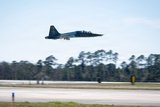
The 8th Fighter Wing in South Korea has received the first F-16 upgraded under the Post Block Integration Team modification programme. (Photo: USAF)
The US Air Force in South Korea has received the first F-16 fighter jet upgraded with an AN/APG-83 radar and other avionics improvements.


The USAF’s South Korea-based 8th Fighter Wing (FW) received its first F-16 to be upgraded by the Air Force Life Cycle Management Center’s Post Block Integration Team on 4 April, the service has announced.
The PoBIT upgrade comprises 22 modifications, including installation of the Northrop Grumman AN/APG-83 Scalable Agile Beam Radar with active electronically scanned array and fitting a new Center Display Unit.
‘The F-16 is planned to continue service into the 2040s, so this upgrade is critical to making sure we are keeping pace with the evolving threat environment,’ Col John D Caldwell, 8th FW vice-commander said.
‘The main components that I interacted with today [the CDU and APG-83 SABR] are both critical pieces that work together to bring the F-16 closer to fifth-generation capabilities, which will keep the F-16 relevant to the fight.’
Other avionics upgrades include a programmable data generator, new-generation EW capability, a communications suite upgrade and a new mission computer.
‘The avionics upgrades allow pilots to take full advantage of the jet’s advanced weapons and sensors, it is capable of providing high-speed data and/or high-resolution video and ultimately aids the pilot in tactical decision-making,’ Capt Michael C Durham, 8th Operations Support Squadron weapons tactics officer said.
‘The upgraded radar, specifically, allows us to track a greater number of targets at longer ranges in both cooperative and non-permissive environments while also improving the F-16’s all-weather capabilities by adding synthetic aperture radar mapping for target nomination and engagement.’
PoBIT upgrades for the F-16 fleet are being conducted in various phases over a period of several years to provide the aircraft the necessary updates while ensuring operational requirements can still be met.
According to Shephard Defence Insight, in April 2020, the USAF announced that it was planning to upgrade more than 600 F-16 aircraft under the Operational Flight Program (OFP) M-series 7.2+ upgrade which includes both software and hardware improvements.
Older F-16 Block 40/42/50/52 jets are being retrofitted with 42 major capabilities, including the AN/APG-83, AGM-158B Joint Air-To-Surface Standoff Missile Extended Range and AIM-120D AMRAAM for $455 million.
Related Equipment in Defence Insight


More from Air Warfare
-
![July drone digest: Sovereign production takes centre stage at Farnborough]()
July drone digest: Sovereign production takes centre stage at Farnborough
Farnborough International Airshow (FIA) 2026 revealed the growing scale of the UK’s uncrewed ambitions, with companies showcasing new CCA, autonomous wingmen and surveillance drones, while sovereign production emerged as a key factor for multiple programmes.
-
![FIA 2026: Bell highlights MOSA-driven growth path for MV-75 Cheyenne]()
FIA 2026: Bell highlights MOSA-driven growth path for MV-75 Cheyenne
Bell Flight’s modular open-systems approach for the US Army’s MV-75 Cheyenne could open doors for international allies and suppliers once locked out by closed rotorcraft architectures.
-
![Maximise survivability with advanced electronic warfare (video)]()
Maximise survivability with advanced electronic warfare (video)
BAE Systems’ all-digital EW delivers 360-degree threat awareness in contested environments, boosts survivability, and cuts lifecycle costs.
-
![US Air Force seeks avionics upgrades for ageing T-38 Talon as T-7A Red Hawk delays persist]()
US Air Force seeks avionics upgrades for ageing T-38 Talon as T-7A Red Hawk delays persist
The USAF is looking for commercial avionics solutions to improve the T-38 Talon’s reliability, readiness and flight safety as continued T-7A Red Hawk delays increase the likelihood that the legacy trainer will remain in service longer than planned.
-
![British Army’s Project Corvus selection highlights new era of drone sovereignty]()
British Army’s Project Corvus selection highlights new era of drone sovereignty
The UK’s choice of the Tekever AR5 for Project Corvus reflects a wider shift in military drone procurement towards solutions that centre on sovereignty and domestic production, moving away from overseas reliance.