Third Australian Triton UAS completes testing
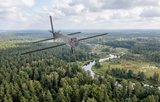
Australia’s third multi-intelligence MQ-4C Triton, also known as “AUS3,” takes to the skies for its first flight. (Photo: Northrop Grumman)
Australia received its first MQ-4C Triton uncrewed aerial system (UAS) in August last year with another two expected to be delivered this year.


Northrop Grumman has completed testing of the third MQ-4C Triton UAS for the Royal Australian Air Force (RAAF) with further testing to take place before the platform’s delivery to Australia along with the second aircraft.
Flight tests of the third platform took place at the company’s Palmdale facility in California and preparations are underway for the aircraft to be ferried to Naval Air Station in Patuxent River, Maryland. At this site it will undergo calibration testing alongside the second aircraft.
Once fully fielded, the aircraft will be operated by the Number 9 Squadron from two locations to perform surveillance over the Indo-Pacific region: RAAF Base Edinburgh in South Australia and RAAF Base Tindal in the Northern Territory.
Related Articles
Australia’s Tritons edge closer to operations as service contract signed
Australian Triton takes to the skies
First Triton welcomed into RAAF service
Shephard Defence Insight notes the Australian Department of Defence’s ‘2020-2021 Major Projects Report’, published in December 2021, stated that the MQ-4C Triton was initially expected to achieve Initial Operational Capability in July 2024.
However, in 2021, the DoD forecast that Full Operational Capability (FOC) was delayed from late 2025 to mid-2031. The report stated that “significant delays have... been experienced” and that the new forecasted FOC schedule now better reflects the aircraft’s production schedule.
Australia originally ordered four aircraft but later exercised an option for a further two. The aircraft is a maritime version of the Global Hawk UAS and in Australian service is expected to operate with P-8A maritime patrol aircraft. The main area of operation will be off Australia’s north-west coast.
Related Programmes in Defence Insight
MQ-4C Triton (5-6) [Australia]
MQ-4C Triton (1-4) [Australia]
Related Equipment in Defence Insight



More from Air Warfare
-
![October crewed air review: Israel’s Apache deal bets on crewed aviation in an uncrewed age]()
October crewed air review: Israel’s Apache deal bets on crewed aviation in an uncrewed age
Israel’s $1 billion Apache helicopter order highlights the continued demand for crewed attack aviation, while growing integration with uncrewed systems could shape future modernisation and procurement decisions.
-
![US Navy keeps Super Hornet production restart option open, but without defined cost or timetable]()
US Navy keeps Super Hornet production restart option open, but without defined cost or timetable
The US Navy plans to preserve Super Hornet and Growler tooling as production winds down, with restart costs unassessed and final F/A-18 deliveries expected in late 2027.
-
![Connecting the layers: how networks can secure the future of European air defence]()
Connecting the layers: how networks can secure the future of European air defence
The rise of drones has reshaped the threat landscape for all European militaries. For industry, future defensive strategies must carefully balance a mix of passive and active measures to address the evolving danger, based around a highly integrated and responsive network of sensors and effectors.
-
![Germany could secure greater influence through sixth-generation fighter partnership with Sweden and Spain]()
Germany could secure greater influence through sixth-generation fighter partnership with Sweden and Spain
Germany is assessing potential pathways for a future sixth-generation fighter capability, including discussions with GCAP partners and Sweden.
-
![Quantum Systems details 480km/h Ukrainian interceptor as production scales up]()
Quantum Systems details 480km/h Ukrainian interceptor as production scales up
Quantum Systems’s Ukraine-made interceptor SPYS is thought to cost approximately 10 times less than Russia's jet-powered uncrewed aerial systems and is being produced at scale.