How detection-led C-UAS solutions are transforming drone defense
Modern C-UAS solutions must detect threats early, integrate layered sensors, and deliver fast, scalable, adaptable defense against evolving drones.


Enjoy free access to this sponsored article, all content provided by Teledyne FLIR Defense
Low-cost and easy-to-operate uncrewed aerial systems (UAS) have fundamentally reshaped the modern battlefield.
Once the preserve of advanced militaries, commercially available UAS of all shapes and sizes are now easily accessible to state and non-state actors alike, delivering unprecedented asymmetric advantage down to the lowest tactical level.
What was once complex and expensive is now affordable and adaptable, empowering adversaries to optimise intelligence-gathering, precision strike and psychological impact with minimal resources and maximum effect.
Whether deployed individually or as part of a coordinated swarm, UAS can pose significant threats to civilian populations, critical infrastructure and warfighters alike, undermining national security and disrupting economies.
Threats range from smaller, vertical take-off/landing (VTOL) Group 1 UAS through to larger, typically military-off-the-shelf Group 3 UAS and above, as well as the proliferation of “dark drones” which possess the capability to evade detection entirely.
Further compounding the problem is the ability of UAS to carry a wide variety of payloads, including kinetic (“hard-kill”) and non-kinetic (“soft-kill”) effects, designed to cause maximum levels of damage or disruption against a wide variety of targets.
Given these widespread and escalating threats, governments around the world are demanding the most efficient and cost-effective means of countering UAS in both battlefield and non-battlefield environments.
However, significant hurdles must be overcome to enable potential customers to identify and deploy the most appropriate counter-UAS (C-UAS) solutions currently available in a highly competitive marketplace.
Constraints can include requirement for extensive levels in capital expenditure; sluggish government acquisition pathways; and slow innovation and production cycles implemented by some of the larger and more traditional original equipment manufacturers.
“You can’t defeat what you can’t find”
Whether deployed across battlefield or non-battlefield environments, modern C-UAS must be capable of operating in congested and contested situations, balancing cost and scalability, and offering magazine depth and resilience against mass attacks.
Critical to the successful neutralization of UAS is the ability to detect and identify a threat at the earliest opportunity. This compresses decision-making processes, providing operators with the necessary amount of time and knowledge to select the most appropriate course of action to disrupt or destroy the threat.
Urban operations, in particular, pose significant challenges for C-UAS, requiring capability to neutralize a threat without endangering civilian populations and violating radio frequency (RF) spectrum regulations.

LVSS ADA C-UAS is a mobile platform that leverages 3D radar, EO/IR camera, and RF detection and mitigation sensors to provide early warning alerts, detection, and non-kinetic countermeasures for drones.
Disruption to local networks can be mitigated through protocol takeover, low-power RF, GNSS (global navigation satellite system) management, and zero-collateral approaches, while spectrum discipline, coordination with aviation authorities, and data minimization can also go some way to ensuring compliance with the relevant government agencies and authorities.
Modern C-UAS should also benefit from a layered network of sensors and software to accurately detect, identify and track threats in real time. Sensor selections can include passive electro-optical/infrared (EO/IR) and stereoscopic cameras, lidar, and radar — the latter two of which are considered particularly effective when used in highly cluttered environments.
This not only offers operators a persistent and wide-area “system-of-systems” approach to overcome single-sensor limitations — it also extends range and early warning with machine learning algorithms assisting in the prioritization of targets and minimizing false positives.
C-UAS should also be flexible in nature, combining fixed-site and mobile systems to adapt to evolving operational requirements, ensuring assets can be redeployed at a moment’s notice, depending upon evolving threats.
Finally, C-UAS solutions must be supported by a mix of effects to successfully neutralize a threat or swarm of threats, dependent upon the operating environment.
Preference should be given to non-kinetic measures such as RF jammers and directed energy weapons — namely high-power microwave and high-energy lasers. Although more costly, kinetic options can be relied upon as a last resort should non-kinetic effects fail to neutralize a threat.
Operational imperatives
Having identified and selected the most appropriate C-UAS solution, customers must ensure technologies can be fielded as quickly as possible, providing those who need it most with secure, reliable and measurable performance parameters.
Equipment should be capable of being deployed within 90-180 days of selection, providing end users with flexibility when it comes to training, set-up, operation, power draw, cyber posture and sustainment.
Systems must also be low-cost, interoperable and scalable as well as capable of both being integrated into larger air defense networks and operating as standalone solutions.
Agile command and control (C2) software, benefiting from open standards and machine learning algorithms, will help to track correlations, prioritize targets, implement autonomous engagement boundaries and cooperate with other air defense systems and effectors.
Finally, C-UAS must support an ever-expanding envelope of use cases, covering extreme and arduous terrain both on land and at sea. This includes the ability to protect military bases at home as well as abroad, often located in remote environments and far from any logistical support.
Similarly, technologies can also be "marinized" to protect surface vessels and offshore infrastructure including gas and oil platforms from corrosion, shock, water damage and electromagnetic threats at sea.
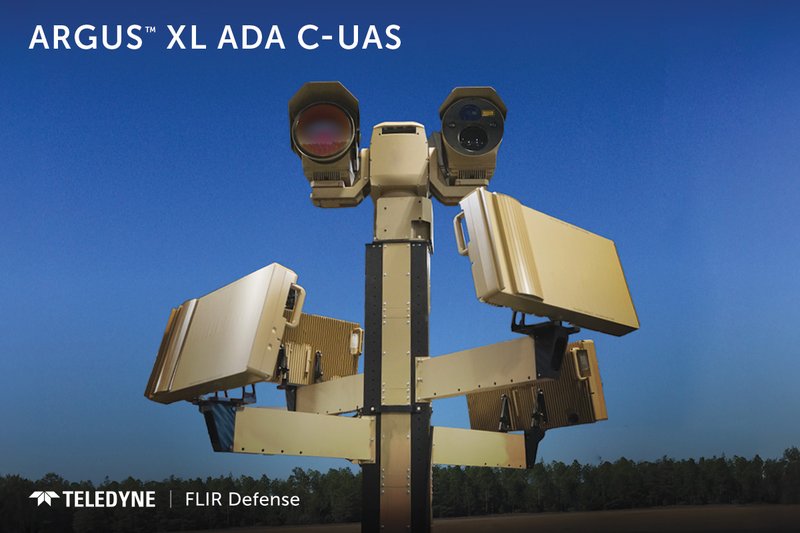
Argus™ XL C-UAS is a fixed surveillance system whose modular design incorporates Teledyne FLIR’s advanced radar and EO/IR sensors, plus a third-party RF sensor.
As detection-led C-UAS solutions become more widely adopted, the decisive advantage will lie not merely in detecting and identifying threats, but in delivering integrated, scalable solutions that can evolve alongside them.
Operators increasingly expect systems that are interoperable, upgradeable, and simple to operate under pressure. For solution providers, this demands a forward-looking approach with architectures designed for modular growth, seamless integration across domains, and rapid capability insertion as threats evolve.
Those who can translate detection into intuitive, adaptable effect, while aligning closely with emerging user requirements, will be best positioned to meet the demands of this dynamic and contested battlespace.
To find out more about Teledyne FLIR Defense's C-UAS solution, click here.



More from Industry Spotlights
-
![MKJ Warrior Series — The Nett Warrior Qualified Connector for Today’s Soldier Systems]()
MKJ Warrior Series — The Nett Warrior Qualified Connector for Today’s Soldier Systems
ITT Cannon’s MKJ Warrior connectors are designed for the harshest environments, delivering mission critical comms, navigation and USB data/power.
-
![“Dramatic leaps in processing capability”: how GDMS–UK is evolving mission systems for the modern battlespace]()
“Dramatic leaps in processing capability”: how GDMS–UK is evolving mission systems for the modern battlespace
In Conversation... Shephard’s Gerrard Cowan talks to Sam Steggall, GDMS–UK’s Senior Director – Air and Naval UK, about the company’s extensive and proven in-country capability to deliver complex avionics solutions and its key role on major Royal Air Force and Royal Navy aircraft programmes.
-
![The future is here: Sixth-gen air dominance]()
The future is here: Sixth-gen air dominance
How RTX is equipping the military airspace – for today’s fleet and tomorrow’s fight.
-
![De-Risking the Future: Manufacturing Certainty for Unmanned Systems]()
De-Risking the Future: Manufacturing Certainty for Unmanned Systems
How strategic manufacturing partnership solves the industrialisation triad — Scale, Compliance and Cost — for hyper-growth defence tech innovators.
-
![Battlefield mobility, made in the UK]()
Battlefield mobility, made in the UK
How does Britain ensure that we can preserve the lives of our soldiers and allies – now and in the future – with homegrown innovation and resilient domestic manufacturing? At Pearson Engineering, we are proud to be a central part of the answer to this increasingly important question.
-
![Strengthening Baltic defence capabilities]()
Strengthening Baltic defence capabilities
How Latvia is bolstering its territorial defences, industrial capacity and international cooperation with Dynamit Nobel Defence’s SKORPION2 Remote Mining System.