Leidos and L3Harris partner on US Army ISR aircraft for ATHENA-S
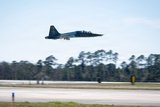
L3Harris currently operates a Bombardier Global series jet as part of the US Army’s ARES programme. (Photo: L3Harris)
Leidos and L3Harris Technologies announced on 26 July they are teaming up for the US Army’s Theater Level High-Altitude Expeditionary Next Airborne – Signals Intelligence (ATHENA-S) proposal.


The companies will seek to deliver two ISR aircraft in support of the programme.
The team will work to modify two Bombardier Global 6500 jets with radar, electronic and communications intelligence capabilities tailored to ATHENA-S requirements, the partners said.
The aircraft are intended to support US Army missions in the US European Command area of responsibility and are designed to close the gap between the army’s medium- and high-altitude ISR aircraft fleet.
Related Articles
Sweden orders two GlobalEye AEW&C aircraft
Leidos Australia to acquire Cobham’s Special Mission aircraft unit
L3Harris, Amazon team up to advance battlespace networking
ATHENA-S will fly at higher operating altitudes, provide increased range, greater endurance, more capacity for larger payloads and greater standoff ranges, along with next-generation sensor technology.
Leidos currently operates two Leidos Special Mission Aircraft (LSMA) for the US Army’s Airborne Reconnaissance Targeting and Exploitation Multi-Mission Intelligence System (ARTEMIS) programme in support of EUCOM.
The LSMA provides deep-sensing ELINT to enable threat analysis and delivery of long-range precision fires.
L3Harris currently operates a Bombardier Global series jet as part of the army’s Airborne Reconnaissance and Electronic Warfare System (ARES) programme, supporting US Indo-Pacific Command.
In addition to ARES, L3Harris is also working on Phase 2 of the US Army’s Multi-Domain Sensing System programme to develop, build, integrate and demonstrate prototype electronic and communications intelligence sensors for the High Accuracy Detection and Exploitation System (HADES) programme.
Related Equipment in Defence Insight


More from Air Warfare
-
![July drone digest: Sovereign production takes centre stage at Farnborough]()
July drone digest: Sovereign production takes centre stage at Farnborough
Farnborough International Airshow (FIA) 2026 revealed the growing scale of the UK’s uncrewed ambitions, with companies showcasing new CCA, autonomous wingmen and surveillance drones, while sovereign production emerged as a key factor for multiple programmes.
-
![FIA 2026: Bell highlights MOSA-driven growth path for MV-75 Cheyenne]()
FIA 2026: Bell highlights MOSA-driven growth path for MV-75 Cheyenne
Bell Flight’s modular open-systems approach for the US Army’s MV-75 Cheyenne could open doors for international allies and suppliers once locked out by closed rotorcraft architectures.
-
![Maximise survivability with advanced electronic warfare (video)]()
Maximise survivability with advanced electronic warfare (video)
BAE Systems’ all-digital EW delivers 360-degree threat awareness in contested environments, boosts survivability, and cuts lifecycle costs.
-
![US Air Force seeks avionics upgrades for ageing T-38 Talon as T-7A Red Hawk delays persist]()
US Air Force seeks avionics upgrades for ageing T-38 Talon as T-7A Red Hawk delays persist
The USAF is looking for commercial avionics solutions to improve the T-38 Talon’s reliability, readiness and flight safety as continued T-7A Red Hawk delays increase the likelihood that the legacy trainer will remain in service longer than planned.
-
![British Army’s Project Corvus selection highlights new era of drone sovereignty]()
British Army’s Project Corvus selection highlights new era of drone sovereignty
The UK’s choice of the Tekever AR5 for Project Corvus reflects a wider shift in military drone procurement towards solutions that centre on sovereignty and domestic production, moving away from overseas reliance.